Thursday, 29 August 2013

Esscom DG denies fishermen kidnapping incident

The Eastern Sabah Security Command (Esscom) director-general Datuk Mohamad Mantek has denied that a kidnapping case involving a fisherman happened in Pulau Mubul, Sabah, Wednesday, as reported by The Star Online.
Instead, he said in Wednesday's incident, two fishermen were detained by individuals in a speedboat between Pulau Denawan and Mabul.
"They were not kidnapped but detained and released within 24 hours. Nothing untoward happened," he said when contacted by Bernama.
He also said the group had no links with the Sulu army.
Mohamad said police had recorded statements from the victims and were investigating the motive and the strength of the group.
He added that police were tracking the group down and sea patrols by the Malaysian Maritime Enforcement Agency and Marine Operations Force had been stepped up.
It was earlier reported that a group of about 20 heavily-armed gunmen abducted a fisherman and demanded to be guided to a holiday resort on Pulau Mabul, but were taken to an army camp on the island instead. - Bernama
Published: Wednesday August 28, 2013 MYT 9:18:00 PM 

Esscom DG: Increased security for Pulau Mabul area

KOTA KINABALU: Security officials are increasing patrols along Sabah's eastern borders as a precautionary measure following Tuesday's incident close to the tourist resort island of Mabul in Semporna.
Eastern Sabah Security Command (Esscom) director-general Datuk Mohammad Mentek said that increased patrols were being carried out by security officials who are placed at various strategic areas along the 1,733km coastline from northern Kudat to southeastern Tawau district, that comprise 480 inhabited and uninhabited islands.
"Obviously we can't have men stationed everywhere, but we have stepped up patrols by the various security agencies to ensure that the sovereignty of the country is not breached," he said when contacted Thursday.
Mohammad said that people should not panic as rumours about the return of defeated Sulu intruders was a ''psy war" aimed at frightening and disrupting the harmony of the people.
He said that the armed intruders who held the local fishermen off Semporna were just "sea pirates" and not linked to the Sulu army or any of the militant groups based in a neighbouring country.
"It just the work of normal criminals, it was not a case of kidnapping for ransom," he said, adding that the police were investigating the fishermen's claims.
Meanwhile, Sabah Police Commissioner Datuk Hamza Taib said police are in the process of recording statements from the local fishermen who were allegedly taken as "hostages", and also to determine the identity of the group.
"Police are still investigating the case as well as to determine if the alleged suspects are involved in terrorism activities," he said.
Elaborating on the incident which took place close to Pulau Kapalai between 6.30pm and 9pm on Aug 27, Hamza said initial police investigations showed that the suspects had robbed the fishermen of their money, handphones and other valuables.
"None of the victims were harmed by the suspects and were released after being robbed," he said, adding that the case is currently being investigated under Section 395 of the Penal Code for gang robbery and Section 4 of the Firearms Act (Increased Penalties) 1971.
He said that almost every island, including mainland Semporna had security bases under Esscom.
A fisherman had claimed that about 20 gunmen in a speedboat armed with shotguns and pistols had ordered him to guide them towards Pulau Mabul.
They claimed the gunmen headed towards international waters and took another eight fisherman hostages before freeing all of them a few hours later.

BY MUGUNTAN VANAR

STAR

Monday, 26 August 2013

General Police Exhibition and Conference 2013

GPEC Asia 2013 is the region’s only exhibition and conference exclusively for specific members of the enforcement agencies, primarily, the police force as well as other law and security enforcement authorities such as the prisons, customs, immigration, civil defence, the military police and selected private security organisations. 


Date/Time : 02 - 04 October 2013
Venue : PICC (Putrajaya International Convention Centre)

GPEC Asia 2013 - General Police and Special Equipment Exhibition & Conference

DSEI 2013: Record number of international pavilions to be hosted

Posted 13 July 2013 by Asian Military review


JOB1385W2381

Defence & Security Equipment International (DSEI) 2013 is on course to host a record 40 international pavilions when the exhibition takes place at ExCeL London from 10 – 13 September.

DSEI is the world’s largest showcase of land, maritime and air applications of defence and security products, equipment and systems. Nations making their debut this year includeIndonesia,Japan,Malaysia,South KoreaandTaiwan, clear evidence of the importance that these key emerging players place on DSEI.India, a previous exhibitor, is increasing its presence significantly, mounting both public and private sector pavilions.

Other newcomers includeChile, which will be joiningBrazilin representing Latin American growth markets, while the UAE is the latest addition to the list of Middle Eastern nations at the event.

DSEI Event Director, Duncan Reid, said, ‘Throughout the last 18 months we have operated an intensive programme of engagement with government buyers and decision makers from the key growth markets of Latin America, the Middle East and Asia Pacific, as well as the more traditional markets of North America and Europe. The global platform that DSEI provides for the sale and procurement of defence and security products and equipment is now recognised by responsible governments around the world’.

He continued, ‘The countries that mount pavilions send high powered delegations to the show, which benefits everyone. Reinforcing this, we are staging our biggest ever drive to bring top quality official delegations to the event. DSEI 2013 will be a truly international show’.

Thursday, 1 August 2013

TLDM perlu 6 kapal selam

KUALA LUMPUR 29 Julai - Tentera Laut Diraja Malaysia (TLDM) memerlukan sekurang-kurangnya enam buah kapal selam bagi membentuk angkatan yang berupaya mengawal sempadan maritim negara secara berkesan.
Timbalan Menteri Pertahanan, Datuk Abdul Rahim Bakri berkata, aset pertahanan itu penting kerana kedudukan Malaysia di kawasan tengah Asia Tenggara terdedah dengan konflik bilateral dengan negara-negara jiran termasuk isu Kepulauan Spratly.
Menurut beliau, angkatan kapal selam tersebut juga diperlukan untuk membuat rondaan di Zon Ekonomi Eksklusif (EEZ) negara seluas kira-kira 600 kilometer persegi yang kaya dengan hasil perikanan, minyak dan gas dianggarkan bernilai trilion ringgit.
"Walaupun Singapura tidak mempunyai sempadan perairan yang besar, negara itu mempunyai enam buah kapal selam dan beberapa aset tempur udara yang canggih.
"Baru-baru ini, Vietnam juga bercadang membeli enam buah kapal selam dan Indonesia telah memiliki dua buah kapal selam yang dibekalkan Rusia," katanya ketika menggulung perbahasan titah ucapan Yang di-Pertuan Agong di Dewan Negara hari ini.
Terdahulu, Senator Abdul Rahman Bakar bangkit mencelah meminta Kementerian Pertahanan menjelaskan tentang keperluan untuk menambah bilangan kapal selam bagi mengawal perairan negara.
Dalam perkembangan sama, Abdul Rahim menafikan dakwaan pihak tertentu kononnya dua buah kapal selam jenis Scorpene yang dibeli kerajaan tidak berfungsi, sebaliknya KD Tunku Abdul Rahman dan KD Tun Abdul Razak turut membuat rondaan di EEZ negara.
Sementara itu, beliau memberitahu, kerajaan sedang mempertimbangkan pembelian peralatan canggih seperti Nationwide Automatic Identification System (NAIS) dan alat pandang malam untuk digunakan di Kawasan Keselamatan Khas Pantai Timur Sabah (ESSCOM).

Thursday, 25 July 2013

China Set To Grab UAV Market While US Restricts Sales

on June 14, 2013 at 1:16 PM
Chinese UAV image
PARIS: Psst. Hey mister. Wanna buy a UAV? China’s got drones for shooting, drones for intelligence, surveillance and reconnaissance, and drones for target practice. Cheap prices and no arms export restrictions.
And China may grab a significant share of the international market for just those reasons, according to a new report by the U.S-China Economic and Security Review Commission. Breaking Defense obtained a copy of the report: China’s Military Unmanned Aerial Vehicle Industry
The irony would be, of course, that the United States has largely created that demand by demonstrating the utility of drones (UAVs, Remotely Piloted Aircraft — RPAs — pick your term) in Afghanistan, Pakistan, Yemen, Iraq and other locales over the last decade.
Here’s what the report’s author, Kimberly Hsu, concludes:
“Surging domestic and international market demand for UAVs, from both military and civilian customers, will continue to buoy growth of the Chinese industry. Chinese defense firms do not face the same export restrictions as top UAV-exporting countries, such as the United States and Israel. As a result, China could become a key UAV proliferator, particularly to developing countries.”
Currently, the great majority of Chinese drones are tactical, but Hsu says that “in the long term, China’s continued interest and progression in strategic-level UAVs appear poised to position China as a leader in the high-end UAV market.” A major reason is that China is not a member of either the Missile Technology Control Regime (MTCR) or the looser but broader Wassenaar Arrangement. “In the absence of competition from more sophisticated U.S. or Israeli alternatives, China could become a key proliferator to non-members of the MTCR or Wassenaar,” she concludes.
Just what drones is China building? Well, the report notes there isn’t much information available about the PLA’s efforts. Hsu says that China, “probably is developing and operating UAVs for electronic warfare (EW).” These would “probably would focus on jamming tactical communications and global positioning system (GPS), but could provide a range of other capabilities, including false target generation against enemy Airborne Warning and Control Systems (AWACS)/Airborne Early Warning (AEW) and power grid attack.”
On top of that, several Chinese government owned defense firms are also developing killer drones in the vein of our Predator or Reaper. “It is not clear if China intends to use UCAVs in an air-to-air or an air-to-ground role,” Hsu writes.
In addition to state-owned enterprises, several of China’s top engineering universities are working on drones.
On the civilian side, China has already demonstrated use of indigenous drones for earthquake relief efforts after the May 2008 and April 2013 earthquakes in Sichuan province, according to the report. And the rough Chinese equivalent of the Coast Guard and harbor police “are integrating UAVs into their operations.
All in all, China’s policy of not participating in what it would doubtless call hegemonic restrictions on its actions — MTCR, Wassenaar — coupled with its willingness to sell to pretty much anybody who can buy their weapons, places it in a prime position to benefit, just as Europe benefited from America’s decision to sharply restrict satellite sales and their components to foreign countries.

Coastal and Littoral Surveillance

Posted on 01 March 2013 by Asian Military Review
GOWIND-
This places an emphasis on flexibility, ease of use for systems often operated by police and Paramilitary organisations and affordability across a range of platform and sensor types.  Ships maintaining a presence at sea have been the traditional means of securing the littoral using a range of Offshore Patrol Vessels (OPV) and smaller craft although the demands of littoral surveillance and the distances required to secure and patrol offshore resources has seen the size and complexity of vessels increase in recent years.

China’s maritime claims have become very expansive of late with the country claiming great swathes of the South China Sea with a building programme in place to support those efforts. The China Marine Surveillance (CMS) agency brought two new 3000 ton patrol vessels into service in early November. The Haijian 137 is currently operating in the East China Sea with its Haijian 110 sister ship in the Yellow Sea. The  largest ship built for the CMS is the 128.6m 5,418-ton Haixun01 which has an unrefueled range of 10,000 nautical miles (18,520 km). Until now the only large vessels in CMS service have been only retired Peoples Liberation Army Navy (PLAN) vessels have been transferred to the CMS. One of the most recent is the demilitarised Luda Type 051 class destroyer the Nanjing (131) which retired from PLAN service in September. The CMS have 36 ocean going vessels currently under construction.

China is not the only country building up its littoral capabilities. The Indian Coast Guard (ICG) continues to balloon. Four of twelve Griffon Hoverworks air cushion vehicles are in service at various locations around the country including the Sunderbans tidal mangrove forest. Twenty new Fast Patrol Vessels being built at Cochin Shipyard Ltd for the ICG, are equipped with Northrop Grumman’s Sperry Marine VisionMaster, Total Watch systems, reflecting the complexity of India’s requirements. Another class of Coast Guard vessels is the 50m, 300 tonne Inshore Patrol Vessel (IPV) which has a 1500nm range and a maximum speed of 34kts with a total of eight IPVs ordered from Garden Reach Shipbuilders and Engineers.

The Philippines Coast Guard currently has nine operational ships. It is acquiring a single 82m high endurance ship and four 24m patrol boats from France in a €90 million ($116 million) due to be delivered in 2014 with the shipyard thought to be CMN. The Philippines Coast Guard have indicated that they expect to also take delivery of ten 40m patrol boats from Japan in the second half of 2013.

Vietnam is also building up its naval and maritime forces with the Vietnam Marine Police Force recently launching a 2400 tonne, 90M Damen 9014 design Offshore Patrol Vessel with the ship entering sea trials ready for entry into service in early 2013.
Solutions developed out side the region have often found a role there. Littoral patrol designs are regularly being developed,
far more regularly than large ocean going warships.

Finland recently chose Marine Alutech to develop the Watercat M18 for inshore roles for example landing troops to deal with pirates. Finland is taking delivery of twelve in a $41 million deal from 2014 to 2016.

The US Coast Guard has been the lead for a number of designs. Its latest is the Offshore Patrol Cutter (OPC) requirement designed to replace the ageing Medium Endurance Cutters with a requirement for 11 OPCs with as many as 25 ultimately required with Bath Iron Works, Bollinger, Huntingdon Ingalls, Marinette Marine, Nassco, Vigor Shipyards and VT Halter Marine competing for the contract.

France’s Direction générale de l’armement (DGA) has recently begun the process to replace its P400 Large Patrol Craft built by CMN in the 1980s. The new programme or Batiment Multi Mission (B2M) will initially see three B2Ms deployed in around the Caribbean waters of French Guyana in around 2014 and tasked with protecting the space centre at Korou and oil fields recently discovered in the area. Next, larger B2Ms will be deployed at French territory in the Pacific and Indian Oceans. Another French OPV with a variety of roles is the  DCNS Gowind class, a design which can also support combat roles having been chosen for the six second-generation patrol vessels for the Royal Malaysian Navy.

Sensors and networks

A platform at sea is in many ways an optimal solution but not one that provides persistent surveillance, limited by the ship’s endurance and the range of its sensors that relatively small platforms can carry. Integrated coastal and littoral surveillance systems matched to command and control (C2) hubs in contrast, offer a persistent fixed presence however, these surveillance systems don’t have it easy with the environment making target discrimination and detection difficult in heavy rain, high-sea state conditions and other clutter associated with the region.

The biggest coastal surveillance programme in the region is India’s Coastal Surveillance Network, operated by the Indian Coast Guard with 46 surveillance stations; 36 locations on the mainland coast, six locations in the Lakshadweep and Minicoy Islands and four in the Andaman and Nicobar Islands, all based on co-located lighthouses. Each installation is designed to cover an area of 25 nautical miles around the site using radar and EO/IR sensors and focused on the area of high sensitivity and traffic density. They are also able to interrogate class ‘A’ and ‘B’ Automatic Identification System (AIS) transponders sourced from Saab and Elcome Marine Services in a $22 million deal signed in November 2010. These were rolled out in the first stage by Bharat Electronics Ltd in a Rs 601.75 crore programme which is due to complete in March. The next stage will see existing stations backfilled with additional surveillance equipment and a
further 38 coastal surveillance radar plus eight Mobile Surveillance Systems added in a Rs 1,000 crore deal.

In addition to terrestrial sensors, countries can also enlist the support of space based assets. Astrium launched its OceanWay solution in October which combines satellite-based AIS and GO-3S for video from space via an Earth-observation satellite system generating imagery at a rate of 25 images per second. Another Astrium effort has been the launch last year of the Astrium Surrey Satellite Technology Limited exactView-1 satellite which also covers AIS and was developed and launched for customers; COM DEV International Ltd and HISDESAT Servicios Estratégicos S.A.

The Brunei National Coastal Surveillance System (NCSS), first formed in February 2010  is also undergoing a new initiative to boost capabilities after an initial period of development which focused on integrating existing organisations and capabilities.
Other AIS efforts include Northrop Grumman Information Systems who completed delivery of the USCG led Nationwide AIS contract worth $12 billion ensuring AIS coverage across the US mainland and its overseas territories.

ESRI UK has supplied the European Union Naval Force (EUNAVFOR) Operation Headquarters tasked with the EU Naval Force’s Mission Network in support of Counter-Piracy operations around the Horn of Africa. The company have delivered the Recognised Maritime Picture based on its geographic information system software including ArcGIS for Server version 2.5 with a server on each ship and ArcGIS Viewer for Flex on board each ship with satcom based updates between ships.

Indra has delivered a coastal surveillance system for use on Spain’s coast and has also been contracted to supply a solution for Hong Kong and the islands under its administration. It is also leading the European Union’s Perseus project to develop a single integrated system from multiple national surveillance systems.
Kylmar’s CT1600 Coastal Surveillance System is in service with Egypt, which is the system’s largest customer. The CT1600 consists of a thermal and day system with a laser range finder which can deliver an accurate position of a ship within just 5m at a range of 20km. Egypt has developed a network of these systems along its Red Sea coast. One element of the Indian coastal surveillance system is the 46 ARGC-2400 cameras electro-optic cameras sourced from Canada’s Obzerv Technologies which are used to classify and identify targets.

Sweden has tasked ITT Exelis with surveillance of its coastline with its SABER 2020, integrated coastal based around the LCR-2020 radar with all-weather coverage of air targets with a range of electronic counter-countermeasures. Indonesian firm Radar and Communications Systems have developed a new shelter and vehicle mounted 96km range, S-band LPI Portable Coastal Radar. Development is due to complete in 2013. Indonesia is already being protected by Kelvin Hughes S-Band SharpEye solid state radar sensors in Maluku province and Papua province, working with local firms. GEM Elettronica plan to release a new X-band  three-dimensional naval surveillance radar in 2013, for navigation and general surveillance with a view for integration on offshore patrol vessels  of about 500 tonnes.

Raytheon have developed a number of coastal and maritime surveillance radars. It worked with Canada on the Next Generation High Frequency Surface Wave Radar (HFSWR) Technology Demonstration Programmes, designed to cover the country’s 200 nautical mile Exclusive Economic Zone. The company’s SeaVue eXpanded Mission Capability was ordered by Morocco in 2011 for coastal surveillance and is deployed on aircraft with users in the region including Australia, Japan, Pakistan, Taiwan and Thailand. The SPEXER 2000 radar, one of Cassidian’s latest development is an Active Electronically Scanning Array (AESA) design with an instrumented range of 21.6 NM (40 km) coupled with high Doppler and velocity resolution.

Elbit Security Systems is currently providing the surveillance systems for the port of Haifa including typical maritime traffic as well as the chemical terminal. The systems fuses information from variety of perimeter and maritime sources in a central C2 hub. In Asia, the company has announced  an Asian contract for maritime surveillance for the  using Micro CoMPASS and DCoMPASS for fixed, airborne and seaborne platforms in a $20 million deal.

Bulgaria tapped Atlas Elektronik in 2011 to provide an integrated coastal surveillance systems covering the country’s 350km of coastline and run by the Border Police. This package comprised a surface radar, signal processing, multi-sensor tracking, including AIS and CCTV, communications, system management and recording & replay based using SEATRACK. The system is comprises twelve remote sites each with radar, AIS transponders, daylight and IR-Cameras and weather stations supplemented by two mobile ground units and twelve Border Police Boats each with its own ISR package.

Airborne platforms

Maritime and land based surveillance and patrol platforms are enhanced by airborne platforms with the requirements eschewing large highly capable platforms such as the P-3 Orion and instead preferring smaller, lighter and more affordable platforms in which still highly capable sensor and mission systems can still be integrated.

The first of six Viking Air DHC-6 Twin Otter Series 400 maritime surveillance aircraft have been delivered to Vietnam for coastal surveillance via Canada’s Pacific Sky Aviation

In Australia, Cobham is supplying Customs and Border Protection Service with the Sentinel aerial maritime surveillance programme, which has been extended to 2021. Beginning in 1995 the contract is a service contract covering 15000 flight hours per year which equates to roughly 2500 mission using Bombardier Dash 8 maritime patrol aircraft.

Indra’s latest airborne coastal surveillance systems is the Maritime Light Surveillance System (MLSS) launched at Farnborough. based on the P2006T MRI, a high wing light twin-engined, aircraft it has been equipped with the Selex Galileo Seaspray 5000E AESA surveillance radar and Indra’s ISIS mission system and is designed for use at up to 150nm from the coast.

The HC-144A Ocean Sentry, based on the Airbus Military CN235, is the US Coast Guard solution for airborne surveillance. The fourteenth aircraft has recently been taken delivery of, with a final requirement for 36 aircraft having been established.
India’s Coast Guard operates the Do-228 maritime patrol aircraft with well over 100 delivered to date. Produced by the Transport Aircraft Division of Hindustan. Aeronautics Limited, it is tasked with maritime surveillance as its primary role but can also be re-roled to troop transport, air-drop, search-and-rescue, casualty evacuation and cargo missions.

Japan To Offer Patrol Ships To Philippines

July 23, 2013 12:03 PM 

TOKYO, July 23 (Bernama) -- The Japanese government is considering offering patrol vessels to the Philippines through its official development assistance, Japan's Jiji Press reported, citing sources as saying on Monday.

Helping the Philippines to improve its maritime security capability would be seen by Japan as a warning to China, which is increasing its maritime presence, the sources said.

The Philippines and China have a territorial dispute over South China Sea islands.

Japanese Prime Minister Shinzo Abe plans to hold talks with Philippine President Benigno Aquino on Saturday as part of his three-day Southeast Asian tour from Thursday.

Abe is considering telling Aquino directly about Japan's offer of patrol vessels during their meeting, the sources said.

The Japanese government aims to reach an official agreement on the aid programme with the Philippines on the sidelines of a special summit between Japan and the Association of Southeast Asian Nations (Asean) in Japan in December, they said.

When Aquino visited Japan in September 2011, the two countries agreed to boost their cooperation on maritime security, including a plan to improve the capability of the Philippine Coast Guard.

After an official request from the Philippines, the Japan International Cooperation Agency would conduct field surveys and provide 10 new patrol vessels worth some 15 billion yen (US$150.77 million), the sources said.

Abe and Aquino are also expected to agree to seek peaceful solutions to territorial issues in the South China Sea based on international law, the sources added.

-- BERNAMA

Wednesday, 24 July 2013

57mm Mk3 Naval Guns for SGPV/LCS

SHAH ALAM: AS first reported here, it was confirmed today the SGPV/LCS will be equipped with the BAE Systems 57mm Mk3 guns, naval guns.
This is the first of the systems meant for the SGPV/LCS which was expected to be announced at LIMA last week but were delayed without any explaination. The GE was the most frequent excuse given but I was reliably informed that the delay was mostly due to haggling over the price.
Since Boustead is the client in this case, it is of course their right to get the best terms possible though how much that it will effect the final price of the ships remained to be seen. I expect the deal for the Exocet Mk 3 and VL Mica to follow soon as well as the others apart from the ship-borne helicopters which probably be ordered in RMK11.
57mm Mk3 naval gun.
57mm Mk3 naval gun.
The release:
BHIC Bofors Asia Sdn Bhd, the joint venture between Boustead Heavy Industries and BAE Systems (Bofors Asia), created in 2004, is set to benefit following the award to BAE Systems of a sub-contract for the sale of six 57mm Mk 3 naval guns for the Royal Malaysian Navy in a deal
worth approximately RM175m.
The contract ‘letter of award’ was granted to BAE Systems this week by the systems integrator, Contraves Advanced Devices, which is a joint venture between Boustead Heavy Industries and Rheinmetall Air Defence AG.
The 57mm naval gun, designed by BAE Systems in Karlskoga, Sweden, will equip the Malaysian Navy’s Second Generation Patrol Vessel – Littoral Combat Ships (SGPV-LCS). The contract includes ammunition hoists, simulator and initial support.
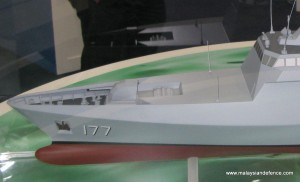
A close-up of the BNS Gowind Frigate
The six versatile SGPV-LCS ships are being built by the shipyard to a design by the French DCNS company. They are designed for a wide range of missions including combat, anti-piracy, counter-terrorism, anti-smuggling operations, search and rescue, humanitarian support, as well as the protection of fisheries and oil and gas platforms
The first gun, will be built at Karlskoga in Sweden, and will be ready for delivery to the Boustead Naval Shipyard in mid-2015 and Malaysian industry will be increasingly involved as the develops.
“Our aspiration is to transfer work to our BHIC Bofors Asia joint venture,” said BAE Systems Integrated Systems Director, Ulf Einefors.
The joint venture company has operations in Kuala Lumpur, Lumut and Kota Kinabalu to carry out maintenance and spares support for the Royal Malaysian Navy and the Malaysian Maritime Enforcement Agency.
“The company could initially support us with production and local procurement of components as part of our global sourcing programme. Then, under a separate transfer of technology programme, assembly and test of the guns, as well as expanding existing maintenance support activities are likely to follow,” Einefors said..
This latest contract underlines the importance BAE Systems places in the establishing long term industrial partnership in Malaysia. John Brosnan, Regional Managing Director in Malaysia said:
“Across maritime defence, aerospace and cyber-security our aim is always to ensure that our Malaysian partners gain the best possible benefits from shared technologies, and skills.

BY MARHALIM ABAS  Malaysia Defence

Tuesday, 16 July 2013

Malaysian Defence Modernisation


Posted on 01 March 2013 by Asian  Military review
OLYMPUS DIGITAL CAMERA
A looming general election which must be held by April 2013 has generally led to the government giving little priority to military procurement under the 10th Malaysia Plan of 2011-2015 which governs all Malaysian government spending for that timeframe. It should however be noted that the Malaysian government did initiate two major procurement programmes in 2010; the development and order to Deftech of Malaysian for 257 indigenously produced AV8 8×8 AFVs and the construction of six Second Generation Patrol Vessels to be built locally by Boustead Naval Shipyards with the assistance of France’s DCNS. Since then no major procurement programme has been initiated save for the signing in December 2011 of an MYR294 million ($97.3 million) contract for the construction of two training ships for the Royal Malaysian Navy (RMN) by Malaysia’s NGV Tech which would be built with the assistance of South Korea’s Daewoo Shipbuilding & Marine Engineering (DSME).
Other than that no major procurement has occurred since, despite an intense marketing effort by aviation companies for a requirement of 18 multi-role combat aircraft to replace the Royal Malaysian Navy’s (RMAF’s) MiG-29 fleet, which is scheduled to be phased out by 2015. However, the Malaysian government has yet to indicate when a decision will be made on that programme save to only say that it will be made after the General Election. The issue of Malaysian defence developments post-Election is a conundrum by itself, while the ruling National Front coalition is expected to win and remain in power, there does exists the possibility that the opposition People’s Alliance could win by a slim margin. Should they do so, it is an open question as to how defence developments in Malaysia will proceed as the People’s Alliance has yet to issue any official statement as to their plans in regards to defence. Rhetorically, the People’s Alliance has made statements stating that they consider defence spending a wasteful expenditure and in one year, proposed that the existing annual defence budget be cut by 90 percent. How much they would actually do so in practice should they gain power is open to question. Even with the ruling National Front retaining power, it is also open to question as to whether any defence programme or requirement will proceed immediately given the Malaysian government’s lack of emphasis on such. For example, the Royal Malaysian Navy has had a requirement for a multi-purpose support ship since 2008 and even the loss to a ship fire in 2009 of the RMN’s sole amphibious capability ship, the Newport class LST KD Sri Inderapura, failed to spur any priority towards this requirement by the Malaysian government. RMN Chief Admiral Tan Sri Aziz Jaafar said in December last year that he expected acquisition of the MPSS to only take place in the 11th Malaysia Plan of 2016-2020. Still there remains open the possibility that the government may approve some programmes post elections though this would depend on the circumstances and finances involved.
Army
The Army’s key current ongoing programme is the indigenous AV-8 AFV to be built by Malaysia’s Deftech and based upon the Turkish FNSS PARS AFV. Deftech is partnered with a number of foreign companies in this programme including Britain’s BAE, Turkey’s FNSS, France’s Thales and South Africa’s Denel among others. 257 vehicles in twelve variants are to be produced with the basic prototype currently under development and scheduled for a sixth month trial in Malaysia by March 2013 with full production expected to begin in 2013 and completed in 2018. The 257 vehicles are expected to be an initial batch with the Army expected to order additional vehicles down the line. Potentially down the line, the Army plans to upgrade its tactical 4x4s and its truck fleet. In the case of tactical 4x4s, though no formal tenders have been called, the Malaysian Army’s table of organisation for the Standard Infantry Battalion calls for at least 15 vehicles per battalion to act as weapons platforms/carriers for the battalion’s support weapons, with the Malaysian Army keen to have its over 30 infantry battalions to be equipped as such, a potential order of over 500 vehicles could emerge in the future should funding be approved. In regard to military trucks, while the Malaysian Army uses the Deftech supplied Handalan series of three tonne general service trucks for much of its requirements, the Army is now planning to establish a second line fleet of trucks to supplement the general service trucks. This fleet would be comprised of trucks capable of carrying more than three tonnes of cargo in rear echelon areas. Again funding has yet to be approved or formalised for this.
Other programmes also on the Army’s development plans but not formalised or budget approved for include the requirement for a medium range air defence capability, self propelled howitzers, a tactical transport helicopter squadron and an attack helicopter squadron. Both the attack helicopter squadron and the tactical transport helicopter squadron are part of the Army’s 2010 Plus 10 overall development plan which calls for the Army Air Corps to have a squadron each for the light observation, tactical transport and attack role. Currently only the light observation helicopter squadron, equipped with eleven Agusta Westland A109s is in existence. The attack helicopter squadron appears to be a priority for the Army, as the lack of transport helicopters can be made up through co-operation with the Royal Malaysian Air Force.
Navy
The Royal Malaysian Navy’s key programme is the six ship Second Generation Patrol Vessel – Littoral Combat Ship (SGPV-LCS). The SGPV-LCS are to be the follow-on to the six Kedah class Next Generation Patrol Vessels (NGPV) built by Boustead Naval Shipyard (BNS) though the SGPV-LCS will be bigger and more heavily armed compared to the Kedah class. Despite the LCS name, the SGPV-LCS is a conventional design hull based on DCNS’ Gowind design, DCNS being selected as the foreign partner to work with BNS on the SGPV-LCS programme. The ship is to have an overall length of 107m, a full load of 2750 tons, a 106 personnel crew, maximum speed of 28 knots with a cruising speed of 16 knots, range of the ship expected to be 5000nm, with an endurance of 21 days. The weapon systems of the SGPV-LCS have been a source of continuing disagreement between the RMN and BNS with the RMN insisting that the ships be outfitted with their exact choice while BNS have pressed for systems of their choice in order to ensure that integration of the ship systems go smoothly and that costs in building the ships be kept down. At the time of writing, no decision has been made yet as to the primary weapon systems for the ship. The RMN is said to prefer the Raytheon ESSM for the surface to air missile with the Kongsberg Defence & Aerospace Naval Strike Missile for the surface to surface missile while BNS have been said to have recommended the Mica system for the SGPV-LCS’ SAM and the MBDA’s Exocet as its SSM. The main gun is expected to be the BAE Bofors Mk3 57mm, which BNS’s parent company, Boustead Heavy Industry Corporation has an existing joint venture partnership known as BHIC Bofors Asia. The first ship is scheduled to be delivered in 2017 with subsequent ships delivered every six months thereafter. All will be built at the BNS facilities in Lumut. However with this ship class only to be delivered beginning from 2017, it is clear that the RMN will face a capability gap till then and likely a situation of concern giving the tensions surrounding the Spratly Islands, which Malaysia claims and where the RMN maintains a presence on five islands and reefs. There has been moves by the US to offer surplus Perry class frigates being decommissioned from the US Navy though little has emerged from this partly as any such acceptance would require funding approval from the Malaysian government, which has appeared to have put any defence decision involving funding on hiatus until after the election.
The first of the two locally manufactured training ships ordered in 2011 was launched on 14th December and RMN Chief Admiral Tan Sri Aziz Jaafar has called additional two ships to be built and outfitted as combat ships. In his speech during the launch of the 75.9m training ship ‘Gagah Samudera’, the RMN Chief urged the Malaysian government to consider the purchase of two additional hulls during the timeframe of the 11th Malaysia Plan of 2016-2020 as replacements for the current eight aging Handalan and Perdana class Fast Attack Crafts which entered service in the 1970s. The second training ship is scheduled to be launched  in January 2013 with the Gagah Samudera scheduled to be commissioned and entering service in 2013 while the second ship will enter service in July 2014.
As stated earlier, the purchase of the Multi-Purpose Support Ship is unlikely to commence until the 11th Malaysia Plan of 2016-2020, possibly also likely to take place in that timeframe, though the RMN would like to have it commence as soon as possible, is the purchase of at least 6-12 anti-submarine warfare helicopters. The US has been heavily promoting the MH-60R Seahawk for this requirement.
Royal Malaysian Air Force
The much talked RMAF programme is the Multi-Role Combat Aircraft replacement for the MiG-29 fleet, though the RMAF has indicated that it would like to have the aircraft delivered by 2015 to coincide with the phasing out of the MiG-29 though such a date would now be impossible to achieved given that the manufacturers of the aircraft in contention have all stated a 28-36 month delivery date after signing of contract. As such this calls into question the Malaysian government’s sense of urgency on the programme, given that the timeframe to sign the contract in order to meet the RMAF date of when they would like the aircraft to be delivered has slipped by and it is possible that contrary to expectations, that a deal for up to 18 aircraft may not be signed in 2013 following the elections. The aircraft in contention are the Boeing Superhornet, Dassault Rafale, Eurofighter Typhoon (marketed for BAE) and Saab Gripen.  Long term plans for the RMAF call for the RMAF to have a force posture of six front line MRCA squadrons. Currently the RMAF has two MRCA squadrons, No. 11 with the Su-30MKMs and No. 18 with the F/A-18 Hornet though No 18 is only a half squadron with Malaysia only having eight Hornets in its inventory. The RMAF also has a number of other procurement and upgrade requirements amongst them the procurement of Airborne Early Warning and Command (AEW&C) aircraft, additional PC-7 Mk II trainers, the construction of support facilities for the A400M transports scheduled to enter service in 2015, the upgrade of the BAE Hawks currently in RMAF service, upgrades of the RMAF’s C-130 fleet and either the obtainment of additional Eurocopter EC-725 helicopters or a service life extension programme for part of the RMAF’s S-61 ‘Nuri’ helicopter fleet. However some of these programmes, notably the AEW&C aircraft, additional PC-7 trainers and upgrades to the BAE Hawks are unlikely to proceed anytime soon due to the lack of funding, particularly for the AEW&C aircraft in which Saab has been marketing its Erieye system and Northrop Grumman the E-2D Hawkeye. The RMAF is looking at an operational requirement for eight AEW&C aircraft though the costs of such is likely to ensure that a lesser number, if any, will be purchased. Both the C-130 fleet upgrade and the S-61 helicopters SLEP have been allocated for but the government has yet to give approval for the RMAF to proceed. Some 15 S-61 helicopters are to undergo the planned SLEP while the C-130 upgrades would involve the upgrading of its avionics to meet international civil aviation standards and the installation of self-protection systems.
Two of the twelve EC725s ordered by the RMAF were delivered on 3rd December. Originally only one EC725 was to be delivered but the second one was completed ahead of schedule. A third will be delivered by March 2013 and the current delivery schedule calls for delivery of all 12 helicopters to be completed by January 2014. The RMAF would like to obtain another twelve EC725s and also obtain funding to fully equip the current twelve with self protection systems and additional specialized equipment but no indication has been given by the Malaysian government as to these requirements. The RMAF expects to take deliveries of its four A400Ms in 2015-2016 and is expected to soon issue a tender for the construction of facilities at RMAF Subang to house the A400Ms which will be stationed there.

Thursday, 13 June 2013

Maritime sector needs reallignment

By NAZERY KHALID


THE New Economic Mode (NEM) envisions transforming Malaysia’s economy into a developed nation status by 2020.
Such an economy will be propelled not just by capital but by productivity and high technology, featuring high income, value adding, innovation driven and knowledge based activities.
The maritime industry is unfortunately not among the first that comes to the mind of many in terms of its potential to generate such activities and to help transform the nation’s economy. It is probably a reflection of its understated importance and contribution to the nation’s economy.
Admittedly the maritime industry – which includes activities such as shipping, port operations, shipbuilding/repairing and offshore oil and gas exploration and production, among many others – is not as high profile or glamorous compared to say the aviation, banking or legal profession. The industry is also arguably not the first career choice of most young people.
However, this does not mean that the industry does not offer exciting earnings and career development potential. There are many sectors within this vast industry that present high-income prospects for those who care to look carefully and set aside stereotypical perception of the industry as being unappealing and characterised by hardship and unattractive remuneration.
Among such services are specialised services in offshore oil and gas exploration and production, integrated logistics services, maritime financing, supply chain management, shipyard services, advisory and consultancy, maritime education and training, shipyard activities, and producing solutions to reduce emissions from shipping.
These value-adding activities not only are capable of generating high -income to meet the goal of NEM but also lead to realising Malaysia’s ambition of becoming a globally competitive maritime nation.
Local companies which can offer value-adding products and services will be able to enlarge their market shares and compete globally. Such activities tend to yield high earnings to their companies and offer high income to their personnel.
Take shipping for example, whose competitive nature has become even more so amid the global recession and slump in the major shipping trades. As demand for shipping services fell, banks tighten financing to shipping, huge new tonnage keeps on entering the major shipping trades and oil prices hovering at high levels, shipping companies have faced very challenging market conditions. Many have gone out of business and hanging by thread amid the tough operating environment.
Those which are still surviving and thriving have done so by offering value-added services to their customers. Being in a very competitive market, shipping lines which can offer more than just transportation services are the ones least likely to run aground amid choppy waters in the industry. Such value-added services include specialised cargo transportation, logistics, ship management, ship brokerage and automated shipping status update.
By promoting such high-income generating activities in the maritime industry, Malaysia can also move to the “blue-ocean” side of the maritime industry and differentiate itself amid the crowded field. This will enhance their prospect of offering their services to the international market, which is crucial given the global nature of shipping and the small domestic market in Malaysia.
The importance of providing high-income, value-adding maritime related services becomes clear when one takes into account that competition in the maritime industry is increasing and Malaysia cannot out-compete countries which have advantages such as cheaper labour cost and economies of scale. To have a truly world-class maritime industry, Malaysia must break away from just offering “plain vanilla”, low-cost maritime services and start investing in developing and nurturing the manpower to cater to high-end, specialised and high-revenue generating activities to remain competitive.
For that to happen, Malaysia needs to re-align its maritime sector to develop the soft-side of the maritime sector. There must be in place a well-defined strategy, infrastructures, conducive environment to promote research and development or R&D, innovation, entrepreneurship and risk-taking, and strong leadership and public-private partnership. Above all, there must be a mindset and attitude change among local players in the maritime sector from relying on cheap labour and cost advantage to a strong desire to serve bigger customers and to compete on an international and global marketplace.
Malaysia’s maritime industry can no longer depend on a low-cost structure to remain competitive internationally. It cannot continue on the common path that it has been practising and hope to keep clinging on to the advantage of low cost as this can easily be replicated by other aspiring maritime nations. Even regional countries like Vietnam and Thailand, which have invested heavily in maritime infrastructures such as trade and shipyards, are fast catching up. They might even overtake Malaysia in certain aspects of the maritime industry, for example attracting main line operators and enlarging market share in handling transshipment cargos and intra-Asean trade, if Malaysia’s maritime industry does not continue to make progress.
A plan of action is also recommended to facilitate the promotion value-adding, high-income activities in the maritime sector. This includes developing a set of strategies and plan of action to align the maritime sector with NEM’s aspirations, offering a comprehensive set of incentives to local companies providing maritime support services, investing in skills and talents, inculcating and promote a strong R&D culture, and consolidating certain sectors to attain economies of scale.
A comprehensive approach in promoting value-adding, high-income activities in the maritime industry can lead to the enhancement of Malaysia’s competitiveness in the maritime industry and put the maritime industry on course to fulfill the aspirations of NEM.
It is high time Malaysian maritime industry players wake up to the fact that taking a myopic worldview of their business environment and continue with the status quo in their respective sectors would lead to a dead-end tunnel. They cannot be depending on the small domestic market and on government contract alone. They must branch out and develop a keen sense of where the business is and where new opportunities will emerge. They cannot just follow the leaders if they want to really excel and make a mark for themselves on the global stage in this ultra competitive industry.
Realising the ambitious targets set by NEM requires nothing short of the highest level of commitment to excellence, strong resolve and hard work, and major mindset transformation.
Only by doing so can the nation make the quantum leap required to attain high-income status and to generate knowledge-based, innovative-driven economy, as envisioned by the NEM. The motto pencapaian diutamakanmust be used as a mantra for maritime industry players to adapt to the dynamics that will be unleashed by the NEM and to enhance Malaysia’s maritime competitiveness on the global stage.
● The writer is senior fellow at Maritime Institute of Malaysia. The opinions expressed are his own

MMEA To Build 12 More Bases

The Malaysian Maritime Enforcement Agency (MMEA) plans to beef up its firepower capacities by having at least 12 more bases nationwide to shorten response time from two hours to one hour.

Its deputy director-general (operations), Maritime Admiral Datuk Ahmad Puzi Ab Kahar the MMEA aspired to have 30 bases throughout the country from 18 at present.

“We would like to have a base or a post at every 60 nautical miles along the coastline to enable us to swing into action quickly upon receiving information,” he told.

Ahmad Fuzi said the additional bases, which were earmarked for islands off the mainland like Pulau Jarak, Perak, would be equipped with a 24-hour operations room, to receive information on crimes at sea.

The MMEA also has 12 radars equipped with cameras, nine of them along in the west coast of the peninsula and three more in the east coast of Sabah, to track the movement of vessels involved in criminal activities, especially smuggling in Malaysian waters, he added.

“For example, we detected suspected criminals attempting to board a ship from a boat at Tanjung Piai, Johor at 0150H last year via a radar equipped with cameras,” he said.

Ahmad Fuzi said the MMEA also capitalised on two mobile radars in hot spot areas that did not have radars with cameras like the coastline of Penang and Perak.

The mobile radars track down speeding boats through a sound detection system without the use of visual recording.

These mobile radars were beleived to be developed by AMCOP in collaboration with Puncak Teknologi (M) Sdn Bhd . aThe multi-sensors Mobile Radar System comprises of Slotted-Waveguide X-band Radar system, Coastal Surveillance System software, Long Range Surveillance Camera, Control Center cabin, Auxiliary Power Unit (APU) and Telescopic Tower.

Mobile Surveillance Unit or MSU is a state-of-the-art marine mobile surveillance system that consists of marine radar, surveillance camera, satellite communication system, 100 ft telescopic antenna mast, control cabin, self-contain power generating system and other support facilities.

MSU is designed to cater for all tropical weather conditions and can be deployed anytime and anywhere along the coastal area. Its modular design makes it easy to be transported by land, sea and air.

Essentially, the MSU is fitted with 12-ft Selesmar radar system and Obzerv ARGC-2400 day and night long range laser based surveillance camera system. The radar system can detect small boats up to 10 nautical miles whilst the surveillance camera can detect small boats up to 12 km range.


user posted image


Indonesia to build infrastructure for submarine production


Jakarta (ANTARA News) - Defense Minister Purnomo Yusgiantoro said Indonesia will soon build infrastructure for the production of submarines.

The infrastructure will be built by state shipbuilding company PT PAL in Surabaya, Purnomo said after a session of the Committee for the Defense Industry Policy here on Tuesday.

He said the country is expected to have the infrastructure ready in the next two to three years.

The session of the Committee, which is chaired by Purnomo, also discusses a plan to produce jet fighter planes in the country.

Purnomo said legal umbrella would be needed before any step taken to build the war plane and submarine infrastructure.

"Support from the House of Representatives would be needed to provide a legal basis for the project," he said.

Indonesia as the world`s largest archipelago, would need strong navy and air force to protect its thousands of islands.

Indonesia has agreed with South Korea to cooperate in building the infrastructure for the production of submarines. The cooperation will include in license, engineering manufacturing and production of prototype.

Cooperation is already implemented in design technology and in the next two years cooperation is expected to be implemented in engineering manufacturing and prototype.

Indonesia and South Korea also agreed on transfer of technology in the construction of submarines.

Earlier, the government said development of modern factory to produce submarine would be implemented in 2016-2017.

The first submarine to be produced under the cooperation agreement in Korea will be completed in 2014.

Naval Open Source INTelligence: Sea tensions, piracy in Asia boon for aircraft pro...

Naval Open Source INTelligence: Sea tensions, piracy in Asia boon for aircraft pro...: Simmering territorial tensions over Asian seas and the rise of piracy are fuelling demand for naval patrol planes, now one of the fastest gr...

Tuesday, 21 May 2013

Osprey debuts at Marine Helicopter Squadron (HMX)

Osprey debuts at Marine Helicopter Squadron (HMX) 1


Marine Helicopter Squadron (HMX) 1 Marines, past and present, family members and friends mingle on the flight line with the newest addition to the squadron, an MV-22 B 'Osprey,' after an MV-22B Introduction Ceremony in the HMX-1 hangar May 4 in Quantico, Va. The aircraft, built by Bell-Boeing under direction from the V-22 Joint Program Office (PMA-275), is the first of 12 to be delivered to HMX-1.
The HMX-1 Ospreys will conduct presidential support missions, meaning these aircraft will carry presidential support staff and news media representatives traveling with the president. The HMX-1 Osprey mission does not include carrying the President of the United States.


Read more: http://www.asdnews.com/news-48957/Osprey_debuts_at_Marine_Helicopter_Squadron_(HMX)_1.htm#ixzz2TusHXpno

Monday, 20 May 2013

1st Boeing P - 81 Maritime Patrol Aircraft for India


SEATTLE, May 15, 2013 – The first Boeing [NYSE: BA] P-8I long-range maritime reconnaissance and anti-submarine warfare aircraft arrived today, on schedule, at India Naval Station Rajali. The P-8I is one of eight aircraft Boeing is building for India as part of a contract awarded in 2009.   
“Boeing is proud to deliver this advanced aircraft to meet the Indian Navy’s unique maritime patrol requirements,” said Chris Chadwick, president of Boeing Military Aircraft. “The P-8I team, which includes our customer and Indian suppliers, has done a fantastic job working together, and we’re on track to deliver the next two P-8I aircraft later this year."
Based on the Boeing Next-Generation 737 commercial airplane, the P-8I is the Indian Navy variant of the P-8A Poseidon that Boeing is developing for the U.S. Navy. The P-8I incorporates not only India-unique design features, but also India-built subsystems that are tailored to the country’s maritime patrol requirements.
1st Boeing P-8I Maritime Patrol Aircraft Arrives in India