Tuesday, 21 May 2013

Osprey debuts at Marine Helicopter Squadron (HMX)

Osprey debuts at Marine Helicopter Squadron (HMX) 1


Marine Helicopter Squadron (HMX) 1 Marines, past and present, family members and friends mingle on the flight line with the newest addition to the squadron, an MV-22 B 'Osprey,' after an MV-22B Introduction Ceremony in the HMX-1 hangar May 4 in Quantico, Va. The aircraft, built by Bell-Boeing under direction from the V-22 Joint Program Office (PMA-275), is the first of 12 to be delivered to HMX-1.
The HMX-1 Ospreys will conduct presidential support missions, meaning these aircraft will carry presidential support staff and news media representatives traveling with the president. The HMX-1 Osprey mission does not include carrying the President of the United States.


Read more: http://www.asdnews.com/news-48957/Osprey_debuts_at_Marine_Helicopter_Squadron_(HMX)_1.htm#ixzz2TusHXpno

Monday, 20 May 2013

1st Boeing P - 81 Maritime Patrol Aircraft for India


SEATTLE, May 15, 2013 – The first Boeing [NYSE: BA] P-8I long-range maritime reconnaissance and anti-submarine warfare aircraft arrived today, on schedule, at India Naval Station Rajali. The P-8I is one of eight aircraft Boeing is building for India as part of a contract awarded in 2009.   
“Boeing is proud to deliver this advanced aircraft to meet the Indian Navy’s unique maritime patrol requirements,” said Chris Chadwick, president of Boeing Military Aircraft. “The P-8I team, which includes our customer and Indian suppliers, has done a fantastic job working together, and we’re on track to deliver the next two P-8I aircraft later this year."
Based on the Boeing Next-Generation 737 commercial airplane, the P-8I is the Indian Navy variant of the P-8A Poseidon that Boeing is developing for the U.S. Navy. The P-8I incorporates not only India-unique design features, but also India-built subsystems that are tailored to the country’s maritime patrol requirements.
1st Boeing P-8I Maritime Patrol Aircraft Arrives in India

Friday, 12 April 2013

Airborne Maritime Surveillance

MSS 6000


The MSS 6000 is built for real time monitoring of sea surface activities. Typical missions include: • General surveillance for protection of the Exclusive Economic Zone • Oil spill tracking • Border control • Fishery surveillance • Ship traffic control • Search and rescue


The core of the MSS 6000 is a mission management system that links all available information together and presents a situation overview to the operator for interpretation and further action. The mission management system is based on GIS (Geographical Information System) technology, and the available information is presented against a backdrop of a digital nautical chart. The information from on board sensors and external inputs is presented live to the operator and also recorded digitally for later analysis.
The mission management system generates various reports, of which some can be customised to meet specific requirements. These reports can be viewed, analysed and distributed in real time or filed, compiled and distributed later.
A post-processing station, located at the mission control centre and/or at the aircraft home base will allow replay of the mission data for continued analysis and processing.


Defence policy: Not just a matter for experts


Singapore has witnessed a growing maturity in the level of public debate on social issues. The same, however, cannot be said of the sphere of defence policy, which has largely remained the domain of the professionals — policymakers, practitioners, academics and defence pundits.
Concerns about the level of defence spending and contributions to National Service (NS) have periodically been raised in the blogosphere and other forms of social media, but they lack the same rigorous treatment or sustained traction of social and day-to-day “bread and butter” issues.
Why is the discourse of defence policy in the public space important? Like the debate on other issues in the public domain, a more pluralistic exchange on defence issues, particularly by independent voices not beholden to any interest group, can act as a check against the “group-think” of professionals and the dominance of partisan agendas.
Rather than impede the decision-making process, the rigour of such a discourse will throw out options hitherto hidden by “expert” blinkers and institutionalised biases.
CITIZEN ARMY
More importantly, Singapore cannot afford to have a military that is divorced from its society — like in the case of some countries with professional militaries.
In a military that depends on citizen soldiers as its core, public discourse on the raison d’ĂȘtre of Singapore’s defence policies and issues that directly impact Singapore’s citizen-soldier model has to be strengthened and factored into the crafting of defence policy.
Expanding the process — from the dominant approach of State-led education of citizen-soldiers about the importance of NS, to one where space is created for citizen-soldiers to define for themselves and take ownership of the “why we serve” question — will go a long way in strengthening Singapore’s citizen-soldier model and the Singapore core.
THE EXCLUSIVITY TRAP
One of the most enduring philosophical explanations of the nature of war is to be found in the writings of the 19th century Prussian military thinker, Carl Von Clausewitz.
For Clausewitz, war exists in a Trinitarian relationship between rational forces embodied by the calculated policies of government, non-rational forces encountered by military forces on the battlefield (such as fog, friction, uncertainty, probability and chance), and irrational forces personified by the passion of the people. The passion that fuelled the rank-and-file of France’s citizen-soldiers was harnessed by Napoleon’s military genius to build an empire which was ultimately undone by his ambitious hubris.
Indeed, Georges Clemenceau, the wartime Prime Minister of France from 1917-1920, was known to have remarked: “War is too important a matter to be left to the military”. War, and by that extension defence of the realm, is a matter of national and personal survival that should not be the exclusive domain of military professionals and — in today’s context — other experts.
Beyond the military, other experts such as academics and defence pundits, too, can be susceptible to intellectual biases, dogmatic mindsets and entrenched assumptions that cloud decision-making.
In particular, for some countries with professional militaries, the military profession has become a community apart from the society that it defends. This separation then becomes the breeding ground of military exceptionalism — an inherent belief that only the professionals are qualified to discuss military matters.
In a critique of British military performance in Iraq and Afghanistan, a former British intelligence officer, Frank Ledwidge, argued that the “manifestation of British military exceptionalism” had led to failures at the strategic and operational levels in both military campaigns.
POLICY IN PUBLIC DISCOURSE
In the Singapore Armed Forces, where citizen-soldiers still constitute its core, more can be done to harness the passion of its NSmen, particularly as a “brain trust” to solve problems and improve processes that require skills and ideas not easily found within the defence establishment.
Beyond that, there has to be a greater confidence in the ability of Singaporeans to help shape defence policy through discourse in the public space. That is not to say that such a process is to be encouraged in all areas of national defence. Debate on matters where operational sensitivity is an issue and where the lives of service personnel may be put in danger should be off-limits.
However, when it comes to public discourse on the raison d’ĂȘtre of Singapore’s defence policies and those that directly impact its citizen-soldier model — such as the inclusion of females or non-citizen volunteers in NS — the Government should encourage this process by the dissemination of green papers to solicit the feedback of Singaporeans.
In addition, conditions for the development of a citizen-led rather than professional-led space for a sustained rigorous debate of such issues should be encouraged. A distinct citizen-led discourse does not mean that ideas arising from such a process cannot be incorporated into policymaking — on the contrary, the growth of such a space has the potential of serving as a “public brain trust” for out-of-the-box thinking and problem-solving.
VULNERABILITY AND RESILIENCE
Singapore’s strategic posture at the turn of the 21st century is succinctly explained in an excerpt from a defence policy paper, Defending Singapore in the 21st Century, published in January 2000.
It states: “A small and open country like Singapore is especially susceptible to unpredictable shifts in the international environment. This vulnerability will increase as we become more integrated with the global economy. What happens in another part of the world can have immediate and great spillover effects on our economy and security.
“But we cannot turn back from globalisation. We depend on the world economy for a living. We will have to work more actively with others to safeguard peace and stability in the region and beyond, to promote a peaceful environment conducive to socio-economic development ... The end of the Cold War may have reduced the risk of a superpower conflict, but regional and sub-regional conflicts remain a real possibility.”
By and large, this observation from more than a decade ago still remains an accurate representation of the international system that Singapore is situated in. As a small state, we may be more susceptible to global shifts, but therein lies the imperative of harnessing the collective passion of those who form, and want to be part of, the Singaporean core.
In short, the creation of space for public discourse on defence issues built on public trust will go a long way in creating a “public brain trust” that is resilient, dynamic and passionate about serving Singapore.
ABOUT THE AUTHOR:
Ong Weichong is an Assistant Professor with the Military Studies Programme at the Institute of Defence and Strategic Studies, S Rajaratnam School of International Studies.

Thursday, 4 April 2013

Australia’s many ‘maritime strategies’

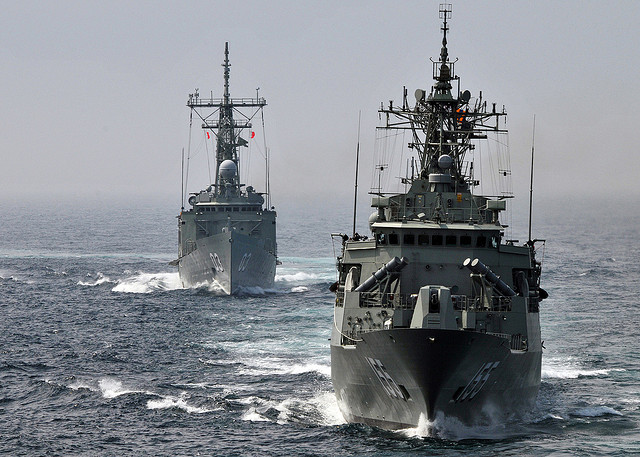
The Royal Australian Navy Adelaide-class guided-missile frigate HMAS Sydney (FFG 03) and the Anzac-class frigate HMAS Ballarat (FFH 155) conduct formation maneuverings in the Atlantic Ocean July 17, 2009.


The combination of the rise of China, interest in new submarines and debates on the Army’s future role has sparked a renewed interest in maritime strategy. There are several alternative maritime strategies in play, often with stark differences, but perhaps all have a similar fundamental shortcoming.
But first what is a maritime strategy? Most quote the early 20th Century British naval strategist Sir Julian Corbett, who believed that a strategy is maritime when ‘the sea is a substantial factor’. Crucially, he stressed that such a strategy involved joint forces working cooperatively to win a conflict rather than fighting their own separate wars.
Maritime strategies have loomed large in Australian strategic thinking, generally as part of someone else’s maritime strategy or, relatively rarely, independently. In this debate, there aresome (PDF) who devise an Australian ‘continental’ strategic school to rail against, but in so labeling specific strategies they disagreed with, the sea remained a substantial factor. The fundamental reason for disagreement was that the Army didn’t have a role—and thus a funding priority—which they considered essential.
So what maritime strategies are in play today?
  • Some propose a sea denial strategy, in which assets like submarines, missiles and maritime strike aircraft prevent an adversary easily using the sea for their purposes. The1987 Defence White Paper was based on this concept, as it built a path to a self-reliant national defence; Hugh White has recently advanced this idea further. Perhaps for similar reasons, the Chinese have also embraced sea denial.
  • Others embrace a technological maritime strategy based principally around specific capabilities that are considered especially significant and intrinsically valuable. Amphibious capabilities and large submarines are currently seen in this way. Big LHDs and big submarines are so versatile that many uses will surely be found for them in whatever future strategic circumstances arise. This is a ‘build it and they will come’ maritime strategy.
  • The Chief of Navy and James Goldrick propose a more wide-ranging maritime strategy that focuses on using the sea as a means of communication, including protecting Australia’s international trade. In this there are a very large number of ships to be protected, very few are Australian owned and they sail on dispersed sea lanes mainly across the Indian and Pacific Oceans. In most cases this would be a strategy that involved many other nations across vast ocean spaces and, if actually adopted, would change our planned force structure significantly.
  • There are also strategies of being involved in other people’s maritime strategies. Australia has deployed ships to the Gulf almost continuously from the early 1990s as part of US-led efforts to promote Middle Eastern stability. Recent tensions between the US and Iransuggest that this involvement will persist and in the nearer term may dramatically intensify—our next Middle Eastern war? Closer to home, Ross Babbage believes (PDF) we should be a part of the US AirSea Battle strategy that would fight for sea control against Chinese anti-access sea denial strategies. Andrew Davies sees such a linkage as a major factor influencing the size and cost of our new submarines. Michael Evans though, worries about such involvement negatively impacting Army force structure, and rejects such a strategy.
  • Michael instead advocates a maritime strategy of land force expeditionary warfare across the Indonesian archipelago. The concept owes much to the successful island hoping campaigns of WWII (PDF) but it can be argued that the strategic environment is very different today. Instead of outposts of European empires, the archipelago now comprises proudly independent states, mostly democratic and with relatively large land forces. Any Australian intervention would be by invitation only and the sea is unlikely to be a substantial factor in the terms Corbett meant. Certainly sea transport might be essential—just as in supporting the war in Afghanistan—but fighting won’t involve clashes at sea.
  • Partly combining all these strategies, the Williams Foundation sets out the operational capabilities Australia should aspire to. This concept—where everybody gets to play—isn’t quite a maritime strategy but rather what one should consist of. The Foundation postulates a scenario where Australia makes an alliance contribution, when the US is committed elsewhere on more important tasks, by mounting a joint force amphibious assault on a distant island against a peer adversary. This sounds somewhat reminiscent of the last days of WWII, when Australia undertook amphibious operations against by-passed Japanese forces while the US drove onto Tokyo Bay and victory. It’s not obvious how valuable that strategy is; Peter Charlton labeled it an unnecessary war.
This criticism highlights what is missing across the various proffered maritime strategies. They don’t clearly communicate how they’ll lead to a successful conclusion of a conflict. If the aim of war is a better peace, not just a return to the conditions that necessitated the war, these strategic alternatives don’t offer a path to this outcome. At the least they need locating within an overarchinggrand strategy that does. In this regard, the maritime strategies advanced are more operational concepts than strategies.
Justin Kelly and Michael Brennan have criticised such a focus on the operational level of war at the expense of considering the ‘bigger’ strategic level picture as at least partly explaining the limited success of recent large scale military campaigns. Historically, free-floating military thought bubbles have proven dangerous. Political leaders can unwittingly allow military forces to act out their aspirations and preferred operational models if there are no other ideas in play. At the start of WWI Kaiser Willhelm II famously complained of just such a conceptual straitjacket when he realized the Germany General Staff could not conceive of any alternatives or even modifications to its preferred Schlieffen Plan.
A sensible maritime strategy might require some more thought to develop and need to be subordinate element of an overarching grand strategy. Fortunately there may be some thinking (here and here) thinking that could be useful in this regard.
Peter Layton is undertaking a research PhD in grand strategy at UNSW. Image courtesy of US Department of Defense Current Photos.


Security challenges in the Asia-Pacific: a US perspective


The United States is prioritising a comprehensive engagement of the Asia-Pacific region. Whether this is called ‘rebalancing’ or not, the US requires growing trade, active but effective diplomacy, and sufficient military investment and presence to promote and preserve a peaceful and prosperous region. However, as I see it, the Asia-Pacific region is beset with at least three somewhat intertwined and hard security challenges: avoiding conflict with an authoritarian North Korea, growing tensions in the East and South China Seas, and managing a more assertive and rising China. While governments have to be concerned with far more than these security challenges, they pose some of the starkest threats to the dynamism of the Asia-Pacific region.
Focusing on China as the starkest long-term geostrategic challenge, many analysts in the US, Australia and the Asia-Pacific region might be quick to dismiss the threat posed by North Korea. But to do so would be a mistake. While conflict on the Korean Peninsula is still likely to be deterred, war is possible. Especially in the wake of recent provocations including the successful Unha-3 rocket and third nuclear tests, there’s no substitute for further strengthening deterrence and defence. Counter-provocation strategies need further attention and must be exercised to ensure better readiness.
From the perspective of the US–Australian alliance, the careful management of the North Korean issue is a prerequisite for achieving regional peace and prosperity. If there is any political will, it might well focus on proposing a peace agreement to replace the 1953 armistice, now declared null by North Korea. Countries like Australia will be important, whether because of its seat on the United Nations Security Council or as a potential partner in debating future strategic moves.
The East and South China Seas also appear to be settling into a long-term state of heightened confrontation. While that confrontation appears manageable, wise statecraft should never be assumed and nationalist fervour is running high in the region.
What is needed moving forward is a mixture of realism, confidence-building measures, transparency, and restraint. The two largest powers, China and the US, have a special duty to secure peace. A good beginning would be to acknowledge that the South China Sea (and to a lesser extent, the East China Sea) is part global good, part sovereign territory. Different national interpretations are inevitable, and being realistic about this fact is an essential beginning point for easing tensions.
The US one day will no doubt learn to live with PLA Navy ships passing off America’s coasts. But for the foreseeable future, issues such as innocent naval passage through exclusive economic zones and territorial disputes in the South China Sea, must be managed rather than settled. Through greater dialogue, trust building and transparency, informal rules of the sea can accommodate both a rising China and a strong America. But the US should simultaneously remain strong—economically and militarily.
This raises the third and related challenge: managing a rising China. China appears to be in the midst of reassessing its strategy after decades of near-continuous policy aimed at a patient approach and a peaceful rise. The visible displays of nationalism over the South and East China Seas suggest that it may well become more assertive and difficult to manage when it comes to defending its interests and creating new military capabilities.
The management of the challenges outlined above will depend on the ability of the US to commit to the rebalance in the foreseeable future, but also the cooperation and involvement of regional partners. To this end, there are five major recommendations or conclusions that I would offer.
The first deals with the overriding American priority of addressing its own problems. If the US can’t put more of its citizens back to work and grow its economy, then the difficult trade-offs regarding budgets, including defence spending, will be even more difficult than they are now.
The second and third recommendations echo the classic advice of Teddy Roosevelt: speak softly and carry a big stick. First the stick; the US needs more, not less, naval and air power. While we need an ability to engage regional partners at their level, we can’t afford to abandon serious combatants or cutting-edge technology. As for speaking softly, a successful commitment to a strong defence posture and genuine, not just rhetorical, rebalancing to the Asia-Pacific region should be matter-of-fact and carried out without fanfare. Improbable contingency planning exercises are best done quietly, especially in a region that prefers and expects superficial tranquility regardless of future uncertainty. Importantly, if the United States wishes to support a rules-based regional architecture, then it must seek to strengthen ASEAN-centred institutions, ratify the U.N. Convention on the Law of the Sea, and embrace the Philippine right to third-party arbitration of maritime disputes with China.
The fourth recommendation is to further encourage the active diplomatic and security participation of allies and partners, especially key allies such as Australia, Japan and Korea, as well as a vital partner in India. Budget constraints alone should be sufficient to motivate a shift of some security burdens onto Asian allies and partners, rather successful and growing economies free-riding on the US.
Australia should be spending closer to 2% of GDP on defence rather than its current 1.56% level. The US needs Australia to play a vital role in the South Pacific, the southern Western Pacific, and into at least the crucial Malacca, Lombok and Sunda straits leading into the South China Sea. Australia’s engagement with states such as Indonesia remains critical. And its key training areas in the Northern Territories and elsewhere remain excellent places to build interoperability with other modern militaries. In the longer run, greater naval access to HMAS Sterling, through shared joint facilities rather than any permanent US bases, would be ideally suited for operations throughout the Indo-Pacific region.
Fifth and finally, the US and its allies should never forget that the overriding political objective of strength is to create a durable, rules-based system that supports more democratic freedom, open and fair trade, and clear rules of the road for resolving disputes and averting conflicts. Within this system, establishing a cooperative framework for greater commerce with China based on real reciprocity and cooperation on selective global issues is essential. Through a dynamic equilibrium that accommodates power shifts and other international changes, the United States hopes not only to perpetuate its own influence for decades to come, but to nudge forward a regional security architecture supportive of freedom in all its dimensions: across the maritime and air, cyber, and outer space dimensions of the global commons; through inclusive, open but fair trade and through more democratic institutions able to protect human liberty.
Patrick M. Cronin is a senior advisor and senior director of the Asia-Pacific Security Program at the Center for a New American Security (CNAS). Image courtesy of The White House.

Tuesday, 2 April 2013

MBDA reports SIMBAD-RC order


Published: Feb. 19, 2013 at 12:45 PM
PARIS, Feb. 19 (UPI) -- European missile manufacturer MBDA has won its first export order for its SIMBAD-RC naval air defense system.
The system was launched as a self-financed development project about a year ago and prototypes are in production.
The systems ordered, MBDA said, will be delivered to the unidentified customer in 2015 and eventually be installed on patrol vessels.
"The SIMBAD-RC program gives a clear demonstration of MBDA's ability to help customers unlock additional capabilities from their previous acquisitions," said MBDA Chief Executive Officer Antoine Bouvier.
"Building upon a market standard like the Mistral missile -- of which 17,000 units have already been produced -- we have developed a simple, highly automated system that largely extends the operational use of the missiles that are already in service."
MBDA, owned by BAE Systems, EADS and Finmeccanica, describes the SIMBAD-RC as a remotely controlled, very short-range naval air defense system against threats such as fighter aircraft, anti-ship missiles and unmanned aerial vehicles. Each of its remotely operated turrets holds two ready-to-fire Mistral missiles.

Monday, 1 April 2013

Boustead suffers heavy losses


Shipbuilder and defence engineering company Boustead Heavy Industries suffered a net loss of RM112.3 million for the year ending 2012, compared to net  profits of RM18.5 million recorded a year ago, due mainly to a one-time cost overrun on its shipbuilding business.
For the fourth quarter alone, its losses were also sharply higher at RM59 million, compared to RM2.5 million losses in the same period a year ago, the company said in a statement to Bursa Malaysia. Boustead however said it expected business to rebound in 2013, aided by subsidiaries undertaking maintenance, repair and overhaul of naval ships, submarines and helicopters and an end to its shipbuilding cost overruns.
“With the completion of the final commercial shipbuilding project in January 2013, the heavy engineering’s segment will not incur further cost implications of this nature,” it said.
The company said that it’s revenue rose 36 percent to RM214 million and 19 percent to RM544 million respectively for the fourth quarter and the whole of 2012, over the previous periods a year ago.
Rising defence related projects such as the Littoral Combat Ship (LCS) project and chartering of vessels contributed positively to its revenue even as the company suffered some setback as three chemical tankers were impaired.

LIMA 2013: BHIC Clinches RM 47.4 Million Deal With MINDEF

Boustead Heavy Industries Corp (BHIC) has won contracts worth RM 47.4 million from MINDEF which include three year installation, service and supply contract for maintaining RMN’s Eurocopter AS-555SN Fennec worth RM 32.4 million (here) as well as RM 15 million worth of contract for maintenance, repair and supply of spares for Oerlikon 35mm gun and Skyguard radar for a period of three years. 

RMN Fennec during LIMA 2013


BHIC Aeroservice will be maintaining six of the RMN’s Fennecs while BHIC Defence Techservice will be responsible to work on the Oerlikon 35mm gun and the Skyguard radar.
24501792953559l
All deals were signed during LIMA 2013 on March 28. 
Previously, an RM 182 million contract has been secured from BHIC subsidiary Contraves Advanced Device from Boustead Naval Shipyard (BNS) for RMN’s littoral combat ship (LCS).
RMN Littoral Combat Ship will be based on DCN Gowind class combat vessel
BHIC Aeroservice had also secured the exclusive right as Eurocopter’s sole MRO center for military helicopters operated by the Government. This has been signed during the first day of LIMA 2013.
With Courtesy from:

LIMA 2013 - Boeing in talks with local aerospace players

Boeing in talks with local aerospace players

LIMA 2013 - 24 deals worth RM4.2b inked at Lima 2013

24 deals worth RM4.2b inked at Lima 2013

LIMA 2013 - French company keen to invest in Malaysia over long term

French company keen to invest in Malaysia over long term

Monday, 18 March 2013

ThalesRaytheonSystems Completes Command and Control System for Malaysian Ministry of Defence

20 February 2013
FULLERTON, Calif (Feb. 20, 2013) – ThalesRaytheonSystems (TRS) today announced full system acceptance has been finalized with the Royal Malaysian Air Force for the Malaysian Air Defense Ground Environment Sector Operations Center III (MADGE) Program. ThalesRaytheonSystems provided the Malaysian Ministry of Defence an enhanced national command and control system.  
“The C2 system we’ve executed in Malaysia represents technological integration at its best,” said Kim Kerry, CEO of U.S. Operations for ThalesRaytheonSystems. “We worked with our Malaysian customers to integrate their legacy system and have augmented it with proven technologies, such as the Sentry® command and control system and the Ground Master 400 (GM 400) radar. The result is a system that reliably and effectively meets their requirements.”
The MADGE system operates in real-time and features multi-radar tracking and a flexible human-machine interface. The GM 400 radar will provide additional long-range surveillance capabilities for the Royal Malaysian Air Force.
ThalesRaytheonSystems has more installed command and control systems operating around the world than any other organization. The Sentry® command and control system is a proven, comprehensive, real-time system that powers national air sovereignty systems around the world, including the NORAD Battle Control System. The company is also a world leader in battlefield and weapon-locating radar systems. The company’s radar capabilities span short-, medium-, and long-range systems. The ground-based radars are capable of detecting both conventional and unconventional threats for homeland and tactical air defense, counter-battery, and weapons system coordination.
Malaysian flag large

Friday, 15 March 2013

Korea - ASIA NEW RISING POWER


With the world’s attention focused ona potential confrontation between China and Japan in the East China Sea, a third player has built what may be the most powerful ship-for-ship fleet in Northeast Asia.  Over the past fifteen years, the Republic of Korea Navy (ROKN) has expanded dramatically, acquiring a substantial fleet of modern, powerful warships. While the ROKN continues to prepare for the contingency of conflict with North Korea, it has become a force capable of significant foreign deployment.  If Seoul maintains its commitment to the Navy, the ROKN could become one of the world’s premier middle power navies. 
Since 1953, North Korea has posed the central strategic problem for the ROKN.  The sinking of the Cheonan and the DPRK’s bombardment of offshore islands in 2010 served as harsh reminders of the maritime aspects of the North Korea dilemma.  New designs (especially frigates) suggest a renewed emphasis on anti-submarine warfare. However, many of the capabilities of South Korea’s new warships seem geared towards global contingencies, rather than being designed to meet specific North Korean threats.
The Aegis equipped Sejong the Great (KD-III) class destroyers, for example, compare favorably with American, Japanese, and Chinese designs, carrying more missiles in VLS cells than their foreign counterparts.  Although quite capable of engaging North Korea in a strike, air defense, or missile defense capacity, the three ships of the class represent a much more substantial commitment to surface warfare than the threat of the DPRK demands. 
Similary, the Dokdo class amphibious warships suggest a maritime focus extending well beyond the Korean Peninsula.  Like many amphibious warships, the 18,000 ton Dokdo strongly resembles a small aircraft carrier. As British and French operations in Libya last year demonstrated, amphibious warships can become strike vessels through the addition of attack helicopters.  Although South Korea does not currently participate in the F-35B project, the prospect of flying the STOVL fifth generation fighter from Dokdo (or potentially from Dokdo’s successors) undoubtedly appeals to some South Korean defense planners.  However, even if the tremendous expense of acquiring and operating such fighters proves daunting, the light carriers could someday employ Unmanned Aerial Vehicles (UAVs) optimized for strike and reconnaissance roles.  In any case, the Dokdos give South Korea a plausible expeditionary capability.
South Korea’s robust shipbuilding industry (the world’s largest) helps support and underwrite the ROKN’s expansion and modernization. Four Dokdos and six KD-IIIs are planned, although actual construction may not match these numbers.  If it does, however, this would represent one of the most potent naval warfare squadrons in the world, potentially capable of conducting many different missions in the region.  The KD-IIIs and Dokdos are supported by a force of nine modern large frigates (designated destroyers), all displacing from 3500-6000 tons and specialized for surface and sub-surface warfare.  Another fifteen 3000 ton frigates are in the ROKN’s plans.
Much like the PLAN, the ROKN has taken advantage of every opportunity to develop experience with distant, long-term deployments.  South Korea is a regular participant at RIMPAC, as well as other significant multilateral exercises.  Also like the PLAN and the Japan Maritime Self-Defense Force (JMSDF), the ROKN has maintained a continuous presence in support of CTF 151’s anti-piracy operations off the coast of Somalia. 
All of this suggests that the ROKN is built for exigencies well beyond war on the Peninsula.  Naval vessels of the sort operated by South Korea (small carriers and the modern-day equivalent of battleships) carry a high prestige value.  This signals to both domestic and international audiences that Seoul is to be taken seriously on the international stage.  However, the fleet also represents a hedge against the possibility that South Korean relations with its larger neighbors may deteriorate.  The capabilities the ROKN is currently pursuing could operate abroad in expeditionary and humanitarian relief operations, or could help protect South Korea’s maritime lifelines.  In any case, the tendency to focus exclusively on the navies of China andJapan misses out on one of the most important new players in the Northeast Asian maritime scene. 

100727-N-2013O-128

Korea defense Industry - Israel Navy Mulling Purchasing South Korean Ships built by Hyundai


Jerusalem, Israel (The Media Line) – Wasting little time after loosing a bid to sell Israel fighter trainer jets, South Korea has now reportedly offered to build large vessels for the Israeli Navy, which is in need of expansion due to strategic changes in the region.The Media Line Staff
A team of representatives from the South Korean government and Hyundai Shipyards have been in Israel recently to discuss a deal to build a frigate with a displacement of 1,300 tons, the Israel Defense website reported.
The report said that no costs were discussed and that the contacts were preliminary “but ongoing.” It further revealed that Hyundai, with its advanced ship-building industry, would sell Israel a skeleton vessel and that various Israeli defense industries would install locally made systems on board, including radar and the much-vaunted Barak anti-missile rocket defense system.
Some of the work could be done by the Israel Shipyards in Haifa, which is desperate to crack into the larger naval vessel market. It has proposed investing in new dry docks that would allow them to construct ships of up to 2,100 tons. Lobbyists sought government backing for the idea in order to keep the strategically important firm open. But this plan is reportedly stuck.
A proposal in 2010 to build together with Spain a littoral combat ship (LCS), a small surface vessel used in operations close to shore, fell through and an earlier bid to procure one from the U.S. also was shelved when the prices skyrocketed.
A Korean vessel would likely be far cheaper than anything purchased from the American or Germans, and they would also likely be more flexible when it came to join-industrial partnering.
A spokesman for Hyundai Shipyards could not be reached for comment.
The Israeli Navy already runs the most expensive pieces of equipment in the Israel Defense Forces and these are the German-made Dolphin submarines. It has three in service and three on order, including one deal inked in Germany last week. Each sub is estimated to cost about $600 million and is tailor-made for Israel by the German shipyards.
The Dolphins have a range of 4,500 kilometers (2,800 miles) and are reportedly Israel’s “second strike” platform equipped with nuclear-tipped cruise missiles, according to foreign reports. But for a country like Israel, where 95% of its military supplies come from the sea, defending the sea routes is without a doubt an existential strategic interest.
The three Sa’ar 5 class missile corvettes (1,250 tons) the navy received in the mid-1990s supplement its smaller fleet of missile boats making it a formidable force to defend the coast and take on Arab navies. But forward looking people in Israel’s defense establishment and government see a larger role for the navy in the future.
Last month, Israel’s Defense Ministry said it was choosing Italy’s M346 trainer fighter jets over the T-50s built by South Korea. It was a heavily fought procurement battle and many feared spurning the Koreans would have strategic and diplomatic fallout.
“With the jet trainer deal now yesterday’s news, it’s crucial for Israel to change the subject with South Korea as soon as it can. The best way to forget an unsuccessful deal is to put an even better deal on the table,” wrote Ariel Harkham, co-founder of the Jewish National Initiative, in Ha’aretz.
A glance at Israel’s strategic landscape presents a different picture than even a decade ago. Iran’s nuclear ambitions make the Arabian Sea an area for Israel’s navy and it recently sent vessels through the Suez Canal for patrolling off the Horn of Africa. The discovery of gas and oil fields in the Mediterranean off Israel’s coast, an increasingly belligerent attitude by Turkey and Egypt’s teetering on Islamist control all demand that Israel needs to turn itself from a coast guard into a regional naval superpower.
Senior naval commanders, including former Navy Adm. Yedidiya Ya’ari, believe the navy should have a bigger role in future battles. They and some government figures warn that the country is merely “one big and exposed aircraft carrier” whose 11 military airfields and numerous army bases are vulnerable to attack and could be paralyzed by enemy action.
Finance Minister Yuval Steinitz has been a strong supporter for a stockier navy. As chairman of the Knesset Foreign Affairs and Defense Committee he released a paper which saw the navy acquiring frigates, (4,000 tons), destroyers (9,200 tons) and cruisers (12,000 tons) equipped with cruise missiles with a range of some 2,000 kilometers, assault drones and marine artillery, including one being developed now which is capable of firing satellite-guided 155mm rounds between 75 and 120 kilometers.

Korea defense Industry - Royal Navy ships to be built by South Koreans


THE Royal Navy’s next generation of support tankers is to be built in South Korea, it was announced today.


Defence Equipment Minister Peter Luff said Daewoo Shipbuilding and Marine Engineering has been chosen as the Government’s preferred bidder to build the four 37,000 tonne vessels costing £452million.

The Ministry of Defence (MoD) said that although a number of British companies took part in the competition, none submitted a final bid for the build contract.

UK firms will however benefit from associated contracts - including the provision of key systems and equipment - worth £150million.
The winning design for the ships is by the British company BMT Defence Services.

“The Government remains committed to building complex warships in UK shipyards,” Mr Luff said.

The MoD’s chief of defence materiel, Bernard Gray, said the competition for the contract had “sought to engage shipbuilders from across the globe”.

He said: “I believe the winning bidder’s solution will offer the UK the best value for money.”

The four Military Afloat Reach and Sustainability (Mars) tankers will maintain the Navy’s ability to refuel warships at sea and will provide support for amphibious, land and air forces.

At more than 200 metres in length, each ship is as long as 14 double decker buses and can pump enough fuel to fill two Olympic-size swimming pools in an hour.


Source: The SUn


The tankers will allow destroyers such as HMS Dauntless to refuel at sea


The tankers will allow destroyers such as HMS Dauntless to refuel at sea


Korea defence Industry - Malaysia NGV Tech To Acquire 66 Pct Stake In South Korean Shipbuilder

Local shipbuilder, NGV Tech Sdn Bhd, will pay US$76 million to acquire a 66 per cent equity interest in South Korean shipbuilder, TKS Co Limited.

NGV Tech will purchase the equity from TKS's parent company, Kumkwang Engineering and Construction Group, in a deal which is scheduled to be inked tomorrow at the Langkawi International Maritime and Aerospace Exhibition 2009 (LIMA 09).

Its Executive Chairman, Zulkifli Shariff, said following the acquisition the local shipbuilder would be in control of a larger and deeper shipyard, modern shipbuilding equipment and have access to quality marine suppliers.

"Ultimately, the acquisition will enable NGV Tech to build bigger ships at competitive prices compared with the shipyard at Sijangkang, Teluk Panglima Garang, Selangor, which suffers from its remote location and absence of heavy lifting facilities," he told reporters here at the Mahsuri International Exhibition Center (MIEC).

TKS will become a subsidiary of NGV Tech, which will later be known as NGV Tech Shipbuilding Sdn Bhd, upon completion of the acquisition.

Zulkifli said following the acquisition, NGV Tech would be exposed to competitive and quality marine products from South Korea which would ultimately benefit its operations in Malaysia.

He added that NGV Tech would now be able to build ships of 200 meters in length either for the private sector or government.

The company recently informed the government of its intention and capability to supply Multi-Purpose Support Ships (MPSS) for the Royal Malaysian Navy.

Yesterday, Defence Minister Datuk Seri Ahmad Zahid Hamidi said the government planned to purchase at least three MPSS for the navy's operations.

Zulkifli said NGV Tech, 100 per cent locally-owned, had the latest technological know-how to build the support ships as stipulated by the government and the navy.

Zulkifli said the government should offer local companies, like NGV Tech, the opportunity to supply the Royal Malaysian Navy as its capabilities have been acknowledged by foreign navies and private customers.

"He said the government should look within the country for companies with such expertise. Why should the government look beyond the shores," he said.

Since it began operations in 1999, NGV Tech has built and delivered 120

ships for prominent clients which included Saudi Aramco, Shell, Exxon-Mobil, Petronas Carigali, Talisman and the China National Offshore Oil Corporation.

It has also built offshore patrol vessels for the navies of several Middle East countries.


Kapal Latihan GAGAH SAMUDERA telah berjaya di bina dengan usaha sama NGV Tech Sdn Bhd dan Syarikat Daewoo Shipbuilding Marine Engineering (DSME) dari Korea Selatan.
Kejayaan pembinaan kapal ini telah membuktikan bahawa syarikat tempatan juga berupaya untuk menguasai kemahiran pembinaan kapal yang berteknologi tinggi serta mampu merealisasikan aspirasi kerajaan untuk membangunkan industri maritim negara.


Dalam pada itu, kehadiran kapal latihan ini juga dilihat berupaya memperkasakan latihan dan kemahiran serta kecekapan the Navy People dalam mengendalikan operasi armada TLDM. Latihan di laut yang bakal ditempuhi juga membuktikan bahawa TLDM sentiasa melaksanakan pembaharuan dan penambahbaikan terhadap aset sedia ada serta mutu kerja the Navy People agar lebih efisyen seiring dengan visi TLDM iaitu Menjadi Tentera Laut Bertaraf Dunia.
Setelah penamaan dan pelancaran ini, kapal latihan GAGAH SAMUDERA akan menjalani kerja-kerja ujian penerimaan di pelabuhan dan di laut serta ujian penembakan meriam sebelum diserahkan kepada TLDM secara rasmi pada 19 Mei 2013.
Kerja-kerja mengintegrasikan sistem dan ujian sebelum penerimaan kapal merupakan satu cabaran yang paling getir dan penting kepada tim projek yang terlibat secara langsung terhadap perolehan kapal latihan ini.

Korea Defence Industry - Casualty - Bangladesh


This file photo shows Bangladesh Navy's only bleeding-edge frigate "Bangabandhu". The ship was purchased from South Korea in 2001 but has remained decommissioned for over five years.


The state of the art frigate of the Bangladesh Navy, purchased in 2001 for Tk 500 crore, has remained idle for more than five years now because of sheer 'political meanness' of the immediate past BNP-led alliance government.
Equipped for underwater, surface and air operations, the high-tech frigate, 'Bangabandhu', was decommissioned on February 13, 2002 and removed from the naval fleet, competent defence sources said.
The decommissioning was done on the pretext of corruption in purchasing the frigate. "If there was corruption, let there be legal actions against that. But what is the justification of decommissioning a world class frigate of the navy?" asks a defence high official.
The decommissioning has caused an incalculable loss, as the one-year warranty period of the onboard high-tech equipment elapsed without utilising them.
Meanwhile, at least 300 officers and soldiers, who could have been given a world-class training on the frigate, had to go abroad for the same purpose.
"Above all, the incident had dampened the spirit and energy of the Bangladesh Navy," said a senior defence official.
The caretaker government is now considering re-commissioning the frigate in mid-June.
The procurement of the frigate of model DW 2000H built by South Korean Daewoo Shipyard, triggered controversies prompting the BNP-led alliance government to file an anti-corruption case against ex-prime minister of the last Awami League government, Sheikh Hasina.
The then Bureau of Anti-corruption filed a case in 2003 in connection with the purchase of the frigate from the fourth lowest bidder in the tender Daewoo -- for incurring a loss for the government. The case virtually died after Hasina, Daewoo's local representative Abdul Awal Mintoo, and four defence officers had been granted bail in August 2003.
But while the BNP-led government did not pursue the case, it chose to decommission the frigate in early 2002 on grounds of corruption and sub-standard equipment.
A high powered investigation committee headed by the erstwhile commodore Hasan Ali Khan was formed. The other members of the committee were Commodore Kalimullah, Captain PK Barua and Captain Naser. The committee was assigned to detect substandard equipment installed in the frigate, but it failed to substantiate the allegation.
A defence high official pointed out that the then prime minister Khaleda Zia's personal secretary who is also her nephew, Saiful Islam Duke, and some enthusiastic naval officers, seeking the political clout of BNP, spearheaded the move to decommission the frigate.
Duke resigned from the navy soon after the Awami League government took over power in 1996. "He did so, because he had piles of negative reports on him from the past. He was a disgruntled officer with discipline problems," said the defence official. Duke himself was also involved in various naval purchases between 2002 and 2006, many of which are very controversial.

THE FRIGATE
With the mandate to provide security and surveillance in a maritime area of 40,000 square kilometres, the Bangladesh Navy has been in dire need of a modern frigate since the early nineties as its existing vessels and weaponry became antiquated. The decision to purchase a frigate was taken in 1996 to upgrade the naval operation capacity from a mere surface level to underwater-surface-air level. Daewoo's DW 200H frigate was picked as the best choice because it offered most modern weapons and warfare technology, sources said.
Daewoo completed manufacturing the frigate and handed it over to the navy on May 29, 2001. The then prime minister Sheikh Hasina commissioned it on June 20, 2001 and the frigate was in operation for eight months.
"During the only eight months of operation, the equipment and weapon set-up underwent fine tuning to make the frigate fault free. But after the decommissioning, we could do nothing. Now with the warranty period over, we will have to purchase everything that needs replacement," said a defence official.
A frigate's normal life span is of 25 to 30 years. This one already lost five years of its life without being utilised at all.
"The frigate is equipped with torpedo for underwater, missiles for surface, and anti-aircraft guns and missiles for air warfare. This gives us a three dimensional capability. This is a very high-tech ship which could provide world class training for our men. The engine and equipment are among the world's best that money can buy," he added.
"This frigate was not over priced," he pointed out.
The 340-metre long and 41-metre wide frigate also has a helicopter base on board. "We will need to buy a helicopter to complete equipping the frigate for three dimensional operations," the official noted. Such a helicopter costs around Tk 5 crore.