Monday, 30 October 2017

Malaysia’s Budget 2018 Summary

Prime Minister Datuk Seri Najib Tun Razak  has proposed an allocation of RM280.25 bil for  Malaysia Budget 2018 on Friday 27 Oct 2017.

Prime Minister Najib presents Malaysia’s largest budget ahead of elections

Here are the main points of his speech :
– A total of RM280.25bil has been allocated for Budget 2018, an increase of RM19.45bil over the 2017 budget allocation of RM260.8bil.
– Malaysia's income per capita is expected to rise to RM42,777 by 2018, median monthly income in the country has risen from RM4,585 in 2014 to RM5,288 in 2016

Budget 2018 has eight core thrusts.
– The first thrust is to enhance investment, trade and industry.
– Amount of domestic investment is expected to increase by 6.7%.
– Private investments are expected to touch RM260bil in 2018, in line with goals to make the private sector an engine of growth.
– Pulau Pangkor to be declared a tax-free zone (excluding liquor, cigarettes and motor vehicles).
– RM30mil allocation for the Malaysian Healthcare Travel Council (MHTC) to implement initiatives, among them to promote Malaysia as the Asian Hub for Fertility Treatment, IVF and Cardiology; to introduce the Flagship Medical Tourism Hospital Programme.
– Construction of the MRT3 or Circle Line to be completed by 2025, earlier than the initial target of 2027.
– The second thrust is towards achieving TN50 aspirations.
– Every Malaysian child born from Jan 1, 2018 until 2022, will be given RM200 worth of Amanah Saham units in new fund called Amanah Dana Anak Malaysia 2050 or ADAM50.
– RM2.2bil for scholarship grants under the Public Service Department (JPA), Higher Education Ministry and Health Ministry
– RM400mil for research grants and development for public universities, including special allocation to Universiti Malaya to become one of the Top 100 universities globally.
– RM90mil allocated for MyBrain Programme for 10,600 people to further their studies at the Masters and Doctorate level.
– University and Form Six student to continue receiving book vouchers worth RM250, benefiting 1.2mil students.
– RM1bil for initiatives spanning FitMalaysia, National Sports Day, athlete programmes, grassroots programme and the national football development programme.
– RM20mil for the Bukit Jalil Sports School to upgrade its facilities as a premier sports school.
– Third Thrust: Excellence in Education Development, Training, Skills and Talent, a total of RM61.6bil for this sector
– RM550mil allocated to special fund for improvement and upkeep of schools, as follows:
RM250mil for national schools; RM50mil for Chinese schools; RM50mil for Tamil schools; RM50mil for Mubaligh (missionary) schools; RM50mil for full boarding schools; RM50mil for Maktab Rendah Sains Mara, RM50mil for government-aided religious schools.
– Government to extend discount on repayment of PTPTN loans until Dec 31, 2018, grace period for PTPTN loan repayments extended to 12 months after graduating, loans for those furthering studies can now be combined.
– Fourth Thrust: Driving inclusive development
– RM6.5bil Budget 2018 allocation for rural development includes:
RM2bil for the Pan-Borneo Highway; RM1.1bil to upgrade bridges, streetlights, villages, surau and markets; RM1bil for SKMM to upgrade the communication infrastructure and broadband facilities in Sabah and Sarawak; RM934mil for rural road projects, including almost RM500mil for Sabah and Sarawak; RM672mil for electricity supplies, including RM620mil for Sabah and Sarawak involving 10,000 rural homes; RM420mil including almost RM300mil for Sabah and Sarawak provided for clean water supply involving 3,000 homes; RM500mil allocated for the Public Infrastructure Maintenance Programme and Basic Infrastructure Project; RM50mil for mapping and measurement of custom lands, in which RM30mil is for Sarawak and RM20mil for Sabah.
– Almost RM9bil allocated for Royal Malaysian Police, including RM720mil to build 11 headquarters and six police stations, purchase of new firearms and operational vehicles, RM170mil to upgrade ICT equipment, including 1PDRMnet system.
– Over RM14bil allocated for the Armed Forces, including RM3bil for purchase and maintenance of defence assets and RM250mil for Esscom to enhance coastal security controls in Sabah and Sarawak.
– Fifth thrust: Prioritising well-being of rakyat and income-making opportunities
– two percentage point reduction in income tax for the middle income (M40) group with household income of RM9,000 and below, benefiting 2.3mil taxpayers.
– Individual tax rate reduced by two percentage points, for those with chargeable income from RM20,000 to RM70,000.
– Move to increase rakyat's disposable income by around RM300 to RM1,000, resulting in an estimated excess of RM1.5bil in disposable income.
– New tax rates for three income brackets as follows:
1) RM20,001 to RM35,000 (3%)
2) RM35,001 to RM50,000 (8%)
3) RM50,001 to RM70,000 (14%)
– Over 261,000 people no longer have to pay income tax.
– Budget 2018 still includes up to RM3.9bil in subsidies, for items, goods and transport, cooking gas, flour, cooking oil, electric subsidies and toll.
– Toll collection to be abolished at Batu Tiga and Sungai Rasau in Selangor; Bukit Kayu Hitam, Kedah and at Eastern Dispersal Link, Johor from Jan 1, 2018.
– Mandatory maternity leave for private sector to be increased from 60 to 90 days; women returning to work after two years to enjoy tax exemption for 12 consecutive months.
– RM27bil allocation to improve healthcare, including RM1.4bil to upgrade and maintain health facilities, medical equipment and ambulances; RM100mil to upgrade hospitals and clinics electrical/wiring systems.
– Cost of hiring foreign domestic helpers to be reduced, employers can employ foreign domestic helper directly from nine source countries without going through an agent.
– Zero-rate GST for all reading materials, extended to cover all magazines, comics, journals and periodicals from Jan 1, 2018.
– Sixth thrust: Preparing for the fourth Industrial Revolution and the Digital Economy
– RM5bil for Green Technology scheme, RM1.4bil for non-revenue water programme, RM1.3bil for off-river storage, RM517mil for flood mitigation.
– RM83.5mil for Phase 1 DFTZ Aeropolis; minimum value for imports raised to RM800 from RM500 so Malaysia can be the regional e-commerce hub.
– Seventh thrust: Enhancing efficiency and delivery of government-linked companies (GLC) and public service.
– GLC employees to enjoy increased benefits such as flexible working hours, childcare centres in offices.
– Increase allowance for senior citizens to RM350 per month, RM50 increase for working and unemployed People with Disabilities (PWD) as well as caretakers.
– Eighth thrust: Balancing between the par excellence of the worldly and the hereafter.
– Retirement benefits for public servants who retire on medical reasons.
– Cash in lieu of accumulated leave of more than 150 days during the retirement year.
– Women more than five months' pregnant and husband can leave work an hour earlier, provided both working in the same location.
– Maximum of 90 days maternity leave a year, total leave allowed is now 360 days.
– Minimum pension of RM1,000 per month.
– Medical facilities extended to parents of retirees.
– Special assistance of RM1,500 to Village Heads and Tok Batin
– Upgrading and maintaining wiring systems in all registered religious schools by GiatMara
– Monthly allowance and one-off RM1,500 payment for imam, bilal, Kafa and takmir teachers.
– A special payment of RM1,500 be given to all public servants, RM1,000 in January 2018 and the balance during Hari Raya Aidilfitri.
– Special payment of RM750 to Government retirees, RM500 in January 2018 and the balance during Hari Raya Aidilfitri.

Thursday, 26 October 2017

Now MMEA is window shopping for Mothership - and China first

The ex PAT company were submitting the proposal of mothership from China and invited the Boss of MMEA for window shopping.

MMEA seeks ship with UAV to nab illegal foreign boats

A mothership with an unmanned aerial vehicle (UAV) is needed to increase the range of surveillance in the country’s wa­­ters, said the Malaysian Maritime En­­force­ment Agency (MMEA).
“With the UAV, we can take pictures of foreign fishing vessels using their illegal trawls which can be used as evidence in courts,” said MMEA di­­rec­­tor-general Mari­time Admiral Datuk Zulkifli Abu Bakar.
A mothership can carry a UAV and six boats.
“With more boats we can better monitor a larger radius of the sea and if there is a group of foreign boats, we can coordinate more effective arrests, maybe two boats to arrest while another two to ga­ther their trawls as evidence,” he added.
Zulkifli said to buy a brand new ship would cost more than RM500mil, so another option would be to purchase an existing ship and upgrade it into a mothership.
The second option should be half or three quarters of the original price, he added.
MMEA has submitted its request for a mothership to the Govern­ment.
Zulkifli said that 102 foreign boats, all of them from Vietnam, had been seized so far this year compared to more than 60 in the past two years.

The star online

MMEA seeks 2 motherships to boost maritime surveillance

The Malaysian Maritime Enforcement Agency (MMEA) is in need of two vessels to function as motherships to beef up security control and surveillance in the country’s waters, especially to curb intrusion by foreign fishing boats and smugglers.
MMEA director-general Maritime Admiral Datuk Zulkifli Abu Bakar said these vessels, which would be able to carry more food and fuel supplies for operations, would most probably be stationed in the waters of Beting Patinggi Ali in the South China Sea and off the peninsular east coast.
“These are  big vessels which will enable longer periods of enforcement as they can be in the waters for a long time.
“Small patrol boats can obtain food and fuel supplies from these vessels without having to return to shore, and it would save time and cost,” he said to Bernama.
He said MMEA had about 250 boats for patrol and monitoring in the country’s waters.
Zulkifli also said that the MMEA hoped to improve its infrastructure to facilitate operations.
“MMEA needs bigger lockups because a single operation can result in the arrest of a large number of foreign fishermen and illegal immigrants,” he said.
Zulkifli said the agency was also cooperating with various other local and foreign agencies for more efficient and effective enforcement via intelligence information exchange.
“Besides, the approach of displaying assets through patrol and monitoring in the hot (crime-prone) areas helps to curb crime and expedite response upon receiving reports of maritime crime,” he said.
Zulkifli, who took over as MMEA director-general on June 1, said he hoped to spur MMEA into a respected maritime agency at the international level.
“I hope that with all maritime agencies working together, we can ensure the security and prosperity of the country,” he said.
Zulkifli, 57, holds a Master’s degree in International Law from the International Maritime Law Institute of the University of Malta and a law degree from Universiti Teknologi Malaysia. – Bernama

MMEA targets landing crafts in new approach to zero encroachment

The Malaysian Maritime Enforcement Agency (MMEA) is aiming to spearhead a new approach to realise its goal of ‘zero entry’ (encroachment) into Sarawak.
State MMEA chief First Admiral Ismaili Bujang Pit said the agency hopes to acquire two landing crafts to optimise its assets and achieve greater effectiveness in overcoming illegal encroachment by foreign vessels into state waters.
“The agency has introduced a different approach by opting to use a landing craft which could ferry MMEA ships and boats to be deployed at sea, enabling the assets to patrol the waters at a longer period as compared to now.
“It (landing craft) could also store fuel and food supplies that could last up to 20 days as compared to the current assets which could only last five days at sea,” he told a press conference at the Tun Abang Salahuddin Maritime Complex (Komtas) at Muara Tebas near here yesterday.
He added that the state MMEA needs at least two units of the landing craft to be stationed north and south of Sarawak waters, which measures about 239,000 square kilometers and is equivalent to 40 per cent of the 660,000 square kilometres of Malaysian waters.
Ismaili noted that as of now the agency is dependent on tip-offs by local fishermen, adding also that any arrest made is time-consuming as it can take up to 24 hours to bring the seized foreign vessels back to the jetty here.
He disclosed that although the matter is still under the consideration stage, the state government has, in principle, agreed with the idea and has also expressed its willingness to fund the building of the landing craft.
“Let us try this method in Sarawak waters and see whether it means something.
“There is no harm to try, and we hope our leaders will look into this encroachment issue very seriously especially as Sarawak is the last frontier,” he said.

June 6, 2017, Tuesday 

RMN & BNS To Send Personnel To China For LMS Project -

The Royal Malaysian Navy (RMN) will be sending 12 of its personnel and nine officers from the Boustead Naval Shipyard Sdn Bhd (BNSSB) to Wuhan, China to monitor the making of the Littoral Mission Ships (LMS).
Its chief, Tan Sri Ahmad Kamarulzaman Ahmad Badaruddin said the matter was part of the procurement contract signed between the Malaysian government, BNSSB and China Shipbuilding & Offshore International Co. Ltd on a joint building of four LMS for the RMN.
“The team for this project has been given such a huge responsibility and task to ensure technology transfer between China and Malaysia, the first of its kind involving defence.
“It is a very significant project to upgrade our fleet in stages...It will take 30 years involving the Sixth Malaysia Plan,” he told reporters after mingling with team members in a get together event here today.
According to Ahmad Kamarulzaman, the team would be sent to Wuhan soon for 37 months to learn on the making of the LMS before embarking on building two remaining ships at its naval base in Lumut, Perak.
It is hoped that with the exchange of expertise, the RMN would be able to achieve its target of building 14 other LMS in stages depending on the country's financial standing, he said.
The procurement contract was signed on March 23.
The construction of LMS is the first product approved by the government under the RMN's Transformation 15-5 Programme which could ensure a more efficient maritime surveillance and to fortify the country's sovereignty.
All 18 LMS will replace old RMN's ships which require high operating and maintenance costs.
The building of the four LMS is expected to complete in stages from 2019 to 2021.
-- BERNAMA
Published on Friday, 07 July 2017 20:53


15 to 5 and LMS Updates

by Marhalim Abas 
Malaysia Defence

LMS and 15 to 5 updates. The RMN 15 to 5 transformation plan is on track and the navy will have a new fleet – if it goes to plan – in 30 years time. The first two ships under the plan are the LCS – two already being built – and the LMS which is to start construction soon.
The LMS project team (standing behind) posed for a picture with Kamarulzaman (third from right)
Three LCS (including the two already built) and three LMS will be build under the current RMK11 plan which ends in 2020. For RMK12 – 2021 to 2025, the navy plans to build three more LCS, eight LMS and one each of the PV (Kedah class) and the MRSS (Damen design?).
RMN’s 15 to 5 plan, graphic posted on the service official Facebook page, TLDM
Between 2026 to 2030 under the RMK13, it will be five PV, seven LMS and two more MRSS. In RMK 14 (2031=2035) funding will be sought for 5 PV and one submarine; in RMK15 (2036-2040) one each of the PV and submarine and four LCS and RMK16 (2041-45) two LCS as the replacement for a replacement for the Kedah class.
The RMN building plans were made public during the sent-off ceremony for 12 officers and men of the LMS project team at KD Seri Gombak, yesterday.
Navy chief Admiral Ahmad Kamarulzaman Ahmad Badaruddin says the project team will be stationed in Wuhan, China, to monitor the construction of the two LMS at China Shipbuilding and Offshore International Co. Ltd, at the Wuchang shipyard. Nine personnel from Boustead Naval Shipyard Sdn Bhd will also be assigned to the shipyard for the build.
The team for this project had a huge responsibility and task to ensure technology transfer between China and Malaysia, which is the first of its kind involving defence, Kamarulzaman said.
He, however, did not state when the keel will be laid and expected commissioning dates. “We will update you with the exact dates from time to time,” he says when pressed further for the construction schedule of the LMS
Kamarulzaman said the LMS could carry up to three standard ISO containers for mission modules, in the future, from mine warfare, hydrography to ISR duties. However, further details on the mission modules equipment for LMS was not available as they have not been finalised or more importantly funded, yet.
Various containerised mission modules are currently available from 120mm Nemo mortar to SSM which can be easily move from ship to ship, though RMN have yet to indicate its preference for such weapon system.
But from the CGI displayed, as reported previously, the first four LMS will be fitted with a China made 30mm RWS forward and two 12.7mm guns amidships.
CGI Image of LMS


First Littoral Mission Ship expected in Oct 2019


Malaysia is expected to receive one of two Littoral Mission Ships (LMS) currently being built in China, in October 2019, says Defence Minister Hishammuddin Hussein.
He said the two ships being built by China Shipbuilding & Offshore International Co Ltd and Boustead Naval Shipyard were currently on schedule.
“I would like to state that I am satisfied with the progress report of the acquisition of both ships. We will get the first of two ships in October 2019.
“Another two LMS will be built in Malaysia after that. This shows that the close cooperation between both countries (Malaysia-China) will continue to be strengthened in various aspects of cooperation, including security, investment, trade, education and tourism,” he said in a statement here today.
The statement was issued by Hishammuddin, who is currently on a three-day working visit to China, which started yesterday.
On Nov 2 last year, Hishammuddin said the four LMS purchased by Malaysia from China in conjunction with Prime Minister Najib Razak’s official visit to the republic would be a joint venture effort.
On his working visit, Hishammuddin said he had conducted a meeting with the Secretary of the Central Political and Legal Affairs Commission of the Communist Party of China, Meng Jianzhu, the State Councillor of the People’s Republic of China, Yang Jiechi and the republic’s Defence Minister General Chang Wanquan.
Hishammuddin, who is also Special Task Force Minister said among the issues discussed were those concerning security, specifically the movement of the Islamic State militant group, and military cooperation between Malaysia and China

Tuesday, 24 October 2017

Royal Malaysia Navy modernization plan and the tight budget !


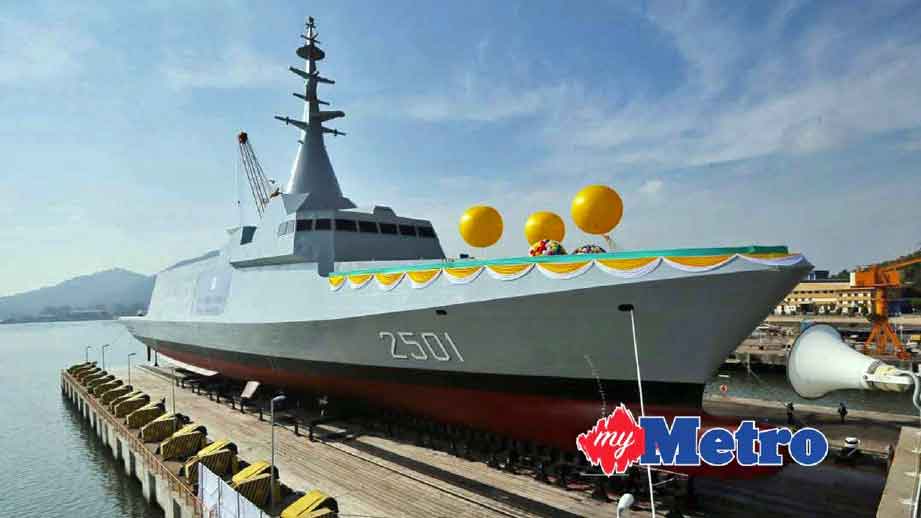
Malaysia's GOWIND LCS: Maharaja Lela (2501) Sharif Mashor (2502) Raja Mahadi (2503) Mat Salleh (2504) Tok Janggut (2505) Mat Kilau (2506)

Malaysia launches its first French-designed LCS as Navy moves to modernize

Mike Yeo Defence News

Malaysia has launched the first of its new littoral combat ships ordered under a $2 billion contract signed in 2011, as the Southeast Asian country continues its drive to modernize its navy.
The ship, named the Maharaja Lela, was launched Thursday at the facilities of builder Boustead Naval Shipyard in Lumut, Malaysia, in a ceremony attended by Malaysian Defence Minister Hishammuddin Hussein and Chief of the Royal Malaysian Navy Adm. Kamarulzaman Bin Haji Ahmad Badaruddin.
Malaysia’s LCS design is based on the French Gowind 2500 corvette, and the first ship is expected to enter service with the Royal Malaysian Navy in the first half of 2019. All six of the program’s ships are scheduled to be in service by 2023. Boustead had laid the keel of the second ship in February this year.
The 3,100-ton ship incorporates stealth characteristics, and its primary armament consists of a single BAE Systems Mk3 57mm gun in a stealthy turret; a 16-cell Sylver vertical launching system for the MBDA VL MICA surface-to-air missile; and a pair of quadruple launchers for the Kongsberg anti-ship Naval Strike Missile. Additionally, a pair of MSI Seahawk 30mm cannons and two J+S Marine triple torpedo launchers are also fitted.
The ship’s electronics suite includes the Thales Smart-S Mk2 3-D surveillance radar and Captas-2 variable-depth sonar, while Rheinmetall will supply the TMX/EO Mk2 fire-control radar and TMEO Mk2 electro-optical tracking systems for the ships. A Swiss subsidiary of Rheinmetall recently agreed on a joint venture with Boustead to provide project management, contract administration and related services for Malaysia’s defense industry.

France’s Naval Group will supply its SETIS scalable multifunction combat management system for the ships, with shipbuilder Boustead to lead the combat system equipment procurement and integration for Malaysia’s LCS program.
As Defense News has previously reported, Malaysia is currently in the process of recapitalizing its aging Navy, with plans to reduce the number of ship types from 15 to five. The so-called 15-to-5 plan, unveiled in 2015, calls for the reduction of the service’s order of battle from 15 to five classes of ships and submarines, which it hopes will trim sustainment costs by retiring older ships and reducing the number of ship classes operated by the Navy by 2030.
The five classes of ships are planned to consist of 12 LCS vessels, 18 Kedah-class offshore patrol vessels, 18 Chinese-designed littoral mission ships, three multi-role support ships of an as-yet undetermined design and four submarines. Of these, those in service include only six Kedah-class offshore patrol vessels, which are based on the German Blohm+Voss MEKO 100 design, along with two French Scorpene diesel-electric submarines.

Malaysian naval power suffers budget woes


 Malaysia’s centerpiece plan for the restructure and recapitalization of its Navy has also been adversely affected by the country’s budget woes, leaving most of it underfunded or unfunded altogether.

The so-called 15-to-5 plan, unveiled in 2015, calls for a reduction of the Royal Malaysian Navy order of battle from 15 to five classes of ships and submarines, which it hopes will trim sustainment costs by retiring older ships and reducing the number of ship classes operated by the RMN by 2030.

The five ship classes will ideally consist of 12 French-designed littoral combat ships, 18 Kedah-class offshore patrol vessels, 18 Chinese-designed littoral mission ships, three multirole support ships of an as-yet undetermined design and four submarines.

Of these, only six lightly-armed Kedah-class offshore patrol vessels are already in service together with two French Scorpene diesel-electric submarines. Malaysia has also ordered six littoral combat ships based on the French Gowind 2500 design under a $2 billion contract signed in 2011, with two ships in various stages of construction at Malaysia’s Boustead Naval Shipyard.

The 3,000-ton ships will be armed with the Kongsberg Naval Strike Missile and MBDA’s vertical launch MICA for anti-ship and anti-aircraft work respectively, along with 57mm and 30mm guns as well as torpedo tubes. The first ship is expected to be delivered to the RMN in late 2019 or early 2020.

Malaysia is also pressing forward with its Littoral Mission Ship program, signing a contract in early November 2016 with China’s State Administration of Science, Technology and Industry for National Defense for an initial four ships with two built by Boustead and the other two in China.
Neither the design of the ship nor the contract value has been disclosed, although it is known that the ships only will be equipped with guns; they will also be fitted for additional weapons and sensors, but budget constraints may affect their equipping. Under the 15-to-5 plan, these ships will replace a number of vessel classes currently in the RMN including the RMN's Laksamana-class corvettes.
However, Malaysian defense analyst Dzirhan Mahadzir told Defense News that the RMN's priority should still be the introduction of multirole support ships or MRSS, citing the strategic sealift capability gap left by the loss of the former U.S. Navy Newport News-class landing ship tank KD Sri Inderapura following an onboard fire in 2009.
Mahadzir noted that the MRSS also "will allow the RMN to conduct humanitarian assistance and disaster relief operations more effectively and also move troops and equipment in large quantity where airlift is not possible or available."
Indonesian state-owned shipbuilder PT PAL signed a memorandum of understanding with Boustead in late 2016 to collaborate on Malaysia's MRSS program, which will be based on the Maksassar-class design used by the navies of Indonesia and the Philippines.
To sum up, it must be noted that Malaysia’s most immediate and pressing security challenges are in the maritime domain. In addition to the spillover of lawlessness and banditry from the southern Philippines into its eastern states, Malaysia — like neighboring Indonesia and Singapore — has had to grapple with piracy off its coastline in both the Malacca Straits and South China Sea.
This is on top of the need to patrol the offshore oil and gas fields that form a significant part of the country's revenue stream, and to enforce its claims to the disputed islands and features of the South China Sea. With no end to its budgetary squeeze in sight, the RMN may find itself forced to sustain a shrinking pool of elderly vessels, casting further doubt on Malaysia's ability to secure its own waters.


SE Asia piracy & armed robbery against ships at South China Sea : Captain Jack Sparrow would love to live in this era.

Unmanned Rig Under Tow Boarded. MMEA Despatched, Robbers Escape in Singapore Strait - 12 Oct

Unmanned Rig Under Tow Boarded. MMEA Despatched, Robbers Escape in Singapore Strait - 12 Oct

Two wooden craft w/ 5 POB approach & board unmanned rig,Panama-flagged Energy Product 1, under tow by Singapore-flagged tug, MMA Crystal, in Singapore Strait. Master raised alarm. MMEA despatch assets but robbers escape - 12 Oct 2017


Anchored Bulk Carrier Boarded; Crew Member Threatened, Items Stolen off Samarinda, Indonesia - 13 Oct

Anchored Bulk Carrier Boarded; Crew Member Threatened, Items Stolen off Samarinda, Indonesia - 13 Oct

Anchored bulk carrier boarded off Samarinda anchorage, Indonesia. 2 robbers w/ knives threaten duty AB who raised alarm as robbers escaped with stolen property - 13 Oct 2017


Anchored Heavy Load Carrier Boarded by Armed Robbers off Pulau Bintan, Indonesia - 30 Sep

Anchored Heavy Load Carrier Boarded by Armed Robbers off Pulau Bintan, Indonesia - 30 Sep

Anchored at the stern of St Vincent and The Grenadines-flagged heavy load carrier, Zhen Hua 18, boarded by 3 robbers armed w/ long knives. Duty Officer raised alarm, crew muster & carried out search. Nothing stolen off Pulau Bintan, Indonesia - 30 Sep 2017


Thai-flagged LPG Tanker Boarded by 4 Armed Pirates; Crew Held/Robbed off Malaysia - 7 Sep

Thai-flagged LPG Tanker Boarded by 4 Armed Pirates; Crew Held/Robbed off Malaysia - 7 Sep

Underway Thai-flagged LPG tanker boarded by 4 pirates armed with guns & knives. Two crew tied in wheelhouse, Master forced to officer's cabin, valuable & belongings stolen before pirates escape in white/blue speedboat off Pulau Aur, Malaysia - 7 Sep 2017


Product Tanker Boarded, 13 Armed Perpetrators Order Siphon Cargo into Mothership off Malaysia - 6 Sep

Product Tanker Boarded, 13 Armed Perpetrators Order Siphon Cargo into Mothership off Malaysia - 6 Sep

Thai-flagged product tanker, MGT 1, boarded by 13 armed perps in 2 small boats. Ordered crew to siphon 1 million litres of diesel oil into mothership east of Kuala Dungun, Malaysia 6 Sep. MMEA dispatch helo and 2 ships to investigate. 10 perps apprehended. Tanker escorted to Kuala Terengganu for further investigation - 7 Sep 2017.

Robbers Attempt to Board Berthed Chemical Tanker in Sandakan Port. 13 Aug.

Robbers Attempt to Board Berthed Chemical Tanker in Sandakan Port. 13 Aug.

Two robbers attempted to board berthed Malaysia-flagged chemical tanker at Sandakan Port, Sabah, Malaysia - 13 Aug 2017

Product Tanker HIJACKED by 6 Pirates. Fuel Siphoned, Crew Robbed off Malaysia - 23 Jun

Product Tanker HIJACKED by 6 Pirates. Fuel Siphoned, Crew Robbed off Malaysia - 23 Jun

6 Pirates in speedboat board & HIJACK product tanker, CP41, off Kuantan, Malaysia. Crew held, assaulted & robbed. Tanker sailed to unknown location. Pirates stole/siphoned fuel before escaping day later. 23 Jun 2017


Berthed Product Tanker Boarded in Batam, Indonesia. Robbers Escaped w/ Stolen Items - 21 Jun

Berthed Product Tanker Boarded in Batam, Indonesia. Robbers Escaped w/ Stolen Items - 21 Jun

Berthed product tanker boarded during pre-departure checks, Jetty No. 3, CPO Kabil Port, Batam, Indonesia. Broke into steering gear & engine room. Stole spares & escaped - 21 Jun 2017

Chemical Tanker Boarded; Crew Tied Up as 6 Armed Robbers Steal Items, Pulau Mangkai, Indonesia - 28 May

Chemical Tanker Boarded; Crew Tied Up as 6 Armed Robbers Steal Items, Pulau Mangkai, Indonesia - 28 May

Marshall Islands-flagged tanker boarded by 6 robbers armed w/ guns knives. Tie up crew and stole cash, belongings before escaping. Master untied himself & reported incident to CSO - 28 May


MMEA wants two 'motherships', UAVs to combat illegal fishing by foreigners: WHY?