Showing posts with label USS Coronado. Show all posts

Monday, 24 October 2016

US says Littoral Combat Ship USS Coronado, now in Singapore, is combat ready

by: Wes Goodman | .
Bloomberg | .
published: October 17, 2016


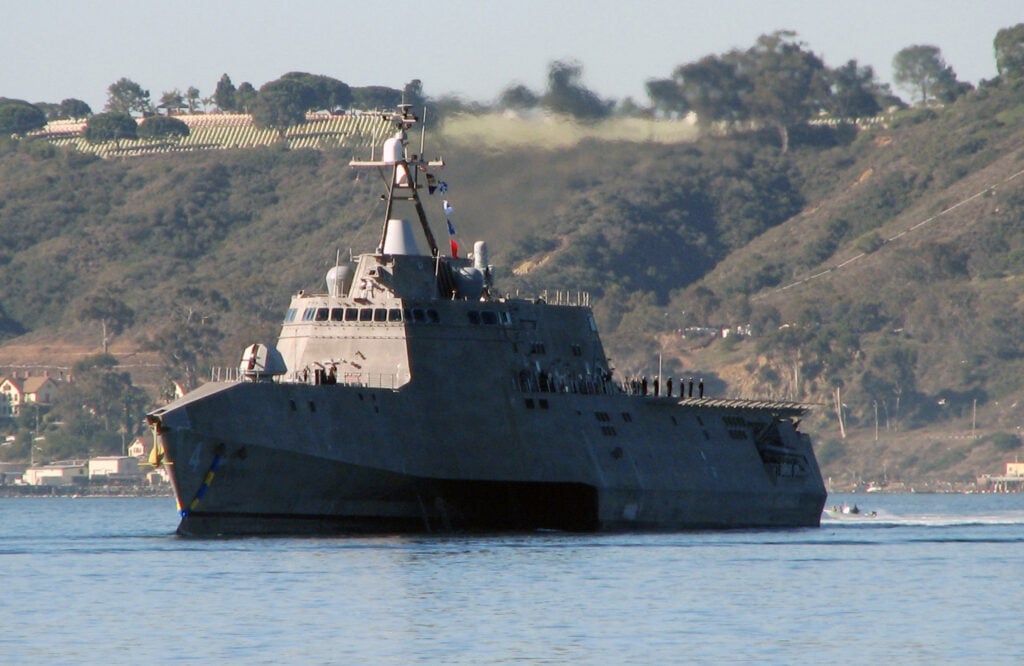
USS Coronado arrives to Changi Naval Base, Singapore, on Oct. 16, 2016 to begin a rotational deployment to the Indo-Asia-Pacific region. Joshua Fulton/U.S. Navy


The latest U.S. Littoral Combat Ship to arrive in Southeast Asia is combat ready, according to a senior Navy officer, after a series of mechanical snafus cast doubt on the ability of the vessels to operate effectively in shallow coastal waters.
The USS Coronado is "ready to go do its job," said Rear Admiral Don Gabrielson, Commander of Task Force 73 and Singapore area coordinator, adding operation, maintenance, design and training issues have been addressed. "Every ship has maintenance issues. Any time you take a new class of ship and you have a new model for taking care of the ship and training the crew, there are going to be things that you learn."
"It's crossed many miles of Pacific Ocean to get here all by itself," he said on Sunday on board the ship in Singapore.
The Coronado is the first deployment of an independence-variant Littoral Combat Ship to Southeast Asia and the third overall in the class. It has a larger flight deck than other LCS vessels and greater fuel capacity. It will use Singapore as a maintenance hub and carry out drills with countries in the region.
The ships, designed for the kinds of shallow coastal waters that surround many islands and reefs in Southeast Asia, are a spearhead for the U.S. military rebalance to the region, a key part of the Obama administration's bid to balance China's greater military and economic clout. Still, they have been confronted with equipment breakdowns and harried crews, with the Navy now moving to revamp the $29 billion program.
Issues with LCS maintenance haven't set back the U.S. presence in Southeast Asia, Gabrielson said. "There's a huge amount of demand for the Littoral Combat Ship by every nation out here in terms of exercise and integration."
The ship, built in two versions by Lockheed Martin Corp. and Austal Ltd., has been criticized for its reliability flaws, limited combat power and uncertain ability to survive in combat. The service is using its first ships for more extensive testing, reducing the rotation of crew members and de-emphasizing the swapping of missions and equipment that was supposed to be a hallmark of the vessels.
Two of the first vessels experienced propulsion-system failures, in December with the Milwaukee and in January with the Fort Worth. The Fort Worth was sidelined in port in Singapore for eight months. Two more vessels experienced failures in July and August.
The U.S. is targeting to have four of the vessels in Southeast Asia in coming years, Gabrielson said. The presence of the LCS is not meant to send a specific message to China, he added. "It's not a message to anyone other than what is going on in this part of the world matters to the whole world."
China claims the bulk of the disputed South China Sea, where its military buildup and land reclamation have created tensions with some Southeast Asian nations. It has also sparked friction with the U.S. amid a broader tussle for influence between the two powers in the western Pacific.
The risk of a clash in the South China Sea lies with non-military ships, Singapore Defence Minister Ng Eng Hen said earlier this month, as China deploys more heavily armed coast guard vessels in the disputed waters.
Singapore has joined other nations in the region and the U.S. in warning the reliance on fishing boats and coast guards to assert territorial claims in the South China Sea raises the prospect of an incident. It's a key shipping lane that carries as much as $5 trillion in trade a year.
China has used its so-called white hull fleet to chase and shoo ships including fishing boats from other countries away from the reefs it claims.

Wednesday, 3 February 2016

A critical test report on the embattled Littoral Combat Ship was “unfair" - US NAVY

WASHINGTON: On Friday, a Navy official told us a critical test report on the embattled Littoral Combat Ship was “unfair.” This afternoon, we found out the Pentagon’s independent test office has already circulated a coldly scathing response.
Defense Secretary Ash Carter has ordered the Navy to cut the LCS in favor of larger, more powerful ships. This particular test is one of the Littoral Combat Ship’s core missions, its ability to repel wolfpacks of Iranian-style fast attack craft. In the test, the USS Coronado used its 57- and 30mm cannon, but not the longer-ranged Hellfire missiles that are planned for — but not yet installed on LCS — a big part of what the Navy official called “unfair.” In essence, the famously tough office of the Director of Operational Test & Evaluation (DOT&E) is saying
  • LCS should be tested with guns only because the ships will have to go in harm’s way without missiles until at least 2017;
  • Even after lowering performance standards to account for the lack of missiles, the LCS still let the simulated attackers get dangerously close; and
  • Adding the missiles may not make as big a difference as the Navy claims.
“On Saturday, January 30, 2016, Mr. Sydney J. Freedberg, Jr., published an article in BreakingDefense.Com titled: ‘LCS Test Vs. Fast Attack Boats “Unfair”: Missile Missing, Navy Says,'” the DOT&E letter begins. “In that article, he references an unnamed Navy official who contended the testing of LCS Increment II SUW Mission Package was unfair because it didn’t take into account the planned surface-to-surface missiles that will be added to the Mission Package in Increment III. Regretfully, the Navy spokesman was apparently not familiar with the basis for the test and many of his statements are incorrect or not related to what was being tested.”
The Navy “established a much lower performance threshold” for the missile-less LCS in a classified 2013 memo from the then-Vice-Chief of Naval Operations, DOT&E says. “It also defined what the Navy considered to be a successful engagement, specifically requiring each target to be neutralized before any of them closed to within the Navy prescribed minimum stand-off range – a range selected based on the distance at which threat weapons would have a good chance of hitting the LCS. In reality, there are several threat weapons that could hit LCS from an even greater distance…..”
Even judging by these lower standards, however, LCS let the bad guys get too close. “Though the ship was able to eventually repel the simulated attack, this was after the targets had successfully penetrated the Navy’s prescribed stand-off range,” the letter continues. “In a real battle, there would be a good chance LCS might have sustained damage at that point that could have affected its subsequent capability to successfully repel the attack.” In other words, it sounds like the test did not simulate battle damage to the Littoral Combat Ship, but rather allowed it to keep fighting — and ultimately prevail — after the point in a real engagement when it might have been too badly shot up to continue.
What if the LCS had been equipped with missiles, which the Navy sees as an integral part of the surface combat package? “When the Longbow Hellfire surface-to surface missile is finally added to LCS’s SUW (Surface Warfare) Mission Package in FY 2017, the ship will be tested again, although more robustly,” DOT&E writes (emphasis ours).


Navy photo
LCS-4 Coronado
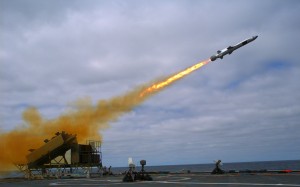
The LCS Coronado test-fires a Norwegian Kongsberg missile.
The LCS Coronado test-fires a Norwegian Kongsberg missile


But the Hellfire’s performance may not be as good as destroying seven out of eight attackers, which is what the Navy official said. In fact, the 7 of 8 success rate came from a series of unrealistic scenarios designed to figure out how to adapt the Hellfire from Army helicopters to Navy ships, not to test combat performance. What’s more, there were never eight attackers in the water at one time.
So were we wrong? I’m sure there’s a lot of highly technical debate to be had, which I’m not qualified to judge. It is clear that the Littoral Combat Ship will be more capable of destroying enemies at range — and therefore more likely to survive — once the Hellfires are installed, and even more so with a future “over the horizon” anti-ship missile. What remains in passionate contention is the controversial LCS’s overall readiness for battle.


published by


breaking Defense
By on February 02, 2016 at 8:06 PM