Showing posts with label Laws. Show all posts

Monday, 20 May 2019

Lasers: Beyond The Power Problem

Miitary lasers are getting more and more powerful, fast. But raw power isn't all you need for a workable weapon.


Lockheed Martin graphic

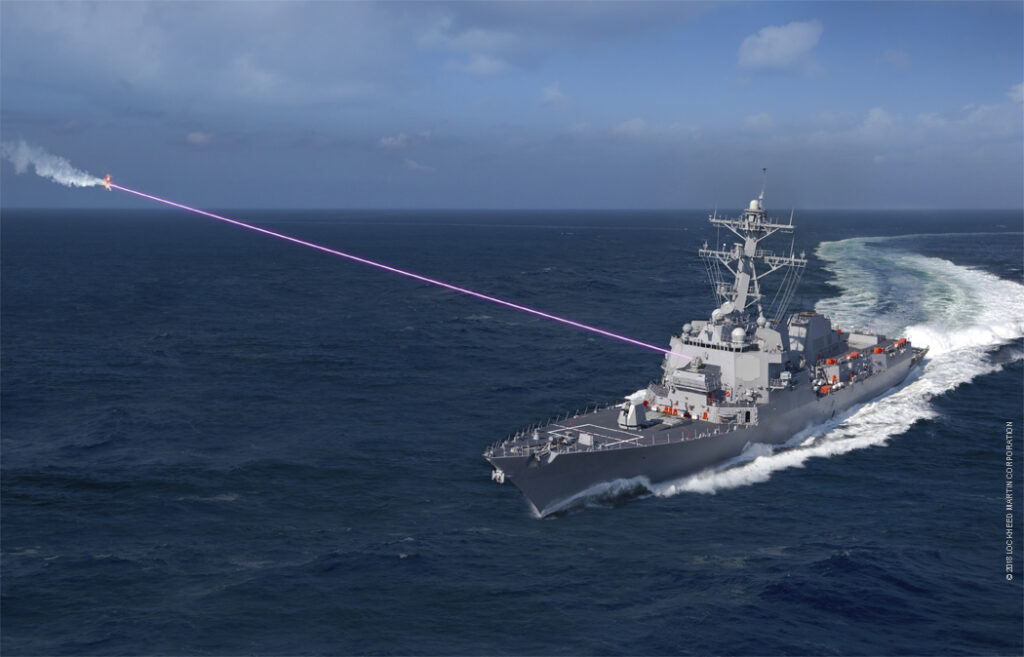
Lockheed Martin concept for their HELIOS laser for the Navy

WASHINGTON: Integration of lasers on ships and other weapons is the biggest challenge today— not power. Officers and officials say there are lots of devilish details to deal with before the US military can employ laser weapons on the battlefield, from beam control to targeting to controls you can operate without a PhD.
“I’m not as worried about the power,” said Rear Adm. Ron Boxall, director of surface warfare (N96) on the Navy’s Pentagon staff. “Everyone seems to be on this race to get more and more power, and make no mistake, we’ve got to get more power — but to me the problem I have today is the integration of that [laser] into my existing combat system.”
Navy & SOCOM: Integration
The Navy’s already experimented with a 30-kilowatt laser, LaWS, on the USS Ponce, and this year it will field a “roll-aboard” laser to blind sensors, ODIN, that can go on “anything that’s floating,” Boxall told last week’s Directed Energy Summit. But LaWS and ODIN are stand-alone systems that don’t connect to the combat system that controls a ship’s permanently installed weapons and sensors.
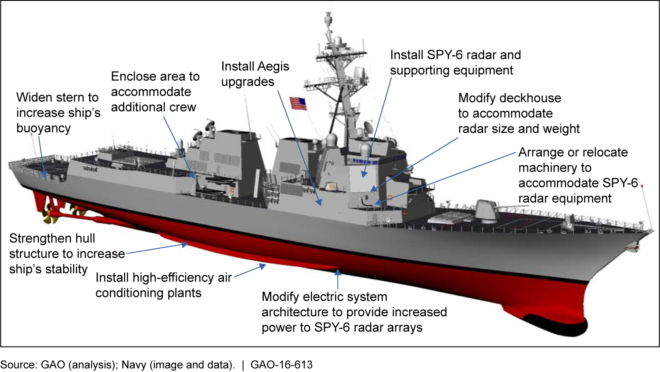
Navy DDG-51 Flight III modifications. SOURCE: GAO
That means, among other things, that the laser doesn’t get targeting data from the ship’s radars and must rely entirely on its own built-in optics. Conversely, the laser’s optics can’t provide targeting data to any other weapon on the ship. And you really want the ships’ other weapons to be able to take advantage of the laser as a sensor: Lasers require extremely high-quality optics to work, and, when not firing, the crew of the Ponce found theirs useful as a super-telescope. In fact, Boxall said, lasers are so precise — both as sensors and as weapons — that they both supply and demand much more data, much faster, than the radar-guided missiles that the Navy’s Aegis fire control system is built around.
Getting lasers and Aegis to work together is a top priority for the Navy’s HELIOSlaser program, which in 2021 will install a 60-kW-plus weapon on an Arleigh Burkedestroyer and — unlike LAWS and ODIN — integrate it with the Aegis combat system. The HELIOS laser will actually replace an existing, proven missile defense weapon, a Phalanx Close-In Weapons System (CIWS) gatling gun.
“I believe that the power will come, I believe that the improvement in beam quality will come,” Boxall said, “but where I’m not yet confident is, very few people are working on that integration.”
While HELIOS will integrate with the Aegis combat system, the admiral said, it still relies on its own dedicated power supply. In the long run, the Navy wants lasers that draw on the ship’s regular electrical system, but modern ships have less and less power to spare as the Navy upgrades their electronics, particularly with the new Air & Missile Defense Radar (AMDR) going on the newest Arleigh Burke destroyers, the Flight III variant. It’ll actually be easier to power a laser on the smaller frigates the Navy is about to buy, said Boxall, because that’ll be a new class whose margin for growth hasn’t yet been eaten up by upgrades. Ultimately, Navy leaders say they want a new cruiser design built for much high power levels.


As Breaking D readers know, Special Operations Command has a similar challenge, but in even tighter quarters: They want a 60-kilowatt weapon on their AC-130 gunships, replacing an existing 30 mm cannon but not impacting the rest of the airplane’s on-board arsenal. That’s the same power as the initial version of the Navy’s HELIOS, but instead of going on a 8,000-10,000 ton warship, it’s going on an aircraft with a maximum takeoff weight of 77 tons.
“It a really challenging math problem in terms of SWAP,” (Size, Weight, And Power) said Lisa Sanders, SOCOM’s science & technology director. The laser will weigh more than the weapon that it replaces — about 8.5 tons counting gun, ammo, mounting, etc. — and the aircraft can take the extra weight,, but the design is tightly constrained, she said.
SOCOM is also working with the Army on a helicopter-mounted laser, Sanders noted, but that’ll be built into a pod and carried externally, rather than tightly integrated into the aircraft itself. Neither laser program has finalized requirements yet. 


on March 25, 2019 at 7:31 AM

Tuesday, 8 August 2017

US NAVY Steers Well Away From An LCS Frigate

The LCS replaced the Perry-class frigates, like this one, the USS Vandegrift. Now the Navy is looking at more traditional frigate designs once more.
UPDATED w/ Sen. McCain’s “optimism,” Cdr. Clark’s analysis WASHINGTON: At 1:10 pm today, the Navy issued its official wishlist for its future frigate and set a 45-day deadline for shipbuilders to respond. As acting Navy Secretary Sean Stackley had promised, today’s Request For Information (RFI) opens the door wide to both US and foreign designs. It doesn’t lock the Navy into buying an upgraded variant of the current Littoral Combat Ships, but it doesn’t rule that out, either.
Overall, the performance requirements in the RFI suggest a very different vessel than the original LCS, one capable not only of auxiliary duties but of escorting aircraft carriers and supply convoys in conjunction with Aegis destroyers. A few parameters in particular stand out:
  • In short, the Navy wants the frigate to do certain things better than the LCS — and the things the LCS does well, the Navy doesn’t care much about.Reliability: The future frigate should be fully functional (“operational availability”) at least 72 percent of the time. Both the single-hulled Freedomand trimaran Independence LCS have suffered embarrassing breakdowns, beyond the normal teething troubles of a new class.
Courtesy Wikimedia Commons
The frigate Bergamini, the first Italian variant of Fincantieri’s FREMM class, a potential contender for the US Navy frigate.
  • Survivability: The frigate’s propulsion, weapons, and other “critical systems” should be sufficiently well-protected (“shock hardening”) for the ship to take a hit and keep fighting, at least with its defensive anti-aircraft systems. The original concept for LCS was to retreat for repairs once hit, so critical systems on LCS are not shock-hardened and were tested less rigorously than the Navy norm, according to the Pentagon’s independent Director of Operational Test & Evaluation.
  • Crew Size: The frigate may have up to 200 crew. By contrast, reducing crew size — and therefore personnel costs — was a major driver of the original LCS design. The small crew raised concerns about having insufficient manpower for routine maintenance, let alone damage control in battle. Even after increasing the crew, LCS still deploys with about 70 sailors.
  • Speed: The frigate must reach and sustain speeds of at least 28 knots (32 mph) . That’s fast enough to keep up with a carrier battle group, but it’s slow compared to the LCS, which can sprint at over 40 knots. That top speed required enormous, expensive, and complex engines relative to the size of the ship, as well as exotically streamlined hulls, driving the whole design, but the Navy never found a solid tactical reason for going that fast.
First, the RFI says “the Navy is particularly interested” in defensive weapons, specifically naming the Evolved Sea Sparrow Missile (ESSM) and the SM-2 Standard Missile. While the ESSM can be launched from rails mounted on deck, the SM-2 is almost always fired from a Vertical Launch System. (The Navy briefly used rail launchers for SM-2s, but they were all retired in favor of VLS).Then there’s the loaded question of weapons. The Navy had already committed to installing a long-range Over The Horizon (OTH) anti-ship missile on both the future frigates and, through retrofits, to the existing LCS. It had ruled out the major modifications to the ship required to install Vertical Launch Systems — essentially, missile silos built into the hull — although both LCS manufacturers said they could add VLS to their designs if asked. The new Request For Information asks for a minimum of eight OTH missiles, but then it raises an intriguing possibility of heavier armament that would require a VLS.
Navy photo
LCS-2, USS Independence, followed by LCS-1, USS Freedom, showing the two different designs.
  • Then, the Navy indicates further interest in “strike length variants to maximize weapons flexibility” — i.e. launch systems capable of handling offensive weapons as well as defensive ones — “if able to be cost effectively integrated.” While very cautious and cost-constrained, this language suggests a strong interest in the dual-purpose offensive/defensive Vertical Launch System.
Another intriguing detail is the instruction that all designs must reserve 26 tons of weight and 600 kilowatts of electrical power “for future Directed Energy and Active EA.” EA means electronic attack, i.e. jamming enemy radios and radars, a vital military specialty in which the US has lost ground compared to Russia and China. “Directed energy” means high-powered microwaves and lasers. The Navy has been keenly interested in defensive lasers, putting one on the USS Ponce in the Persian Gulf to shoot down drones — but that’s only a 30-kilowatt weapon: the future frigate could fire a far more powerful laser.
This is not the official beginning of a competition — that would be the Request For Proposals, RFP — nor a binding commitment on the Navy’s part. But with those caveats, the Request For Information gives a fascinating window into what the Navy wants.It’s important to remember that the Navy is still exploring the art of the possible here, and is not yet building a ship. The Request For Information (RFI) is just that, asking companies to provide their existing ship designs, estimated costs to modify them to Navy requirements, and rough costs and schedules to build the first ship in 2020 and two more a year thereafter.
US Navy photo
The Navy’s Laser Weapons System (LaWS) aboard the USS Ponce in the Persian Gulf

Meanwhile, retired Navy Commander Bryan Clark, a former top aide to the Chief of Naval Operations, gave us his analysis of the requirements — putting particular emphasis on places where the Navy seems willing to accept less powerful, more affordable frigate:  LCS arch-critic John McCain, chairman of the Senate Armed Services Committee, announced Wednesday that he was “cautiously optimistic” about the Navy’s direction. “I am cautiously optimistic regarding the request for information on a new Frigate program that the Navy released yesterday,” McCain said in a statement. “This new Frigate must be more capable than the Littoral Combat Ship (LCS) program, with minor modifications. For example, the new Frigate’s ability to perform local area air defense for convoys of ships would provide a necessary and clear capability improvement over the LCS program.”
“The RFI implies the Navy is still concerned about the cost of the new ship and perhaps wants to use the FFG(X) as something other than a traditional frigate,” Clark wrote in an email. “This RFI incorporates several optional requirements that would reduce the FFG(X)’s capability and cost. For example:
The Navy is leaving its options open here, Clark said, because it’s leery of installing heavy-duty air defense would increase cost and degrade performance, potentially to the point it knocks LCS-derived designs out of the running. “While Congress is pushing foreign designs such as the Fincantieri FREMM or Navantia F-105 (which already have VLS installed), the Navy likely wants variants of the current LCS to be able to compete for FFG(X),” he said. “To include VLS, the Freedom-class LCS would likely need a hull extension; the Austal LCS may be heavier with VLS and become slower and less efficient.”“The FFG(X) is not required to do air defense for another ship. (It) would conduct ASW (anti-submarine warfare) and ASUW (anti-surface warfare) and have improved survivability against air threats. The RFI leaves open the degree to which the FFG(X) would be able to do air defense for another ship, asking respondents to propose how they would provide for air defense, and what launchers, such as VLS, they would use to host ESSM and SM-2 interceptors. ESSM would provide the bare minimum capability needed to defend another ship, but only in very constrained geometries where the FFG(X) is very close to the defended ship and between the defended ship and an incoming missile. In other situations, an SM-2 would probably be required.”
Similarly, Clark notes, the RFI only requires passive, defensive electronic warfare systems, not active jamming capability, and it puts anti-submarine warfare at a lower priority (“Tier 2”) than either defensive systems or offensive anti-ship weapons. “While the RFI says the Navy wants a ship capable of doing (both) ASUW and ASW,” he said, “this could result in an option for FFG(X) that is less expensive and focused on ASUW.”
Overall, Clark said, these requirements suggest less a traditional frigate than a kind of picket ship, a spotter transmitting targeting data to more powerful vessels: “Instead of being a full-up multi-mission frigate, the RFI suggests the FFG(X)’s job is to support Distributed Maritime Operations and Distributed Lethality by hosting unmanned systems and acting as a remote active and passive sensor to support shooters over the horizon” — such as the more powerful Aegis destroyers.

on July 10, 2017 at 5:12 PM