Showing posts with label McCain. Show all posts

Tuesday, 7 November 2017

Collisions Study Shows US Navy Needs Better Training, More Ships


WASHINGTON: Lookouts were looking in the wrong direction on the USS Fitzgerald. The bridge crew – including the commander – didn’t know how the helm worked on the USS McCain. The collisions that killed 17 sailors this summer were “preventable” lapses in basic seamanship, the Chief of Naval Operations admitted today, as he ordered a host of measures to prevent a repeat.
It’s not just 7th Fleet’s problem, Adm. John Richardson emphasized: It’s the Navy’s.
“Now that we have that investigation complete (into 7th Fleet),” Richardson said, “I just transmitted a message to all commanding officers….for them to study this at all levels of command to figure out and determine where they might be vulnerable (and) what of the recommended actions might be applicable to them.”
But, Richardson warned, a culture of shortcuts arose in the first place because Japan-based 7th Fleet, and the Navy as a whole, are under intense pressure to get ships out to sea and keep them there. Ultimately, he said, the only way to meet the demand is to build more ships.
“The Navy’s been run hard in the past 16 years of war and the pace is picking up, especially in the Pacific,” Richardson said at a Pentagon press briefing. “Rising pressure to meet operational demands led those in command to rationalize declining standards (and) a reduction of operational safety margins.”
Like the proverbial frog in the pot of hot water, not knowing it is slowly boiling to death, 7th Fleet leadership didn’t realize all their short-term expedients added up to long-term disaster.
After USS Antietam ran aground in January, for instance, some crewmembers still needed to get time at-sea for their training and certifications, so they were transferred to the McCain. “This is not unusual,” said Richardson, but in this case, no one made sure the crewmembers from Antietam, a cruiser, were properly trained to operate the somewhat different equipment on the McCain, a destroyer. “A couple” of those ex-Antietam sailors were on the McCain‘s bridge at the time of the collision.
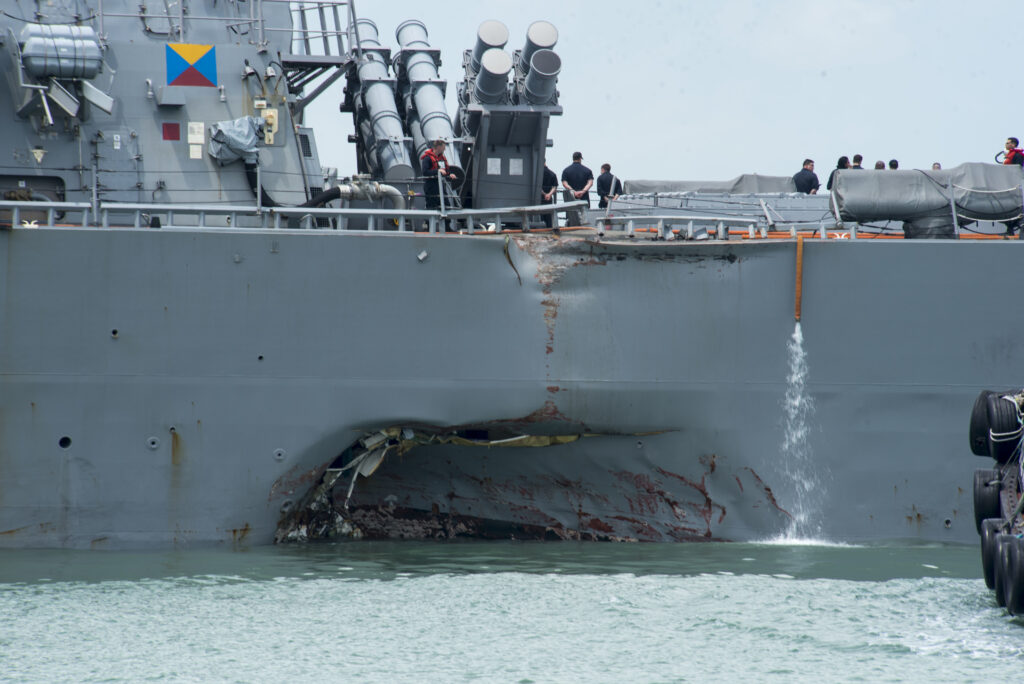
Navy photo
The USS McCain heads for Shanghai after a collision that killed 10 sailors.
That said, no one else on the McCain’s bridge seemed to know what they were doing, either, including the ship’s commander. When they belatedly realized a current was pushing them onto a collision course with oncoming ship traffic, they tried to adjust the steering system – reconfiguring it five times in the three minutes before impact. Instead of correcting course, they lost control of the ship.
One mistake on the Fitzgerald was even more basic. The ship had posted look-outs as it went through busy sea lanes, but they were only looking left (port). No one was watching the ship’s right (starboard) side – which of course is where it was hit.
“These were fundamental mistakes of ship driving,” Richardson said, definitively ruling out speculation about a cyber attack. “These ships in the 7th Fleet had not mastered the fundamentals – and we noticed some issues at headquarters that may have set them up for that.”
Adm. Phil Davidson‘s team of 34 sailors and civilians studied both accidents and “other mishaps going back 10 years,” said Richardson, to come up with a battery of recommendations. Some are simple: warships will now routinely turn on their AIS (Automatic Identification Systems) beacons, sending their positions to nearby vessels. Some are easy to explain but not to implement: sailors must now be allowed to sleep at least six hours in every 24. Some are complex: a new, more deliberate work schedule for 7th Fleet; a new independent readiness body; a “near miss” program to investigate almost-accidents and disseminate lessons-learned; and a more rigorous process of readiness assessments.
“A big conclusion of the comprehensive review is we’ve got to beef up the assessment process across the board, both individual and team,” Richardson said. “While we did focus on this area in the 7th Fleet, there’re assessments of readinessgoing on throughout the Navy.”
Ultimately, however, part of the solution is in Congress’s hands. “There’s a mismatch between the sustainable level of naval power that we can generate with the current assigned forces in the 7th fleet and the mission set, the growing mission set,” Richardson said. “That gap can only be met by additional naval forces — more ships.”
on November 02, 2017 at 3:27 PM

Monday, 21 August 2017

USS John S. McCain collides with merchant ship east of Singapore

10 Sailors Missing After U.S. Navy Destroyer, Merchant Ship Collide

Incident is second destroyer accident in about two months


Ten American sailors were missing and five were injured after the guided-missile destroyer USS John S. McCain collided with a merchant vessel near the Straits of Malacca and Singapore, U.S. Navy officials said, making it the second destroyer accident in just over two months.
Search-and-rescue efforts are under way. In a statement, the U.S. Navy’s Seventh Fleet said four of the injured sailors were taken to a hospital in Singapore to treat non-life-threatening injuries. The fifth injured sailor doesn’t require additional medical attention. No fuel or oil is visible on the water’s surface near the McCain, it said, adding that initial reports show the ship sustained damage to its port side aft.
The Alnic, a nine-year-old oil-and-chemical tanker, was also on its way to Singapore, scheduled to arrive at about 11 a.m. local time, according to VesselsValue, a maritime information provider. It departed a port on China’s northeast coastline on July 10 before traveling around the coast of South Korea. It then waited a few days for orders around Taiwan, then steamed southwest to Singapore.
Its last reported location was east of Singapore and Malaysia where ships enter and exit the busy straits. VesselsValue records indicate the oil tanker, a 600-foot tanker with a gross tonnage of 30,000, wasn’t holding cargo at the time of the collision.
VesselsValue data shows the Alnic is owned by Greece’s Brave Maritime Corp., which is owned by Greek shipping magnate Harry Vafias. Brave Maritime wasn’t immediately able to be contacted for comment.
Singapore’s Maritime and Port Authority said in a statement that both ships were on their way to Singapore to assess damage, adding that search-and rescue operations were ongoing. It said the U.S. Navy vessel requested tug assistance to move it to port after sustaining damage to its left side. The authority said one of the Alnic’s tanks was damaged above the waterline; it reported no injuries.

The damaged USS John S. McCain off Singapore on Monday.

Ship collisions are extremely rare, even in congested waters like those around Singapore’s coast. But the accident comes days after the Navy released an initial report on the June 17 collision of the USS Fitzgerald, which hit a merchant ship, the ACX Crystal. Seven American sailors died in that accident, and the Fitzgerald’s captain, the executive officer and the senior enlisted sailor were relieved of command.
The McCain had just conducted a freedom-of-navigation operation in the South China Sea, navigating to within 12 nautical miles of Mischief Reef, one of a chain of disputed islands.
Bryan McGrath, a former Navy destroyer captain, said: “Shocking is not the right word, it’s almost unbelievable,” reacting to news of the McCain accident.
Mr. McGrath said he didn’t have enough information to assess what might have happened.
“It raises questions about the readiness of those ships and whether or not they are navigating prudently in very crowded waters,” he said. “We’ve gone years since a collision [and] to have two, one after the other, is either a coincidence, which I’m willing to believe, or it’s a sign of something deeper, which I’m also willing to believe.”
Singaporean tug boats, patrol ships, helicopters and a police coast guard vessel were in the area to offer assistance to the McCain and the Alnic, according to the Seventh Fleet. In addition, American MV-22 Ospreys and SH-60 helicopters from the USS America were also responding.
In a post on Twitter, the chief of Malaysia’s navy said Malaysian search-and-rescue teams had also responded.
The U.S. Navy maintains a close relationship with Singapore, an island nation of 5.6 million people placed strategically at the narrow Strait of Malacca, a narrow stretch of water between Malaysia and Indonesia is a major shipping gateway to Asia for vessels from the Middle East and the Indian Ocean.
Singapore agreed to allow the U.S. use of its military facilities as long ago as 1990, in an agreement that the two sides extended most recently in 2015. U.S. Navy vessels regularly stop in Singapore for maintenance and refueling, including ships that go on to conduct patrols that challenge Chinese and other maritime claims in the South China Sea.
“The waters near Singapore in the Straits of Malacca are a choke point in the most important shipping lanes in the world,” said David Adelman, the U.S. ambassador to Singapore from 2010 to 2013. “As tensions in the South China Sea have increased, the U.S. Navy’s role in the region has become more important than any time since the conclusion of the war in Vietnam.”