Showing posts with label drones. Show all posts

Friday, 29 September 2017

More than 150,000 Commercial Drones to be Shipped in 2017


LONDON, UK, September 26, 2017 /EINPresswire.com/ -- More than 150,000 commercial drones or UAVs (unmanned aerial vehicles) will be shipped in 2017 according to a new report from Interact Analysis. The detailed research report found that commercial drone shipments are growing by 68 percent this year. Media and entertainment applications still hold the lion’s share and will consume 85 percent of this shipments; however, other industries including construction, building inspection and public safety are growing much quicker.
95 percent of all shipments will be multi-rotor
Unsurprisingly, the report – which was produced based on six months of primary research -revealed that rotary/multi-rotor drones will account for 95 percent of all commercial drone shipments this year. “Multi-rotor drones are clearly the preferred platform of many vendors, including leader DJI, and the preferred platform for the media and entertainment sector” said Ash Sharma, Research Director at Interact Analysis. However, the relatively low price of rotary UAVs compared to other types means that they will ‘only’ account for 77 percent of revenues this year, down from 80 percent last year. Conversely, although fewer than 1,000 unmanned helicopters will only be shipped this year (0.5 percent of the total), they will generate 9 percent of the industry’s revenue.
Divergence in Pricing
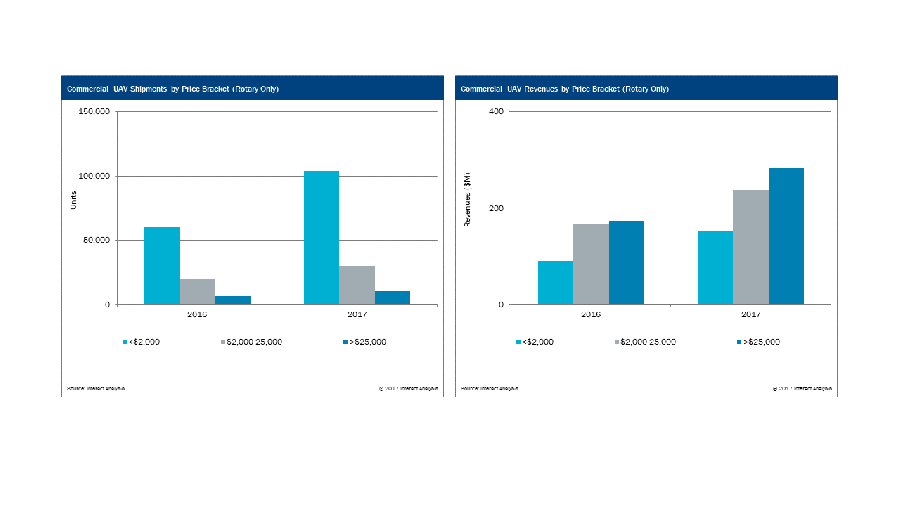
The report also found a similar picture when analysing shipments by price bracket. More than 100,000 rotary drones priced below $2,000 will be shipped this year. “These low-cost drones are the preferred choice for many in the media and entertainment sector, with roughly three-quarters of customers selecting drones in this price range, but not necessarily in more professional or industrial applications like oil and gas.” said Sharma. Just 10 percent of drones shipped to the oil and gas sector this year will be priced below $2,000, the report found.
Despite large shipments of <$2,000 rotary drones, the report showed that these types of products will be the smallest contributor to industry revenues this year and worth just over $150 million. Drones priced at $2,000-$25,000 and over $25,000 on the other hand will account for 78 percent of revenues, despite making up just 28 percent of shipments.
Automation Continues to Advance
Higher levels of drone automation will continue in 2017, with just 14 percent of drones shipped this year relying on full human control and no flight assistance. Some form of auto-pilot or obstacle avoidance has become increasingly common and roughly three-quarters of all commercial drones sold this year will have this feature, the report found. “Fully autonomous drones – ones which truly can operate without any human intervention are still relatively rare however. Whilst these are tipped for rapid growth, they will remain a niche for this industry, at least in the next five years” commented Sharma.
Ash Sharma
Interact Analysis
+44 1933 654245

More than 150,000 Commercial Drones to be Shipped in 2017

Low-cost drones are the preferred choice for media & entertainment, with three-quarters of customers buying <$2k drones, but not necessarily in professional or industrial applications like oil and gas”
— Ash Sharma, Research Director at Interact Analysis

Thursday, 29 June 2017

Vietnam’s illegal fisheries are old threat to malaysian fisherman

Malaysia’s economy losses $334 Million (1 Billion Malaysian ringgit) a year to illegal fishing activities by foreign fisherman within its territorial waters.
The fishery sector has for decades been playing an important role as a major supplier of animal protein to the Malaysian population. In 2007 the total fishery production of the country amounted to 1,563,942 tonnes. 
The greatest bulk of the fish landings has always come from the capture fisheries, constituting 88.3 percent of the total production for the year 2007.

There are 129,622 fishermen working on 49,756 licensed fishing vessels. Of these, 36,566 people are fishermen of foreigners, especially from Thailand, Vietnam and Indonesia. 

Fishery Trade

Export value of fishery products increased to RM 2,328 million compared to RM 2,112.5 million in 2009. The main export contributors were shrimp (51%), fresh / cold / frozen (23%) and fish stocks (15%). While import value has increased to RM2,219 million compared to RM 2,098 million in 2009. 

The production of marine fish from Malaysian waters was 1,482,899 t.m which gave a value of RM8.336 billion in 2013. In 2014 production decreased by 1.67% to 1,458,128 t.m, with a value of RM 8.785 Billion.

Threats

- The Invasion by foreign fishermen; Vietnamese, Thais and China fishermen. The occurrence of intrusion by foreign fishermen, whether registered or unregistered, will not only affect the income of local fishermen but also threaten their safety.

- Foreign sales of foreign fish & criminals who use government-provided facilities, such as oil subsidies and boats, 

the  use of illegal trawlers; that result in the loss of fish sources and local fishing net damage

The weaknesses of security patrols due to issue arising out of inadequate of fuel  provisions for the boats

- the patrols Boats were over 40 years old compared to Vietnam's powerful fishing boats

- The intervention among three enforcement agencies, the Coast guard, the Department of Fisheries and the Marine Police, is very grateful with each one blaming one another without settlement until now.

Nelayan tempatan tidak puas hati

solution

1. Revoke the license or place certain conditions on the owner of the fishing boat C2 so as not to use the service of the Vietnamese fisherman anymore.

2. MMEA  to always improving patrolling and enforcement.

3. Eradicating the activities of foreign fishermen in the waters of the country

4. Using diplomatic channel to control the foreign fisherman activities

5.  patrolling for local fishermen's safety and security.


Unfortunately, the suggestion to use the "drone" - a small flying watchdog, was not accepted and ignored by the minister in Parliament during the recent debate on March 2017.


Wednesday, 9 September 2015

Small Drones Are A Big Danger; Think Flying IEDs: CNAS

WASHINGTON: Sometimes small is beautiful. Sometimes small is lethal. While China andRussia are researching stealthy and armed drones, the drunk intelligence analyst who landed a Chinese-made mini-drone on the White House lawn in last month may be the more worrying sign of things to come.
Afghan and Iraqi guerrillas kludged together murderous roadside bombs with scavenged or homebrewed explosives triggered by cellphones or garage door openers, killing more Americans than any of Saddam’s Scud missiles or main battle tanks. What might similarly ingenious insurgents do with off-the-shelf drones?
“We’re seeing capabilities that were previously the monopoly of major military powers are now accessible…to non-state actors, even individuals,” said Kelley Sayler. She’s an associate fellow at Center for a New American Security and author of a report out this morning, “A World of Proliferated Drones.” (CNAS provided us a copy in advance).
“There’s been a lot of discussion around town, particularly as relates to drones in the national security space about high-end drones,” Sayler told me. “We didn’t really see there being discussion on the range of systems that are available…particularly given the availability of low-end systems, hobbyist drones, even commercial drones.”
The biggest danger in the medium term: swarming technology. As drones get not only smarter but cheaper, an enterprising adversary could buy a bunch and release them all at once, with the drones using insect-like artificial intelligence to converge on their target. Lots of little threats carrying lots of little bombs can add up quickly.
“Particularly if you’re looking at systems that can truly navigate autonomously, using those systems en masse is going to enable you to neutralize a much larger target,” Sayler said, “[and] it’s going to be more difficult to defend against because some of the lower end solutions like shooting the thing out with a shotgun might not necessarily be feasible.”
“Drones will enable airborne IEDs [improvised explosive devices] that can actively seek out US forces, rather than passively lying in wait,” Sayler wrote in the report. “Indeed, low-cost drones may lead to a paradigm shift in ground warfare for the United States, ending more than a half-century…in which US ground forces have not had to fear attacks from the air.”
Sophisticated drones are definitely part of that future threat, she said. But they require the resources of an advanced nation-state to develop and operate, and nation-states tend to be less murderously inventive than low-rent irregulars.
“When we are looking at the higher end systems we are seeing something that would be akin to missiles or manned fighters,” Sayler said. “When you’re looking at traditional state use, you are probably going to find more traditional and restrained uses.”
Guerrillas and terrorists, by contrast, generally have much less capability than nation-states, but they are more likely to use what they have in unexpected ways. Hezbollah has fired a drone with almost 60 pounds of explosives at Israel, although it was detected and shot down. Smaller drones are harder to detect, and states less vigilant than Israel — which has anti-missile systems constantly stopping rockets — might not be set up to detect them.
“We’re more looking at a threat that is rising from unanticipated use where US troops or allied troops are not particularly expecting a threat…. and therefore your countermeasures are not really in place,” said Sayler.
The simplest use of off-the-shelf drones would be to spy on US forces. That kind of low-rent reconnaissance could provide a significant tactical advantage without requiring any modifications. With a little jury-rigging, many widely available drones could carry five to 10 pounds of explosive. That’s hardly the same as a vehicle-flipping 500-lb roadside bomb, but it’s enough to kill.
The good news is that if you are aware of the threat, there are plenty of ways to stop it. “If you know these systems are coming … you can shoot them down with a shotgun,” Sayler said. Or, if you’d like to fight robotic fire with fire, there are specialized “drone-hunting drones” that catch unauthorized flying objects in a net.
The easiest way to defend large areas for a long time is jamming. At the very least you prevent the enemy drone from transmitting back intelligence to its operators. For the majority of drones flying today that navigate using either continuous GPS signals or constant remote control by a human, jamming can stop them in their tracks.
The immediate problem is what else you’ll jam. In a wilderness or free-fire war zone, the electronic collateral damage might not matter. In urban counterinsurgency, peacekeeping, or policing, however, you’ll turn the local population against you quickly if you’re constantly scrambling their cellphones. Set the jammers to avoid civilian signals like phones and police radios, and you can bet the bad guys will convert their drone controls to use the same frequencies.
The longer-term problem is that drones are getting smarter and more autonomous. “In the next few years we’re going to see technologies like sense-and-avoid systems being incorporated that allow the drone to autonomously navigate around objects,” said Sayler, reducing the need for a GPS signal or constant human supervision. That makes the coming swarm much harder to stop.
Army photo
on June 10, 2015 at 10:34 AM

Tuesday, 8 September 2015

New China Drone: Looks Like A Reaper

breaking defence By 
on September 02, 2015 at 11:29 PM


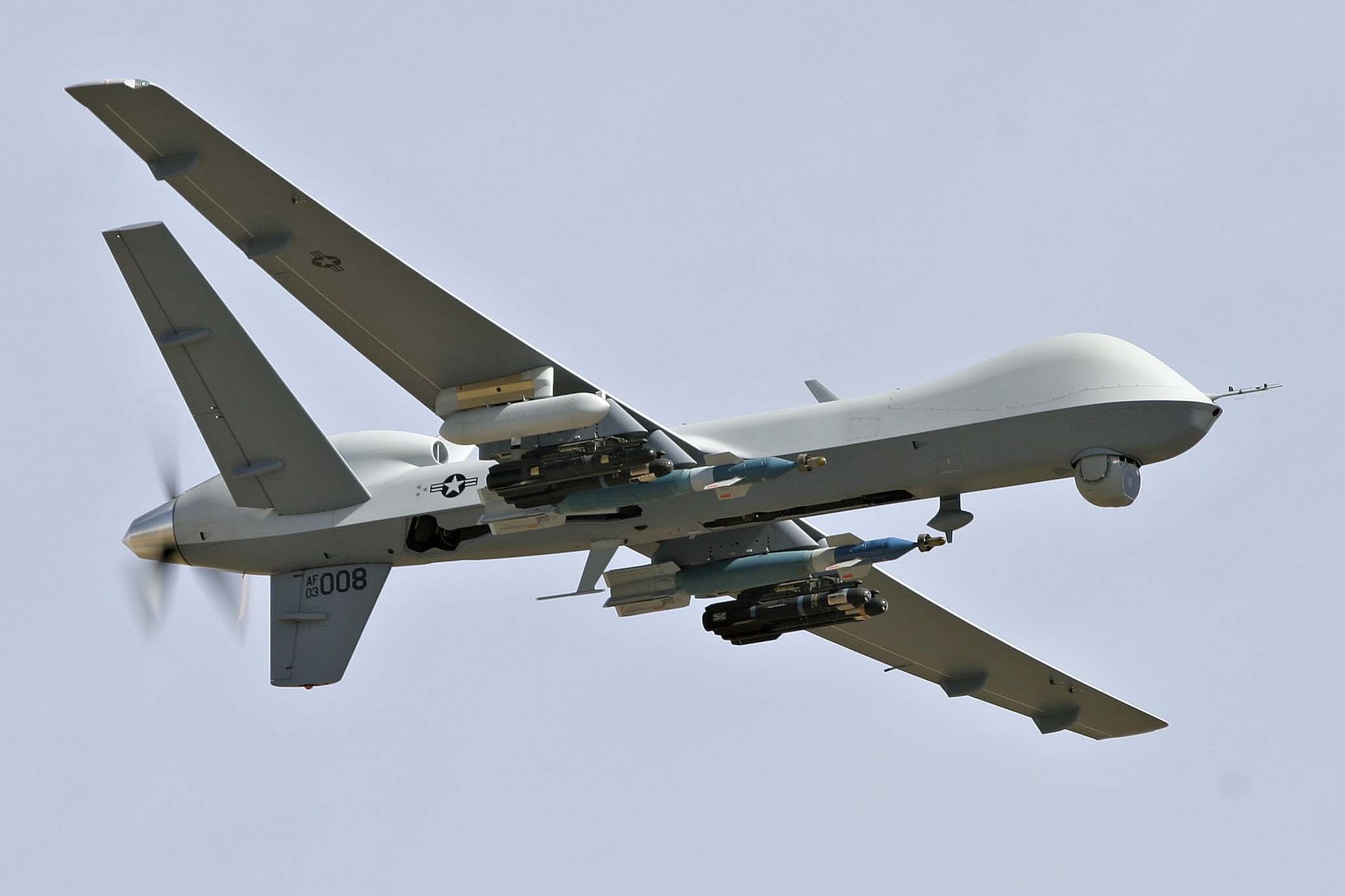
WASHINGTON: China’s newest drone, the Caihong 5, appeared in last night’s huge military parade in Beijing. Chinese media are comparing the Medium Altitude Long Endurance (MALE) drone to America’s MQ-9 Reaper, which with up to four Hellfire missiles and two 500-lb. precision-guided bombs under its wings is the baddest drone known.
(Today’s parade is ostensibly put on to celebrate the 70th anniversary of “victory in the Chinese People’s War Against Japanese Aggression” — better known to English speakers as the end of World War II. The fact is, China did relatively little to defeat Japan, since Chiang Kai-shek saved much of the cash and weapons we supplied him during the war to try and defeat Mao Zedong’s Communist army once the other allies defeated Japan. The Editor)
To the untrained eye the two drones may look a hell of a lot alike. But we hear from experts who cannot be named that the similarities between the Caihong 5 and the Reaper are at best superficial. Our experts work on black drone programs and can’t speak on the record.
The Caihong 5 has both a radome nose and an upward pointing V-tail like the Reaper, and its 66 foot wingspan is exactly the same as the American drone. According to Chinese media, the Caihong 5’s maximum gross takeoff weight is about 6,000 lbs., well below the Reaper’s 10,500 lbs., and Beijing’s Reaper knockoff has a reported maximum payload of 900 kilograms (1,984 lbs.), far less than the MQ-9’s combined payload of 3,000 lbs. external and 850 lbs. internal. The Reaper’s combined payload is about 1,749 kilos, nearly double the Caihong 5’s.
But that tale of the tape is just as superficial as the Caihong 5’s resemblance to the Reaper.
“There is no magic to building these vehicles,” said one expert who played a key role in developing the smaller Predator (Reaper’s father), the General Atomics Aeronautical Systems Inc. drone whose unprecedented endurance of more than 24 hours airborne broke the mold in unmanned systems. “The magic is in getting them to do what you want them to do when and where you want them to do it.”

MQ-9 Reaper heavily loaded
The Caihong 5’s manufacturer, China Aerospace Science and Technology Corporation, told Chinese media their drone can carry six missiles and stay airborne 30 hours, which is significantly more than the Reaper’s usual endurance of 18 to 27 hours, depending on what it carries. Chief designer Ou Zhongming said the Caihong 5 also has a “powerful wall-penetrating radar (that) would change the way that military drones are used in counterterrorism missions.”
Maybe, but don’t believe it til you see it. “There is stuff like that out there, but it’s not very mature,” one expert said. In any event, this person added, “They don’t have any kind of similar sensor or weapons capability” to the Reaper.
Duplicating external hardware is one thing; duplicating the internal software that allows Predator and Reaper operators to track and attack targets on the other side of the globe would be a (don’t miss this reference) great leap forward for the Chinese indeed. It isn’t as simple as signing up for satellite TV. Even many drone “experts” don’t realize that the U.S. system of Remote Split Operations, as it’s called, relies on fiber optic cable to carry control and data signals to and from the United States to satellite earth links in Europe and then on to Predators and Reapers. That’s the only way the delay in the signal can be held to the necessary maximum of 1.3 seconds or less.
How much thought the Chinese may have devoted to capabilities like that is unclear, of course, but judging by the Caihong 5’s outward appearance, “It’s obvious they didn’t think real hard on being original,” one Reaper expert said.
How the “Rainbow” got its name is unclear, but the Reaper got its name more or less by happenstance, as I learned at a 2010 ceremony dedicating installation of the second MQ-9 in the Air Force Museum in Dayton, Ohio.
In 2006, as Air Combat Command was trying to come up with a name for what until then had been the “Predator B,” Lt. Col. Jonathan Greene, first commander of the first squadron to use the MQ-9,  was asked to weigh in.
“They couldn’t come up with a name that they liked,” Greene told me in 2010. “So they were asking me down at the squadron level what I thought. I provided a few names, like Demon. I was trying to think along the ‘Predator’ line, in the same vein as ‘Predator.’” Then Greene spent a weekend with his father in New Mexico and asked him for ideas. “I said, ‘Hey, we’re trying to come up with the name for this aircraft. Everybody’s racking their brains.’ He said, ‘Well, what about Reaper, like Grim Reaper?’ I said, ‘Yeah, that sounds great.””  Greene said he submitted the name to Air Combat Command the following Monday.
The chief of staff at the time, Gen. T. Michael “Buzz” Moseley, loved it.
“ACC brought it to me and I immediately approved it,” Moseley recalled. The name Reaper “has got the panache. It’s got kind of a classic combat aircraft name to it. And it does kind of paint a picture of what we’ve been tasked to do.”


Thursday, 25 July 2013

China Set To Grab UAV Market While US Restricts Sales

on June 14, 2013 at 1:16 PM
Chinese UAV image
PARIS: Psst. Hey mister. Wanna buy a UAV? China’s got drones for shooting, drones for intelligence, surveillance and reconnaissance, and drones for target practice. Cheap prices and no arms export restrictions.
And China may grab a significant share of the international market for just those reasons, according to a new report by the U.S-China Economic and Security Review Commission. Breaking Defense obtained a copy of the report: China’s Military Unmanned Aerial Vehicle Industry
The irony would be, of course, that the United States has largely created that demand by demonstrating the utility of drones (UAVs, Remotely Piloted Aircraft — RPAs — pick your term) in Afghanistan, Pakistan, Yemen, Iraq and other locales over the last decade.
Here’s what the report’s author, Kimberly Hsu, concludes:
“Surging domestic and international market demand for UAVs, from both military and civilian customers, will continue to buoy growth of the Chinese industry. Chinese defense firms do not face the same export restrictions as top UAV-exporting countries, such as the United States and Israel. As a result, China could become a key UAV proliferator, particularly to developing countries.”
Currently, the great majority of Chinese drones are tactical, but Hsu says that “in the long term, China’s continued interest and progression in strategic-level UAVs appear poised to position China as a leader in the high-end UAV market.” A major reason is that China is not a member of either the Missile Technology Control Regime (MTCR) or the looser but broader Wassenaar Arrangement. “In the absence of competition from more sophisticated U.S. or Israeli alternatives, China could become a key proliferator to non-members of the MTCR or Wassenaar,” she concludes.
Just what drones is China building? Well, the report notes there isn’t much information available about the PLA’s efforts. Hsu says that China, “probably is developing and operating UAVs for electronic warfare (EW).” These would “probably would focus on jamming tactical communications and global positioning system (GPS), but could provide a range of other capabilities, including false target generation against enemy Airborne Warning and Control Systems (AWACS)/Airborne Early Warning (AEW) and power grid attack.”
On top of that, several Chinese government owned defense firms are also developing killer drones in the vein of our Predator or Reaper. “It is not clear if China intends to use UCAVs in an air-to-air or an air-to-ground role,” Hsu writes.
In addition to state-owned enterprises, several of China’s top engineering universities are working on drones.
On the civilian side, China has already demonstrated use of indigenous drones for earthquake relief efforts after the May 2008 and April 2013 earthquakes in Sichuan province, according to the report. And the rough Chinese equivalent of the Coast Guard and harbor police “are integrating UAVs into their operations.
All in all, China’s policy of not participating in what it would doubtless call hegemonic restrictions on its actions — MTCR, Wassenaar — coupled with its willingness to sell to pretty much anybody who can buy their weapons, places it in a prime position to benefit, just as Europe benefited from America’s decision to sharply restrict satellite sales and their components to foreign countries.