Showing posts with label fiery cross reef. Show all posts

Thursday, 21 February 2019

Cost of conflict in South China Sea 'too high'

China and several Southeast Asian countries, including Vietnam, the Philippines, Indonesia and Malaysia, have competing claims over territorial waters in the South China Sea (SCS). In recent years, Beijing has been building airstrips and hangars, as well as stationing anti-aircraft and anti-missile systems in the Spratly Islands — a collection of reefs and rocks located off the coast of the Philippines. 
China claims sovereignty over a large part of the South China Sea, although these claims were rejected by an international tribunal in 2016. The head of the US Pacific Command at the time warned the international community about China's "assertive, aggressive behavior in the South China Sea."
At this year's Munich Security Conference, Singapore's Defense Minister Ng Eng Hen spoke to DW about the importance of multilateral cooperation and transparency between countries in avoiding conflict. 
DW: The South China Sea has been a flashpoint for quite some time. In case of an all-out military confrontation, what could Singapore do to diffuse tensions?
Ng Eng Hen: I don't think an all-out confrontation will take place. All the parties involved — the claimant states and the international community — recognize that the price is too high and the issues in the South China Sea do not warrant an actual physical confrontation.
Having said that, it doesn't mean there can't be any miscalculations or mishaps. This occurred recently when the [USS] Decatur during a freedom of navigation operation came close to a Chinese ship. We all recognize that there's been dispute over territorial claims of China, the Philippines, Vietnam, Malaysia and Indonesia, with a slight overlap of their exclusive economic zones (EEZs) with the nine-dash line [China's demarcation line in the South China Sea].
All the claimant states have built on the disputed territory. Some argue that China has built more — whatever the case, all have done so. Whatever China has done, whether it's in the Spratlys or the Paracels, has allowed them to operationalize their forward defense line. It's now some 800 kilometers (500 miles) from the mainland coast, with intelligence, surveillance, reconnaissance capabilities, extended runways, which can accommodate their planes including aircraft and fighter jets. The features on the South China Sea have point defense systems. I doubt if anyone is thinking of pushing the Chinese off.
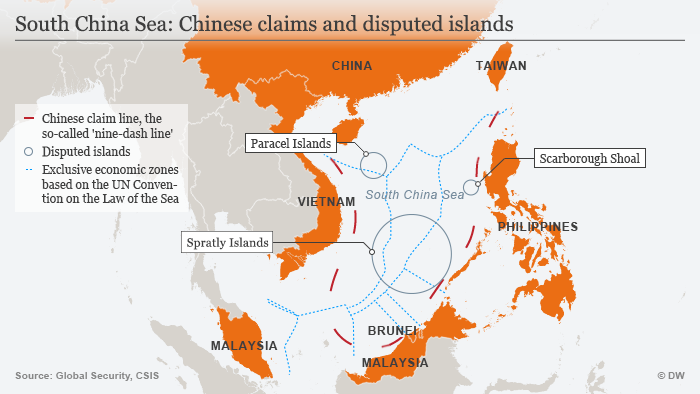
Infografik Karte South China Sea: Chinese claims and disputed islands

Are you worried about it? Do you think it could also endanger Singapore's security?
Not Singapore's security, but you know the South China Sea is one of the busiest sea lines of communication, carrying a sizeable load of global trade and functioning as a maritime passage for oil — a strategic asset. But all the countries know that. So it's not so worrisome for Singapore. They will be careful not to precipitate any confrontation. In fact, on the ground, there have been some incidents, but on a historical scale and compared to some other regions, it's significantly less.
Do you think China's belligerence and increasing hegemony could pose a challenge to other countries as well?
That's an opinion. From China's perspective, they term it a peaceful rise, which they want other countries to participate in and to that extent, I think there is some truth to it. For the past decade, in the aftermath of the global financial crisis, when Europe and America were in economic doldrums, it was Chinese growth that sustained Asia.
I remember meeting a group of businessmen at the time, including American and European businessmen, and asking them: "Where would you have liked to be in this decade?" Three of them said Asia. So I wouldn't mischaracterize China's role. We recognize China's claims on the nine-dash line, as well as the arbitral ruling that the Philippines brought upon the Chinese, making a declaration in terms of claims and what the features are entitled to. The Chinese approach has been to establish a code of conduct with the claimant states and with the Association of Southeast Asian Nations (ASEAN).
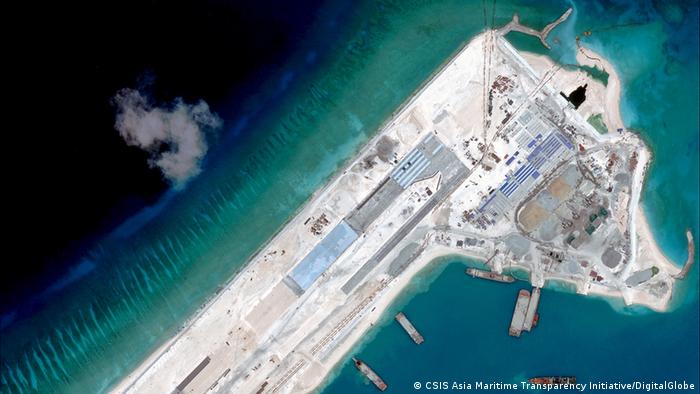
China Expansionspolitik in Südchinesischem Meer

BEIJING'S ISLAND-BUILDING IN THE SOUTH CHINA SEA

Runway

China is expanding the construction of its facilities on Fiery Cross Reef. Provided by the Asia Maritime Transparency Initiative (AMTI), this June 28, 2015 photo reveals Beijing has nearly completed a 3,000 meter (9,800-foot) airstrip, long enough to accommodate most Chinese military aircraft. Two helipads, up to 10 satellite communications antennas, and one possible radar tower are also visible.

ASEAN appears to be a bit split on the South China Sea issue. What role can Singapore play to help the regional players find common ground?
There's been the declaration of conduct, which preceded the code of conduct, signed by all ASEAN leaders and China in 2012. There has been a consensus statement with the defense and foreign ministers of ASEAN, who consistently declare their resolve for the dispute to be settled by peaceful means and respect for international law.
As to the role Singapore can play: we take a very practical approach. When Brunei had the chair [at ASEAN], we persuaded them to hold an 18-nation maritime exercise, and we succeeded in doing that. This was also an exchange of ten ASEAN countries plus eight others.
Recently, as chair, Singapore facilitated the first ASEAN-China maritime exercise — in China. I think our approach is that you have to increase these engagements to reduce the risk of miscalculation. The ASEAN defense ministers' meeting has also set up hotlines so that you can deescalate.

DW
  • Date 18.02.2019
  • Author Shamil Shams (Interview)

Wednesday, 18 January 2017

China’s artificial islands -How they do it?

Will Nicol
Digital Trends  

Tuesday, 5 January 2016

South China Sea tensions surge as China lands plane on artificial island

SOUTH-CHINA


BEIJING: China’s first landing of a plane on one of its new island runways in the South China Sea shows Beijing’s facilities in the disputed region are being completed on schedule and military flights will inevitably follow, foreign officials and analysts said.
China’s increasing military presence in the disputed sea could effectively lead to a Beijing-controlled air defense zone, they said, ratcheting up tensions with other claimants and with the United States in one of the world’s most volatile areas.
Chinese foreign ministry officials confirmed on Saturday that a test flight by a civilian plane landed on an artificial island built in the Spratlys, the first time Beijing has used a runway in the area.
Vietnam launched a formal diplomatic protest while Philippines Foreign Ministry spokesman Charles Jose said Manila was planning to do the same. Both have claims to the area that overlap with China.
“That’s the fear, that China will be able take control of the South China Sea and it will affect the freedom of navigation and freedom of overflight,” Jose told reporters.
China has been building runways on the artificial islands for over a year, and the plane’s landing was not a surprise, although it will almost certainly increase tensions.
The runway at the Fiery Cross Reef is 3,000 meters (10,000 feet) long and is one of three China was constructing on artificial islands built up from seven reefs and atolls in the Spratlys archipelago.
The runways would be long enough to handle long-range bombers and transport craft as well as China’s best jet fighters, giving them a presence deep into the maritime heart of Southeast Asia that they have lacked until now.
Work is well underway to complete a range of port, storage and personnel facilities on the new islands, U.S. and regional officials have said.
Fiery Cross is also expected to house advanced early warning radars and military communications facilities, they said.
Chinese officials have repeatedly stressed that the new islands would be mostly for civilian use, such as coast guard activity and fishing research.
Foreign ministry spokeswoman Hua Chunying said at the weekend that the test flight was intended to check whether the runway met civilian aviation standards and fell “completely within China’s sovereignty”.
Leszek Buszynski, a visiting fellow at the Australian National University’s Strategic and Defence Studies Centre, said he believed military landings on the islands were now “inevitable”.
An air defense zone, while unlikely soon, was feasible and possible in future once China’s built up its air strength.
“The next step will be, once they’ve tested it with several flights, they will bring down some of their fighter air power – SU-27s and SU-33’s – and they will station them there permanently. That’s what they’re likely to do.”
De Facto Defence Zone
Ian Storey, a South China Sea expert at Singapore’s ISEAS Yusof Ishak Institute, said he expected tensions to worsen as China used its new facilities to project power deeper into the South China Sea.
Even if China stopped short of formally declaring an Air Defence Identification Zone, known as an ADIZ, Beijing’s need to protect its new airstrips and other facilities could see it effectively operating one.
“As these facilities become operational, Chinese warnings to both military and civilian aircraft will become routine,” Storey said.
“These events are a precursor to an ADIZ, or an undeclared but de facto ADIZ, and one has to expect tensions to rise.”
Hua, the Chinese foreign ministry spokeswoman, said on Monday that there were no immediate plans for an ADIZ in the South China Sea.
“As for whether China will establish an ADIZ, the decision will be based on our judgment of the situation and our needs,” she aid, adding that Beijing respected other nations’ rights to international freedoms of navigation and overflight.
China claims most of the South China Sea, through which more than $5 trillion of world trade ships every year. Vietnam, Malaysia, Brunei, the Philippines and Taiwan have rival claims.
The United States has no claim in the South China Sea, but has been highly critical of China’s assertiveness and says it will protect freedom of navigation.
China sparked condemnation from the United States and Japan in late 2013 when it declared an ADIZ over the East China Sea, covering uninhabited islands disputed with Tokyo.
Chinese officials have reserved their right to do the same in the South China Sea but have said the conditions do not warrant one yet.
However, regional military officials say they are logging increased warnings to aircraft from Chinese radio operators, including some from ground stations on Fiery Cross reef.
-Reuters

Vietnam protests after China lands plane on disputed Spratlys

January 3, 2016


HANOI: Vietnam formally accused China of violating its sovereignty and a recent confidence-building pact on Saturday by landing a plane on an airstrip Beijing has built on an artificial island in a contested part of the South China Sea.
Foreign Ministry spokesman Le Hai Binh said the airfield, had been “built illegally” on Fiery Cross Reef in the Spratly archipelago, in territory that was “part of Vietnam’s Spratlys”.
China’s Foreign Ministry rejected the complaint, saying that what was a test flight to the newly built airfield on the reef, which China calls Yongshu Jiao, was a matter “completely within China’s sovereignty,” the Chinese state news agency Xinhua reported.
The United States said it was concerned that the flight had exacerbated tensions.
Washington has criticized China’s construction of artificial islands in the South China Sea and worries that Beijing plans to use them for military purposes, even though China says it has no hostile intent.
Pooja Jhunjhunwala, a spokeswoman for the US State Department, said there was “a pressing need for claimants to publicly commit to a reciprocal halt to further land reclamation, construction of new facilities, and militarization of disputed features.”
“We encourage all claimants to actively reduce tensions by refraining from unilateral actions that undermine regional stability, and taking steps to create space for meaningful diplomatic solutions to emerge,” she said.
Chinese Foreign Ministry spokeswoman Hua Chunying said China used a civil aircraft to conduct the flight to test whether the airfield facilities meet civil-aviation standards.
“China has indisputable sovereignty over the Nansha Islands and their adjacent waters. China will not accept the unfounded accusation from the Vietnamese side,” she said, referring to the Spratly’s by their Chinese name.
Hua added that China hoped Vietnam could work to achieve “sustainable, healthy and stable” development of bilateral ties.
Hanoi’s Foreign Ministry said Vietnam handed a protest note to China’s embassy and asked China not to repeat the action.
It called the flight “a serious infringement of the sovereignty of Vietnam on the Spratly archipelago”.
China claims almost all the South China Sea, which is believed to have huge deposits of oil and gas, and through which about $5 trillion in ship-borne trade passes every year, and has been building up facilities on the islands it controls.
It completed an airfield on Fiery Cross Reef that security experts say could accommodate most Chinese military aircraft late last year.
Brunei, Malaysia, the Philippines and Taiwan also have rival claims in the South China Sea.
– Reuters