Showing posts with label strategy. Show all posts

Wednesday, 4 January 2017

2016 - China Arising

what is the most interesting story in 2016?

I pick 1 topic - CHINA. In the presence of her military, in economic, China footprint was very clear and determine. The message was also loud.. I'm coming and nobody can stop me.
WASHINGTON: Leading Republicans hastened today to denounce China’s deployment of anti-aircraft missiles to the South China Sea. But what can the US actually do about it? The arrival of the sophisticated HQ-9 missiles in the Paracel islands — claimed by Vietnam and Taiwan but occupied by China — is just the latest step in Beijing’s steady extension of military power into the Pacific, and it won’t be the last.
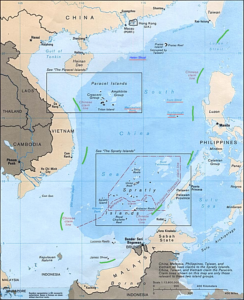
While America reacts, struggling to figure out each move, China is pursuing a long-term strategy. The Chinese have claimed the whole South China Sea, based on the notorious Nine Dash Line drawn on the map by the Chiang Kai-Shek government they ousted in 1949. Now they’re gradually filling in that area with actual capability to control it — and they’d be doing so regardless of what the US was doing.
Yes, the Paracels are where a US Navy destroyer conducted a Freedom Of Navigation Operation (FONOPS) last month challenging Chinese territorial claims. But was that operation the cause of the Chinese deployment or just a pretext for it? Two leading experts from different parts of the political spectrum both told me: pretext.
John McCain
John McCain
“The Chinese are pointing to the US operations — the FONOPS and our increased exercises in the region — and trying to pin blame on the United States. It’s a convenient justification,” said Bonnie Glaser of the militantly centrist Center for Security & International Studies. “This is really part of a plan that the Chinese have to put in place capabilities that will enable them to exert greater control over airspace and sea-space.”
External events like American operations, the recent electoral victory of Taiwan’s pro-independence party, and the just-concluded Association of South-East Asian Nations (ASEAN) summit in California may have shaped the timing and tactics of Chinese actions, said Dean Cheng of the conservative Heritage Foundation. But what’s driving the decisions is a long-term strategy to dominate the South China Sea and president Xi Jinping‘s determination to appear a strong champion of Chinese nationalism.
To the extent that political factors matter, it’s internal Chinese politics rather than geopolitics between China and the US. “The next party congress is next year, Xi Jinping is going to be replacing a whole lot of senior leaders, and the economy is slowing down,” Cheng told me. “He cannot afford to look weak.”
“The Chinese are making clear that the Paracels are theirs, both symbolically and militarily. You might as well put ‘Molon Labe‘ [‘come and take them’] on them,” Cheng said. “This is consistent with the broader Chinese effort to establish control over the South China Sea.”
(Wikimedia Commons)
The “9-dash line” describing Chinese claims to the South China Sea
The Military Significance of the Paracels
So why the Paracels in particular? First, they’re simply closer to mainland China than the also-disputed Spratly Islands. China’s been there longer, having seized them from then-South Vietnam in 1974 (and having fought there with Communist Vietnam in 1988). Second, whereas some of the Spratlys are occupied by the Philippines, the Paracels are completely under Chinese control.
The Paracels were also conveniently excluded from Xi’s carefully worded pledge not to militarize the region, Glaser told me. The pledge only covered the Spratlys — though, she added quickly, “that’s not to say Xi Jinping may not in the future militarize the Spratlys as well.”
“Militarization of the Paracels has been underway for years,” Glaser said. “What’s new here is advanced Chinese capabilities catching up with what have been long-standing claims of sovereignty.”
In the Paracels specifically, they have built a military-grade runway on Woody Island, complete with hardened hangers to resist bombardment. They’ve operated fighter aircraft there, most recently in November in response to US freedom of navigation operations. Now they’ve deployed two advanced surface-to-air missile batteries on Woody Island to protect their investment. “It’s not surprising,” Glaser said.
“The S-300/HQ-9 is a nasty piece of work,” said Cheng. The Chinese HQ-9 anti-aircraft missile system derives from the Russian S-300 — aka the SA-10, a world-class “double digit SAM” — but adds infusions of technology from the American Patriot (helpfully provided by Israel in the 1990s).
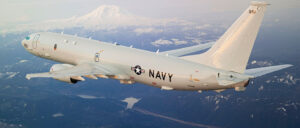
“It essentially projects an air defense keep-out zone that only the most advanced fighters and systems would dare enter,” Cheng says. “If you’re going to fly in those areas, there’s going to be a whole lot of pucker factor, and that’s true for high-performance fighter planes, never mind lumbering planes like P-3s and P-8s,” the long-range patrol aircraft typically used to reconnoiter Chinese bases.
Former Navy Undersecretary Bob Martinage was less concerned — for now. “In isolation, the apparent deployment of an HQ-9 air defense system to Woody Island has marginal operational significance,” he told me. “In the event of a conflict, it would pose a limited threat to air lines of communication in the vicinity, but could be quickly overwhelmed and neutralized. In peacetime, US reconnaissance aircraft” — mainly meaning those P-3s and P-8s — “operating within roughly 100 miles will now do so under constant threat, which may reduce crisis stability.”
But the deployment has much wider significance if it’s one step in a larger strategy, Martinage continued, “especially if this is a trial balloon to see how the United States and other regional states react….The deployment of large numbers of long-range surface-to-air missiles and anti-ship cruise missiles more widely across the South China Sea would be destabilizing, increase the threshold for US intervention in a crisis (or increasing the chances that the US would be self-deterred), and have significant operational ramifications.” Any one outpost might be manageable in isolation, but together they would form the kind of “anti-access/area denial” network that Martinage’s home institution, the Center for Strategic and Budgetary Assessments, has long warned about.
US Navy P-8 Poseidon
Next Steps For China
So if the Paracels deployment is just one step in a long-term plan, what’s next?
“We should be fully prepared and expect that the Chinese will then move on to the third of the ‘Three Sands,'” Cheng said. To assert its claims over the South China Sea, Beijing created a prefecture on Hainan Island to exercise jurisdiction over the entire area. The name of this prefecture translates to “Three Sands,” referring to the Paracels (West Sands), Spratlys (South Sands), and the Macclesfield Bank/Mischief Reef area (Middle Sands). The Chinese already have airstrips and other facilities in both the Paracels and the Spratlys, so the Middle Sands are next.
“[Expect] island building and all the rest in the Macclesfield Bank area,” Cheng said. “At that point, if you look at the map, you now have a triangle of outposts that have airfields, SAM batteries, etc. You’re not going to go into the South China Sea lightly.”
“They may declare an Air Defense Identification Zone (ADIZ) over a portion of the South China Sea,” said Glaser, probably starting with the Paracels. The Chinese already declared an ADIZ in the East China Sea over the Senkaku/Diaoyu islands, contested with Japan, in 2013. A preliminary sign the Chinese planned such a move in the South China Sea might be their declaring legal “baselines” for their territorial claims around the Spratlys, which they’ve already done for the Paracels — in a way that US and other international observers consider excessive.
Rep. Randy Forbes
Rep. Randy Forbes
Next Steps for the US?
So what can the US do to throw a wrench in Beijing’s works? The chairmen of the Senate Armed Services Committee and the House seapower subcommittee certainly have suggestions.
“At the very time China is pronouncing its commitment to regional stability at an international conference in California, the deployment of these weapons on a disputed island should further dispel any confusion about China’s determination to play a destabilizing role in the region,” said Rep. Randy Forbes, HASC seapower chairman, in a statement this afternoon. “The United States and its partners must continue to steadfastly uphold freedom of navigation and overflight and the rule of law.”
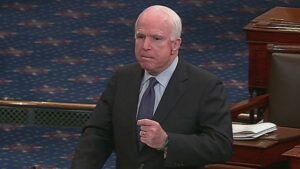
SASC chairman John McCain went further. “China’s actions in the South China Sea this week demonstrate Beijing’s continued desire to resort to militarization and coercion,” the former Navy pilot fumed in a statement. “The United States should consider additional options to raise the costs on Beijing’s behavior. Declarations that we remain committed to what amounts to an ever-changing status quo and conducting occasional freedom of navigation operations are inadequate. The day-to-day system management that is required to actually shape Beijing’s actions will mean adopting policies with a level of risk that we have been unwilling to consider up to this point.”
What kind of higher risks are we talking about? McCain didn’t specify, but our expert analysts had some ideas.
“This is China inviting the United States to climb the escalation ladder and destabilize the region,” said retired Navy captain Jerry Hendrix. “What they want the United States to do is just accept them and allow those things to be there without protest; however, that’s not acceptable, and we’ve made that clear.”
“We need to think about diplomatic and political approaches to impose a cost on the Chinese,” Cheng said. “So far no one has made the Chinese pay a price for their activities”: No one’s cancelled a major contract or un-invited them from an international conference. Indeed, Cheng noted sourly, the Chinese have been invited back to the Navy’s Rim of the Pacific (RIMPAC) exercises. The Pentagon has argued repeatedly that such military-to-military contacts reduce the chance of deadly misunderstandings in a crisis and should not be cancelled just to show show political displeasure.
Army photo
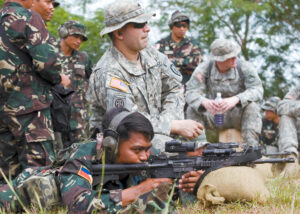
US Army soldiers train their Filipino counterparts.
“The first thing is to not let up on FONOPS and the like,” Cheng said, as we did for three years, from 2012 through 2015. “We cannot give in [to] this idea that it’s their territorial waters…. That’s not acceptable. It throws the entire concept of international law in the trash bin.”
“Ideally, it means getting friends and allies to cooperate with us,” Cheng continued. “ASEAN is a very weak reed” — some members are landlocked with little interest in maritime disputes, others are Chinese clients — “but you may be able to create a coalition of the concerned.” Vietnam and the Philippines would be anchor members, both having bitter territorial disputes with China, but more neutral Indonesia and cautious Singapore could join in as well.
Convincing countries to stand up to China, however, runs into a “who bells the cat” problem: Almost everyone wants the job done, but no one wants to run the risks of doing it. “Some countries are very happy that the US is doing what it’s doing but they don’t’ want themselves associated with it,” Glaser said with a laugh. “That’s not surprising because any country that criticizes China may pay a price.”
Worse, so far no freedom of navigation operation, no ASEAN declaration, no legal case in the Hague, “none of these steps appears to have deterred China,” Glaser said. “All the countries in the region are worried….that regardless of what the US does, nothing can really stop China from militarizing its land features, not only in the Paracels but also in the Spratlys.”
on December 28, 2016 at 8:00 AM

Monday, 20 July 2015

MH17 - The Malaysian Jet

2 Overlooked Clues in Malaysian Jet Shoot Down

on July 18, 2014 at 11:02 AM
1280px-9M317_surface-to-air_missile_of_Buk-M2E


[UPDATED 2:10 pm with comment from President Obama & Pentagon spokesman Kirby] Western media are hardly going easy on Russia. But in all the often-excellent coverage I’ve read so far of the Malaysian Airlines Flight 17 disaster – which claimed 295 lives – no one* is pointing out two basic facts that point towards Russia and its separatist proxies:
1) MH17 was flying eastwards.
2) The Russian-backed rebels don’t have an air force.
For our latest on the Ukraine crisis and Malaysian Airlines Flight 17, read MH17 Tragedy Strengthens European Spines To Sanction Russia: UK Ambassador
Both these factors make it extremely unlikely Ukrainian government forces shot down the airliner. It’s not that Ukrainian troops are incapable of such a horrific mistake: Theyaccidentally shot down a Russian jetliner during a military exercise in 2001, killing 78 people, and frankly the Ukrainian military’s skills have only degenerated since. Even the well-trained US Navy shot down an Iranian airliner in 1988, killing 290, because, amidst high tensions in the Gulf, the USS Vincennes mistook the approaching airliner for an attack plane.
But context matters. First, from a Ukrainian perspective, MH17 was flying from friendly, government-controlled territory towards rebel-held territory and Russia. That outbound vector would make it much harder for an anxious, trigger-happy Ukrainian air defense officer to mistake it for an incoming attack. From the perspective of a separatist or Russian gunner, however, MH17 was inbound from enemy territory.
Second, Ukrainian air defenses haven’t been shooting at anything so far this war because they haven’t had anything to shoot at. Russia has given the separatists weaponry, evenrocket launchers and main battle tanks, but the rebels still don’t have aircraft. Russia itself does, of course, and Kiev claims a Russian aircraft shot down a Ukrainian Su-25 fighter Wednesday, so Ukrainian air defense units probably are now watching the skies more nervously than before (although, again, they would be watching for aircraft flyingwestwards).
But Russian-backed separatists have an actual track record of shooting down Ukrainian government aircraft, including a large-bodied AN-26 transport. A Ukrainian military AN-26doesn’t look particularly like a Malaysian Airlines Boeing 777: It’s much smaller, with straight wings and propellers, in contrast to the larger, swept-wing jet. But the two look much more like each other than either looks like, say, a fighter plane, especially on radar where details of shape would be obscured. And, notoriously, a separatist commander (and suspected Russian operative) known as Col. Igor Strelkov tweeted a claim the rebels had shot down an AN-26 just after MH17 crashed – a post later deleted.
If rebel forces did fire the fatal missile, however, their regular shoulder-launched weapons couldn’t have reached the high-altitude airliner: They would have had to use a more sophisticated anti-aircraft system such as the Russian-made Buk (in English, “Beech”; NATO codenames “SA-11 Gadfly” and “SA-17 Grizzly” depending on the variant). AP reporters have seen a Buk in rebel hands, and the rebels themselves claimed to have captured one from Ukrainian government forces. With ex-Soviet, ex-Ukrainian, and ex-Russian military personnel in their ranks, it’s quite possible they had enough former air defense troops to get the Buk working – although they would not have had a supporting infrastructure of command, control, and sensor networks to help them distinguish hostile from friendly aircraft.
It is also possible that Russian operatives sent by Moscow were working the advanced equipment on the rebels’ behalf. I personally think it unlikely (not impossible) that the highly centralized Russian military would have opened fire by accident – but personnel loaned to the Ukrainian separatists would be operating outside the usual safeguards.
[UPDATE: At a press conference this afternoon, the Pentagon’s top spokesman, Rear Adm. John Kirby, demurred on most questions about the tragedy, citing the ongoing investigation, but he did make some blunt statements.
“The SA-11 [missile], the one we believe was used to down Flight 17, is a sophisticated piece of technology,” Kirby said. “It strains credulity to think it could be used by separatists without at least some measure of Russian support and technical assistance.”
That could include the training of separatists on “vehicle-borne” anti-aircraft systems, which European Command chief Gen. Philip Breedlove has said has already happened on Russian soil. Or it could be Russian personnel working for or with the separatists. “We don’t know,” said Kirby. 
But the US is now confident that the missile that downed MH-17 was fired from separatist-controlled territory, Kirby said — a statement so damning that I felt compelled to email the admiral to confirm I heard it correctly (he said I had). President Barack Obama said the same thing.]
Those of us – myself included – who have long been suspicious of Putin’s Russia should be careful not to rush to judgment. But the circumstantial evidence so far makes it highly unlikely the blame falls on Ukraine.

The analysis in this article represents my personal judgment and not any official position of Breaking Defense. — Sydney J. Freedberg Jr.


MH17 Tragedy Strengthens European Spines To Sanction Russia: UK Ambassador

on July 21, 2014 at 5:31 PM
THE WATERGATE: United we stand, Great Britain’s ambassador to the US insisted today. Despite all the strains on the Atlantic alliance — post-Snowden backlash against American spying, rising anti-EU sentiment in Britain, German dependence on Russian energy — the US, the UK, and their continental European allies stand together against what he called Russian “hybrid warfare” in Ukraine, Sir Peter Westmacott said this afternoon. In fact, he said, the downing of Malaysian Airlines Flight MH17, most likely by Russian proxies, has convinced even some of the more reluctant partners of the need to tighten sanctions.
“We have been genuinely joined at the hip,” Amb. Westmacott told me after his public remarks here at the offices of DefenseOne. “The entire response to what’s going on in Ukraine is something which we have all sought to make as trans-Atlantic as possible. [There have been] a fantastic number of telephone conversations between political leaders, on the same page: ‘This is terrible, what are we going to do about it?'”
That hardly means that unity on Ukraine erases differences on other issues. Only four NATO members — the US and UK among them — meet the alliance target for spending at least 2 percent of GDP on defense, a longstanding source of resentment in the US and a chronic worry for the Brits as well. Conversely, the Europeans’ new fear of the Kremlin has hardly made them forget their new fear of Fort Meade, home of the National Security Agency monitoring network that eavesdropped on both ordinary Europeans and their leaders, including German Chancellor Angela Merkel herself. Indeed, Germany, the economic heart of Europe, has reacted with particular bitterness, and for good reason.
“I’m constantly reminded by my German friends that this whole issue of revelations of spying… is something that is taken very seriously in Germany and upsets German public opinion , and that it goes back to the days of the Stasi,” the notorious East German secret police, Amb. Westmacott told me. “It is important that we bear in mind this is not posturing, these are real concerns.”
As genuinely upset as the Germans and others are over American espionage, however, their dismay at Russia’s actions is “in a separate category” altogether, Westmacott went on. “The German response, with the rest of us in Europe, is about outrage at what’s going on,” he said. “It’s about trying to ensure that this behavior is brought to an end. It is about, in the short term, trying to ensure that we get to the facts and deal with the humanitarian aspects of the bodies and victims [of the Flight MH17 shoot-down]. It is also, of course, about trying to ensure that in years to come Europe is not excessively dependent upon Russia,” e.g. for energy.
russian-troops-parade-in-st-petersburg
Mobilizing Europe
In the public Q&A session, Amb. Westmacott modestly played down the idea the UK might play a unique role as intermediary between their bellicose American cousins and their cautious continental neighbors. That said, he told the group at the Watergate, “we have played quite an important role, much of it behind the scenes, in trying to stiffen the backbone of our other European partners who weren’t quite sure that this was the right path.”
Nor is the UK applying this pressure on America’s behalf.  “When we are trying to persuade some of our European partners to be more robust in their response to Russian behavior in Eastern Ukraine, it is not simply because the White House has said to us, ‘please beat up on your European allies,'” Westmacott said. “It is actually because we think it is the right thing to do and the international community must make that stand.”
Europe is working with the US but “looking at what’s going on in Ukraine through the prism of its own interests,” Westmacott told me, not simply following party lines in some new Cold War.
So what next? “There are a number of levers that we have” to turn up the pressure on Russia, the ambassador told the group at the Watergate. “One of the consequences of the terrible event, the shooting down of the Malaysian Airlines aircraft, is that a number of European governments that which been a little wary of going down the sanctions route are going to be more robust.”
Tighter sanctions won’t just hurt Russia, however, especially if they rise to the controversial level of “sectoral” sanctions against, say, the Russian energy or arms industries. (The current approach targets specific individuals and companies). The famous City of London won’t be happy to stop lending money to Russian oil magnates, for example, nor the French shipyards to cancel the sale of two Mistral-class amphibious warships, nor anyone in Germany to pay more for Russian oil and natural gas.
“We know that for us, it will be difficult for the financial services industry,” Westmacott said. “We know that for some of our partners it will be difficult if it’s an arms embargo. We know that for others that energy technology or energy purchases with be painful.” (The ambassador diplomatically declined to name specific countries, unlike me).
Nevertheless, Westmacott said, “we’ve got to make this stand on this joint principle that you can’t allow the playground bully to carry on beating on other children.”

A computer-generated image of a Royal Navy F-35B taking off vertically from the new carrier HMS Queen Elizabeth, which will be commissioned July 4th.
A computer-generated image of a Royal Navy F-35B taking off vertically from the new carrier HMS Queen Elizabeth.
Unshared Burdens and Grounded Jets
As Westmacott also repeatedly mentioned, however, diplomacy is a thin reed without “credible” military power to back it up. That’s where European failure to meet NATO’s two percent target becomes a problem. “We need strong traditional militaries,” the ambassador said, as well as “a subtle array of alternatives,” from intelligence to cybersecurity to diplomacy. “It is not reasonable to continue to expect the United States to continue to bear more than its fair share of costs,” he said, but currently the US spends roughly three times as much as all the other NATO nations combined.
“It’s not just about what is the amount of money you spend, it’s what you do with it,” Westmacott added. “Are you willing to use the equipment you’ve got?….Is [it] the right stuff to deal with current and future threats?…. There are of course countries which spend quite a lot on defense but then don’t actually do anything with what they’ve got.” Those are all crucial questions for September’s NATO summit in Wales, he said.
For its part, the UK has committed to being able to deploy and sustain, indefinitely, a 10,000-strong force at intercontinental distances, including if need be in the Asia-Pacific, the Ambassador said. Central to that power-projection force are the two (enormously expensive)Queen Elizabeth-class aircraft carriers now under construction and their “state-of-the-art F-35s.” But what about the F-35 Joint Strike Fighter‘s chronic cost overruns, delays, and glitches, most recently the engine fire that grounded the entire fleet and caused the plane to miss its scheduled international debut at the Queen Elizabeth’s christening, the Royal International Air Tattoo, and the mammoth Farnborough International Airshow.
“We were obviously disappointed that we didn’t have the F-35s,” Westmacott said. “New products unfortunately have teething troubles, [but] we remain confident in the product, convinced that it’s what we need, proud of the partnership the UK has with the United States, pretty much as a prime contractor.” (In fact, the ambassador emphasized the importance of a “two-way street” in arms sales and joint ventures of all kinds between the US and Europe). When it comes to the F-35, he said, “we are absolutely not wavering our commitment to this enterprise.

Ban introduced on civil flights over zone of military operation in eastern Ukraine

July 8, 2014, 9:06 p.m. | Ukraine — by Interfax-Ukraine

Ukraine's State Aviation Service has extended the ban on civil flights to the entire zone of law enforcement operation in the east of the country, State Aviation Service chief Denys Antoniuk told Interfax-Ukraine on July 8.