Showing posts with label Navy. Show all posts

Monday, 12 July 2021

Defense Maritime Industry In Malaysia : just how bad is the situation ?

Defence Industry

In dialogue and survey session by KPMG involving more than 20 MIDES and VDP companies in February 2021, the most number of complaints submitted was the dire state of the ecosystem. This is as a result of the postponement of the LCS Project and nearly 3 -year -old debts that have not yet paid by BNS. Many of the vendors are in a danger zone due to pressure to clear outstanding payments from suppliers, banks, and government authorities.

MASTRA calls upon the Ministry of Defence Malaysia and the ministry of Entrepreneurs and Cooperatives Development to look into the plight of the entrepreneurs, vendors, and SME's affected by the alleged non-payment. While the government’s efforts in reviving the LCS project are commendable the sustainability of the SME’s must be included in the equation. MASTRA proposes that direct payment to the SMEs be made a precondition of the revival plan.

STRIDE ought to be  under Markas BERSAMA , looking after the interest of all services of MAF , with representative from APMM and Marine Police. Restructure and Reassign STRIDE  for a wider scope of responsibility and accountability. Perhaps jointly with BIP . It must be properly organised with separate  Divisions taking care of Aeronotics, Marine and Automotive. include a 'Proactive' Division for Defence Industry . 

Participations headed by Veteran Senior Officer from Engineering Branch of the  TD, TLDM or TUDM, with council members representing the industry in  Automotive, Marine and Aeronautical Services. 

According to internal sources, STRIDE has no fund to do R&D, past develop project management and events led to loss of confidence in STRIDE's capability in managing innovations , hence sceptics to provide funding.

STRIDE should not continue as the old Defence Research Centre (PSTP) - more for fuel oil and material test labs!


Maritime Industry

MiGHT ought to Review and Audit their Maritime Strategy for 2020 that was published in 2011. They should identify  progress and more importantly shortcomings of the strategy up to this date and propose viable solution through Direct Interaction with in-country marine  technology practioners , and ONLY move forward from there  with  more practical and achievable steps . There were too much Way Forward ! yet if still sluggish to 'MOVE FORWARD' ,  it will not take our National Marine Technology Competencies and Sustainability to ANYWHERE ! So much were left out or ignored, at least over the last decade!

MASTRA suggest there a must change the KPI mentality to PDCA mentality in these agencies, besides Improve Governance. Their role is also governance , Tighten requirements for made in Malaysia and Malaysian products. This must Reflect in tender specification, Encourage integration and systems production.

Maintenance contracts should be given to 100% locally owned companies to promote and strengthen self-reliance. Clean up licensing and registrations. Clean up GLCs. Close the non-strategic collaboration. 

At a time when our ecosystem in bad shape we need to do the needful.

 If OEM still required, they must go through local 'technologically related and competent' companies.

We are aware of the problems exist, so how do we counter this or manoeuvre ourselves in this ecosystem ?

For more almost 15 years since our involvement in the industry in AMIM in 2006, we keep seeing plans after plans being launched by VVIP and yet our industry remains almost as 40 years ago. All these seminar, conference and workshop nicely done and presented documents are just for KPI or show only.

Perhaps the Ministry taking care of Technology. Development and Sustenance , such as MOSTI, and Ministry responsible for survival and progress of SMEs , perhaps MITI, are not fully aware, or indifferent,  on the plight of  Malaysian Marine  Industry ?


from defence industry brain storming group


Wednesday, 4 January 2017

2016 - China Arising

what is the most interesting story in 2016?

I pick 1 topic - CHINA. In the presence of her military, in economic, China footprint was very clear and determine. The message was also loud.. I'm coming and nobody can stop me.


WASHINGTON: Leading Republicans hastened today to denounce China’s deployment of anti-aircraft missiles to the South China Sea. But what can the US actually do about it? The arrival of the sophisticated HQ-9 missiles in the Paracel islands — claimed by Vietnam and Taiwan but occupied by China — is just the latest step in Beijing’s steady extension of military power into the Pacific, and it won’t be the last.
While America reacts, struggling to figure out each move, China is pursuing a long-term strategy. The Chinese have claimed the whole South China Sea, based on the notorious Nine Dash Line drawn on the map by the Chiang Kai-Shek government they ousted in 1949. Now they’re gradually filling in that area with actual capability to control it — and they’d be doing so regardless of what the US was doing.

Yes, the Paracels are where a US Navy destroyer conducted a Freedom Of Navigation Operation (FONOPS) last month challenging Chinese territorial claims. But was that operation the cause of the Chinese deployment or just a pretext for it? Two leading experts from different parts of the political spectrum both told me: pretext.
John McCain
John McCain
“The Chinese are pointing to the US operations — the FONOPS and our increased exercises in the region — and trying to pin blame on the United States. It’s a convenient justification,” said Bonnie Glaser of the militantly centrist Center for Security & International Studies. “This is really part of a plan that the Chinese have to put in place capabilities that will enable them to exert greater control over airspace and sea-space.”
External events like American operations, the recent electoral victory of Taiwan’s pro-independence party, and the just-concluded Association of South-East Asian Nations (ASEAN) summit in California may have shaped the timing and tactics of Chinese actions, said Dean Cheng of the conservative Heritage Foundation. But what’s driving the decisions is a long-term strategy to dominate the South China Sea and president Xi Jinping‘s determination to appear a strong champion of Chinese nationalism.
To the extent that political factors matter, it’s internal Chinese politics rather than geopolitics between China and the US. “The next party congress is next year, Xi Jinping is going to be replacing a whole lot of senior leaders, and the economy is slowing down,” Cheng told me. “He cannot afford to look weak.”
“The Chinese are making clear that the Paracels are theirs, both symbolically and militarily. You might as well put ‘Molon Labe‘ [‘come and take them’] on them,” Cheng said. “This is consistent with the broader Chinese effort to establish control over the South China Sea.”
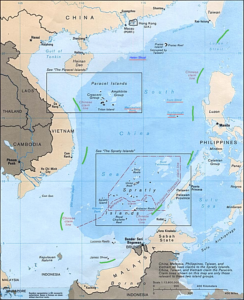
(Wikimedia Commons)
The “9-dash line” describing Chinese claims to the South China Sea
The Military Significance of the Paracels
So why the Paracels in particular? First, they’re simply closer to mainland China than the also-disputed Spratly Islands. China’s been there longer, having seized them from then-South Vietnam in 1974 (and having fought there with Communist Vietnam in 1988). Second, whereas some of the Spratlys are occupied by the Philippines, the Paracels are completely under Chinese control.
The Paracels were also conveniently excluded from Xi’s carefully worded pledge not to militarize the region, Glaser told me. The pledge only covered the Spratlys — though, she added quickly, “that’s not to say Xi Jinping may not in the future militarize the Spratlys as well.”
“Militarization of the Paracels has been underway for years,” Glaser said. “What’s new here is advanced Chinese capabilities catching up with what have been long-standing claims of sovereignty.”
In the Paracels specifically, they have built a military-grade runway on Woody Island, complete with hardened hangers to resist bombardment. They’ve operated fighter aircraft there, most recently in November in response to US freedom of navigation operations. Now they’ve deployed two advanced surface-to-air missile batteries on Woody Island to protect their investment. “It’s not surprising,” Glaser said.
“The S-300/HQ-9 is a nasty piece of work,” said Cheng. The Chinese HQ-9 anti-aircraft missile system derives from the Russian S-300 — aka the SA-10, a world-class “double digit SAM” — but adds infusions of technology from the American Patriot (helpfully provided by Israel in the 1990s).
“It essentially projects an air defense keep-out zone that only the most advanced fighters and systems would dare enter,” Cheng says. “If you’re going to fly in those areas, there’s going to be a whole lot of pucker factor, and that’s true for high-performance fighter planes, never mind lumbering planes like P-3s and P-8s,” the long-range patrol aircraft typically used to reconnoiter Chinese bases.
Former Navy Undersecretary Bob Martinage was less concerned — for now. “In isolation, the apparent deployment of an HQ-9 air defense system to Woody Island has marginal operational significance,” he told me. “In the event of a conflict, it would pose a limited threat to air lines of communication in the vicinity, but could be quickly overwhelmed and neutralized. In peacetime, US reconnaissance aircraft” — mainly meaning those P-3s and P-8s — “operating within roughly 100 miles will now do so under constant threat, which may reduce crisis stability.”
But the deployment has much wider significance if it’s one step in a larger strategy, Martinage continued, “especially if this is a trial balloon to see how the United States and other regional states react….The deployment of large numbers of long-range surface-to-air missiles and anti-ship cruise missiles more widely across the South China Sea would be destabilizing, increase the threshold for US intervention in a crisis (or increasing the chances that the US would be self-deterred), and have significant operational ramifications.” Any one outpost might be manageable in isolation, but together they would form the kind of “anti-access/area denial” network that Martinage’s home institution, the Center for Strategic and Budgetary Assessments, has long warned about.

US Navy P-8 Poseidon
Next Steps For China
So if the Paracels deployment is just one step in a long-term plan, what’s next?
“We should be fully prepared and expect that the Chinese will then move on to the third of the ‘Three Sands,'” Cheng said. To assert its claims over the South China Sea, Beijing created a prefecture on Hainan Island to exercise jurisdiction over the entire area. The name of this prefecture translates to “Three Sands,” referring to the Paracels (West Sands), Spratlys (South Sands), and the Macclesfield Bank/Mischief Reef area (Middle Sands). The Chinese already have airstrips and other facilities in both the Paracels and the Spratlys, so the Middle Sands are next.
“[Expect] island building and all the rest in the Macclesfield Bank area,” Cheng said. “At that point, if you look at the map, you now have a triangle of outposts that have airfields, SAM batteries, etc. You’re not going to go into the South China Sea lightly.”
“They may declare an Air Defense Identification Zone (ADIZ) over a portion of the South China Sea,” said Glaser, probably starting with the Paracels. The Chinese already declared an ADIZ in the East China Sea over the Senkaku/Diaoyu islands, contested with Japan, in 2013. A preliminary sign the Chinese planned such a move in the South China Sea might be their declaring legal “baselines” for their territorial claims around the Spratlys, which they’ve already done for the Paracels — in a way that US and other international observers consider excessive.

Rep. Randy Forbes
Rep. Randy Forbes
Next Steps for the US?
So what can the US do to throw a wrench in Beijing’s works? The chairmen of the Senate Armed Services Committee and the House seapower subcommittee certainly have suggestions.
“At the very time China is pronouncing its commitment to regional stability at an international conference in California, the deployment of these weapons on a disputed island should further dispel any confusion about China’s determination to play a destabilizing role in the region,” said Rep. Randy Forbes, HASC seapower chairman, in a statement this afternoon. “The United States and its partners must continue to steadfastly uphold freedom of navigation and overflight and the rule of law.”
SASC chairman John McCain went further. “China’s actions in the South China Sea this week demonstrate Beijing’s continued desire to resort to militarization and coercion,” the former Navy pilot fumed in a statement. “The United States should consider additional options to raise the costs on Beijing’s behavior. Declarations that we remain committed to what amounts to an ever-changing status quo and conducting occasional freedom of navigation operations are inadequate. The day-to-day system management that is required to actually shape Beijing’s actions will mean adopting policies with a level of risk that we have been unwilling to consider up to this point.”
What kind of higher risks are we talking about? McCain didn’t specify, but our expert analysts had some ideas.
“This is China inviting the United States to climb the escalation ladder and destabilize the region,” said retired Navy captain Jerry Hendrix. “What they want the United States to do is just accept them and allow those things to be there without protest; however, that’s not acceptable, and we’ve made that clear.”

“We need to think about diplomatic and political approaches to impose a cost on the Chinese,” Cheng said. “So far no one has made the Chinese pay a price for their activities”: No one’s cancelled a major contract or un-invited them from an international conference. Indeed, Cheng noted sourly, the Chinese have been invited back to the Navy’s Rim of the Pacific (RIMPAC) exercises. The Pentagon has argued repeatedly that such military-to-military contacts reduce the chance of deadly misunderstandings in a crisis and should not be cancelled just to show show political displeasure.
Army photo
US Army soldiers train their Filipino counterparts.
“The first thing is to not let up on FONOPS and the like,” Cheng said, as we did for three years, from 2012 through 2015. “We cannot give in [to] this idea that it’s their territorial waters…. That’s not acceptable. It throws the entire concept of international law in the trash bin.”
“Ideally, it means getting friends and allies to cooperate with us,” Cheng continued. “ASEAN is a very weak reed” — some members are landlocked with little interest in maritime disputes, others are Chinese clients — “but you may be able to create a coalition of the concerned.” Vietnam and the Philippines would be anchor members, both having bitter territorial disputes with China, but more neutral Indonesia and cautious Singapore could join in as well.
Convincing countries to stand up to China, however, runs into a “who bells the cat” problem: Almost everyone wants the job done, but no one wants to run the risks of doing it. “Some countries are very happy that the US is doing what it’s doing but they don’t’ want themselves associated with it,” Glaser said with a laugh. “That’s not surprising because any country that criticizes China may pay a price.”
Worse, so far no freedom of navigation operation, no ASEAN declaration, no legal case in the Hague, “none of these steps appears to have deterred China,” Glaser said. “All the countries in the region are worried….that regardless of what the US does, nothing can really stop China from militarizing its land features, not only in the Paracels but also in the Spratlys.”
on December 28, 2016 at 8:00 AM

Wednesday, 8 June 2016

Chinese Scarborough Shoal Base

WASHINGTON: If China builds an artificial island on the disputed Scarborough Shoal, Sen. Dan Sullivan warned today, it will complete a “strategic triangle” of bases that can dominate the South China Sea. At this morning’s Senate Armed Services Committee hearing, Sullivan displayed a map (above) of the region overlaid with the ranges of Chinese fighters striking from a triangle of bases on (1) the Chinese island of Hainan, (2) the disputed Spratly Islands, and (3) Scarborough Shoal (as yet unbuilt). The overlapping rings would cover not only almost all the South China Sea, but much of the Philippines and Vietnam.


“Your map’s absolutely accurate,” responded Defense Secretary Ashton Carter. China’s actions are “deeply disturbing to countries in region, which has them all coming to us….We are being increasingly invited to work with countries,” from old allies like Australia, Japan, and the Philippines to new partners like India and Vietnam.
Vietnam has agreed to allow the US Army to preposition equipment for humanitarian responses, in itself a major shift by Hanoi, which has fought multiple wars and skirmishes with its giant neighbor, China. As Sullivan’s diagram shows, almost all of Vietnam is in range of existing Chinese bases.
The US has also expanded its long-standing but often-strained relationship with the Philippines. Under a new Enhanced Defense Cooperation Agreement (EDCA), the two countries announced in March that US forces would have access to five military bases across the country. But as Sullivan’s map makes clear, two of those five bases would be in range of Scarborough-based Chinese fighter-bombers, as would the capital city of Manila.
“Senator Sullivan is right,” said Greg Poling, director of the much-cited Asia Maritime Transparency Initiative (AMTI) at the Center for Strategic and International Studies. “If China built an artificial island and military base at Scarborough, as it has in the Spratlys and Paracels, it would bring the entire South China Sea within Chinese radar, air, and eventually missile coverage. It would also bing much of the Philippines, including Manila, Clark (air base), Subic (Bay), and at least two of the bases the US is getting access to under EDCA within that Chinese umbrella.”
So far, China hasn’t started work on Scarborough, Poling and his CSIS colleague Bonnie Glaser agreed. “In the (satellite) imagery that we have obtained from DigitalGlobe, we have not seen anything,” Glaser told me. That said, given the limits of commercial imagery, she added, “we are not monitoring this 24-7, of course.”

The Chinese are allegedly more active in the region. Chief of Naval Operations Adm. Jonathan Richardson has described “survey type of activity,” there are rumors of dredging vessels in the area (though not at the Shoal itself), and Philippine papers reporting more Chinese Coast Guard vessels, historically far more aggressive than their Chinese navy counterparts. In response, US aircraft have stepped up patrols of the area, including land-based A-10 attack planes flying from the Philippines.
There are also strong signals from unnamed sources and websites associated with Beijing that China will begin reclamation. Glaser, however, is skeptical. One People’s Liberation Army officer “with stars on their shoulders” told her island-building on Scarborough is “very, very unlikely,” because Beijing is well aware how badly the region would react. Such action would blatantly violate both China’s 2015 pledge to cease island-building and its 2002 Declaration of Conduct with the Association of South East Asian Nations (ASEAN). China has broken both promises before, but never so egregiously as building on Scarborough would be.
“A resumption of land reclamation after stating they would stop would make the rest of the region very, very nervous,” Glaser said. “It would also be a signal, not only to the region, but also to the rest of the world that China is going to flout international law.”
Dean Cheng, of the conservative Heritage Foundation, is much more pessimistic. The “strategic triangle” is practically enshrined in Chinese law, he noted: In 2012, Beijing created the prefecture of Sansha, or “Three Sands,” to administer its claimed territories in the “South Sands,” i.e. the Spratlys; the “West Sands,” i.e. the Paracels; and the “Middle Sands,” i.e. Scarborough Reef, Mischief Reef, and other areas off the Philippines.
“The Chinese were telegraphing this years ago,” Cheng told me, and the US has put up only feeble resistance to Chinese land-grabs so far, so why would they stop? “Given how quickly the Chinese built the Spratlys, I say we’ve got maybe less than a year before the first runway gets built” on Scarborough, Cheng said.
(Wikimedia Commons)
Chinese HQ-9 anti-aircraft missile launcher
If China did build an island, the second question would be what it built on the island. So far, high-end military capabilities like bomb-proof aircraft hangars and HQ-9 anti-aircraft batteries are restricted to the Paracel Islands, which are natural features off Vietnam, said Glaser. The artificial islands in the Spratlys have received advanced radar and runways, Poling said.
Long-range anti-aircraft missiles like the HQ-9 or the Russian-made S-400, combined with fighter jets, would dominate the airspace over the South China Sea, putting unarmed American P-3 and P-8 patrol aircraft at risk. Such missiles on Scarborough could fire right over Philippine territory into airspace off Taiwan. The Chinese will likely declare an Air Defense Identification Zone (ADIZ) over the South China Sea as they did over the East China Sea, Cheng said. Long-range anti-ship missiles could hold at risk the vast volume of commercial maritime trade that passes to and from the Strait of Malacca.
Putting offensive capabilities like long-range missiles on the islands would be “a very destabilizing move,” said Andrew Krepinevich, former president of the Center for Strategic and Budgetary Assessments. Such assets would be intimidating in a crisis, but so vulnerable in an actual shooting war that China would face the temptation to “use it or lose it.”
“Given the small size of the islands, the missiles would be highly vulnerable, as they could not rely on mobility or hardening to provide passive defense against attack,” said Krepinevich. “They are high-value assets that are also soft targets tethered to a very small area—the island they are on.”
“The deployment makes the most sense if you have a military doctrine that calls for striking first,” Krepinevich continued, “or if your principal purpose is not to fight, but to intimidate your much weaker neighbors in the absence of a serious effort by the United States.”
Certainly Senate Armed Services chairman John McCain doesn’t think the administration is sufficiently serious about taking a public stand against excessive Chinese claims. Frustrated with Defense Secretary Ash Carter’s repeated refusal to acknowledge recent South China Sea patrols, on the grounds they might be classified, McCain declared that “the fact that we are sending our ships and airplanes into international waters (is) classified, when it should be magnified throughout the world…is confusing and befuddling.”


by
on April 28, 2016 at 4:43 PM
Breaking defence


Graphic supplied by Sen. Sullivan's office

Wednesday, 9 September 2015

The Case For LCS: Searching For The AirAsia Plane

The Littoral Combat Ship Fort Worth joined the search for the remains of Air Asia Flight QZ8501. This grim mission marked more than a real-world test of a new and controversial class of ship. It also shows why the Navy needs something like LCS at all.
The Fort Worth started working this weekend with the USS Sampson, an Aegis guided missile destroyer. The two vessels are very different. The LCS is small and lightly armed — so much so, in fact, that Defense Secretary Chuck Hagel has ordered a redesign — with a length of 388 feet, a displacement of 3,400 tons, and a crew of only 50 sailors. The destroyer (designated DDG-102) boasts almost 100 missile launchers, a length of 509 feet, 9,300 tons displacement, and a crew of over 350. Many naval experts sneer at LCS’s inability to do what destroyers can, from protecting other ships against enemy aircraft to surviving a cruise missile hit. But in operations like this recovery mission, which occupy a great deal of the Navy’s time, LCS can do as well as the big ship or better at a fraction of the cost — freeing up those high-powered vessels for high-threat missions.
A sailor on the Fort Worth searches for Air Asia debris
LCS lacks a destroyer’s high-end Aegis radar system, for example, but in the search for floating debris, both ships are relying primarily on sailors’ eyes. Aircraft are crucial to the wide-area search as well, and each ship has about the same airpower. Specifically, the destroyer has two MH-60 Sea Hawks, which are manned aircraft, while the LCS has a single Sea Hawk and two robotic MQ-8B Fire Scouts, which don’t have the advantage of a human brain onboard but which can also stay out longer than a human crew. In this mission, where endurance matters more than adaptability, the unmanned aircraft arguably give LCS an edge. Now, an Aegis destroyer could swap out a Sea Hawk so it could carry unmanned aircraft too; indeed, an upgraded Fire Scout dronewas recently tested aboard the destroyer Dunham.
Navy phoyo
An MQ-8B Fire Scout drone aboard LCS-3 Fort Worth
But LCS has one advantage in this search a destroyer can’t replicate: Precisely because it’s a smaller ship with much less draft — 14 feet instead of 31 — the Fort Worth can better navigate reefs and shallows around South Asia’s innumerable islands. That’s the environment LCS is built for, in fact: The technical term for these shallow waters, “the littorals,” is what gives the Littoral Combat Ship its name.
LCS’s many critics charge it doesn’t live up to the second word in its name, “combat.” LCS is nowhere near the warship that a destroyer is. But the Navy designed it primarily for supporting roles on the margins of the main battle, like minesweeping, sub-hunting, and fending off small attack craft — not slugging it out with other ships or launching missiles.
And in peacetime — which is most of the time — the Navy fleet’s main mission is what Navy officers call “presence.” That means showing the flag, visiting foreign ports, training with allies, reminding adversaries that the America is on patrol — and, when necessary, responding to disasters to help search for the dead or care for the living. Those are missions a small, lightly armed ship with shallow draft can do as easily as a bigger, more heavily armed one. Whether you’re the US Navy or Woody Allen, 80 percent of success is still just showing up.

https://static.dvidshub.net/media/thumbs/frames/video/1501/385272/486x274_q75.jpg

on January 05, 2015 at 12:36 PMBreaking Defence

Monday, 20 July 2015

US NAVY LCS UPGRADE : Better Armed and Production Surges, Price Drops,

Once, the Navy’s Littoral Combat Ship was a nightmare of cost overruns, schedule slips, and design flaws. That was especially true of Lockheed Martin’s LCS-1, the Freedom, with its hull cracks and electrical failures. Eight ships later, the design is fixed and the price has dropped by a third .
Production is moving at such a pace and has become so routine that Lockheed’s vice-president for LCS, Joe North, sometimes forgets which ship comes next.
“We’re up here this week [for] the launch of LCS-11, which is the future USS Sioux City — I’m sorry, LCS-9, which is the USS Little Rock,” North said, chagrined, in a conference call from Marinette. “Later this year, we will be launching LCS-11, which is Sioux City.”
Losing track is understandable. “We currently have seven ships in production up here,” North told reporters. LCS-9 will launch this Saturday and LCS-11 later this year. Work is well underway on LCS-13 and -15, while it has just started on LCS-17 is under production. LCS-19 and -21 are under contract, and Lockheed expects a contract for LCS-23 soon. (Even-numbered LCS are built by Austal in Alabama, which uses a completely different design).
The cost is currently about $358 million for the Freedom version and headed down to a low of $348.5 million. (Note these figures are for the ship itself and don’t include military equipment, such as weapons, that the government purchases separately, which can add over $100 million). The price has dropped steeply since the mismanaged early days of the program, when the Navy changed the design of LCS-1 and -2 midway through construction. Now the price is starting to level out. Costs will eventually climb back up slightly: After years of making LCS manufacture more efficient, the shipyard is reaching diminishing returns, while inflation in labor and materials is beginning to catch up.
Lockheed LCS costs

So what’s unique about LCS-9? The future Little Rock is the first Lockheed LCS to be built entirely in Marinette’s revamped facilities. When Marinette was bought in 2008 by Fincantieri — on whose civilian designs the Lockheed LCS is based — the Italian company committed to a $73.5 million investment in the shipyard, parts of which dated to World War II. The more streamlined manufactured process reduces the distance ship components travel through the yard by eight miles, North said.
LCS-5 and LCS-7 were built as the yard was renovated around them, which some work done in the old facilities and some in the new. LCS-9 was built entirely in the new.
“The one thing we will not to do is…break production,” said North, “because we’ve already bid these ships and we already have contracts in place for them.” That means keeping the design the same — and resisting any urges to “improve” it that might increase cost or impose delay.
That said, the Navy is looking at an upgunned, upgraded, and more expensive variant of the LCS, designated a frigate. The current plan is for 32 of the existing LCS designs and 20 LCS frigates, but there’s considerable interest in cherry-picking some of the frigate’s improvements and adding them to the original-model LCS.
North made clear, however, that such upgrades would not be allowed to interfere with ongoing production: They “would probably be [done] in a backfit mode once we’re done and delivered here,” he said.
Lockheed is already looking at how to modify its LCS into the frigate design — but the details of what weapons and other equipment it has to carry are still being decided by the Navy. “We’re working…on cost and weight reductions to account for the fact that you’re going to get rid of large open module areas and fill them in” with new systems, North said. “They’re supposed to have final definition later this year [and] tell us what their final selection of systems is.”
Lockheed Martin photo

on July 16, 2015 at 4:00 PM


McCain Warns Navy On LCS Upgrade


CAPITOL HILL: The war over the Navy’s Littoral Combat Ship is far from over. This morning, Senate Armed Services Committee chairman John McCain warned Navy leaders that their drive towards an upgraded LCS frigate may be repeating the mistakes that resulted in the original, much-criticized LCS design.
“Without a clear capabilities-based assessment, it is not clear what operational requirementsthe upgraded LCS is designed to meet,” McCain said. “The Navy must demonstrate what problem the upgraded LCS is trying to solve. We must not make this mistake again.”
The biggest controversy over the Littoral Combat Ship has been its inability to survive in combat. At this morning’s hearing, Navy Secretary Ray Mabus acknowledged a small ship would never be as tough as a full-size destroyer but that “survivability — for a small surface combatant, particularly with the upgrades — meets our fleet requirements.”
That sounds okay, but it begs the crucial question: Are the requirements right? Meeting the standard doesn’t help if the standard is set too low. Japan’s Fukushima Daiichi reactor was designed with the requirement to survive anything short of a once-in-a-century storm, for example, but it turned out that 100-year-storm occurred a lot earlier than anticipated.
For another example, both the current and upgraded LCS designs have radically unorthodox hulls and disproportionately massive powerplants — with a complex combination of both diesel and turbine engines — because the Navy wants the ships to go faster than 40 knots. That’s staggeringly fast for a warship, about 30 percent faster than an Aegis destroyer. But no one in the Navy seems to have ever figured out quite what to dowith all that expensive speed in a real-world tactical situation. It’s a solution searching for a problem.
Skeptics argue that launching helicopters, drones, and missiles provides far faster response at far less cost than trying to accelerate the whole ship. A requirement that sounded intuitively awesome to the admirals might have proven excessive if subjected to rigorous analysis, but that analysis wasn’t done.
The Navy did conduct a great deal of analysis before settling on the upgraded LCS designs — but much of that analysis was based on naval officers’ intuition and experience. A Small Surface Combatant Task Force conducted extensive focus groups with experienced officers across the fleet, asking them to rate the value of different capabilities and make tradeoffs among them to determine the highest priorities. The SSCTF then used computer modeling to work through thousands of alternative designs, from all-new warships to foreign designs to modifications of the existing LCS, ultimately choosing a modified LCS to absolutely no one’s surprise.
That was work worth doing, but it can’t replace the traditional process of formal analysis, Congressional Research Service analyst Ron O’Rourke argues in a recent study. O’Rourke takes issue not with the Small Surface Combatant Task Force itself, but with then-Secretary Chuck Hagel’s February 2014 memorandum that rebooted LCS in the first place.
“[There are] two formal, rigorous analyses that do not appear to have been conducted prior to the announcement of the program’s restructuring,” O’Rourke writes. Before you commit taxpayer dollars to a weapons program, you traditionally take three steps, he writes: “[1] identify capability gaps and mission needs; [2] compare potential general approaches for filling those capability gaps or mission needs…and [3] refine the approach selected as the best or most promising.” In short, you figure out what problem you’re trying to solve, then how to solve it, then how best to implement that solution. The upgraded LCS skipped the first two steps.
Specifically, the Small Surface Ship Combatant Task Force did Step No. 3. The SSCTF was created to examine existing, all-new, and modified designs for “a more lethal and survivable small surface combatant, with capabilities generally consistent with those of a frigate.” After extensive analysis, the task force came up with the ship that met those criteria best. But it was Hagel’s memo that set those criteria. It did so with no evident analysis of what specific problem the frigate was supposed to solve. Nor was there analysis of whether a frigate was the best solution, as opposed to some other kind of ship or something else altogether — for example a larger ship, an aircraft, or new tactics.
“Having refined the design concept for [the upgraded LCS], the Navy will now define and seek approval for the operational requirements for the ship,” O’Rourke writes. “Skeptics might argue that definition and approval of operational requirements should come first, and conceptual design should follow, not the other way around.”
For an expert like O’Rourke to pose the question is itself significant: He’s one of the most respected naval analysts around, and his job at CRS is specifically about advising Congress. For a bulldog like McCain to promise oversight on the issue raises it to a higher level — one the Pentagon needs to deal with.

What’s In A Name? Making The LCS ‘Frigate’ Reality

on January 16, 2015 at 6:45 PM


CRYSTAL CITY: What’s in a frigate? That which we call a Littoral Combat Ship by any other name would smell as sweet — or stink as bad, according to LCS’s many critics. While LCS is being redesigned and renamed, there’s a lot of hard work and hard choices required to make the improvements real.
Yesterday, Navy Secretary Ray Mabus announced the new upgunned, uparmored, and as yet unbuilt version of LCS would be formally redesignated as a “frigate.” (From heaviest to lightest, the traditional classification runs: battleship, cruiserdestroyer, frigate, corvette). One of the major criticisms of the original LCS design was its lack of firepower andprotection compared to the Perry-class frigates it would replace. The improved design will be worthy of the frigate designation, Mabus insisted.
Navy Secretary Ray Mabus
“If you list the attributes of a frigate and then list the attributes of [an improved LCS], we’re actually more capable than a normal frigate is,” Mabus told reporters after his remarks to the Surface Navy Associationconference. “They don’t look like traditional Navy ships sometimes, and I think that’s one of the issues that traditionalists have, but if you look at missions, if you look at what a frigate is supposed to be able to do, that’s what this ship does.”
The basic plan set forth a year ago is to buy 32 Littoral Combat Ships of the current design, the last of them in the fiscal 2018 budget. Then the Navy will buy 20 of the upgunned version — what’s now the frigate — starting in fiscal 2019. The exact package of upgrades that will actually make the frigate a frigate won’t be finalized until ’19, but it will include more weapons, armor, and sensors.
The Navy wants to add at least some of these improvements to at least some the Littoral Combat Ships being built before 2019. “We’re going to try to fold in these new capabilities earlier than [LCS] 32,” Mabus said.
How many of them? “All of them,” Mabus hopes. “If we fold in some, we’re going to fold in all [the improvements]. It’ll add about $75 million a ship but, as we said, that’s still under the congressional cost cap. We’re not going to piecemeal it, we’re going to do the entire upgrade.”
The Secretary’s subordinates sounded somewhat less sanguine. “We’re going to want to do that [upgrade] across the board as best as possible,” said Sean Stackley, assistant secretary for acquisition. But “this isn’t exactly a binary thing,” Stackley told reporters: It’s not an either/or where you either have to add the entire upgrade package envisioned for the frigate or do nothing.
Sydney J. Freedberg Jr.
Sean Stackley, Assistant Secretary of the Navy
“[Upgrades] to improve the survivability, we want to do those on all the ships,” Stackley said: extra armor around weapons magazines, for example, shock hardeningaround vital equipment, or degaussing the hull to reduce its magnetic field. But the details of more complicated upgrades — such as missiles and electronics — will take a few years to figure out. In the meantime, he said, you might have to build ships with places for the systems-to-be-determined to plug in later.
Some of the Littoral Combat Ships already in the water may never get all the upgrades. Internal armor, for example, is such an integral part of a ship’s construction that it might be impractical or impossible to retrofit. “For ships that are already delivered, it may be such a large charge that we may only be able to do partial [upgrades],” said the Navy’s Program Executive Officer (PEO) for LCS, Rear Adm. Brian Antonio.
There’s also the constraint of time, Antonio told reporters. “LCS-1 was commissioned in ’08, and with a 25-year service life, that takes her to 2023,” when she retires — which would be just four years after the upgrade design is finalized in 2019. Littoral Combat Ships come in for major maintenance every 32 to 36 months. So with the earlier ships, said Antonio, “there’s a mathematical possibility that we wouldn’t be able to get everything in.” (It’s also inefficient to invest in upgrading a ship about to retire).
Rear Adm. Brian Antonio
“We’ll catch as many as we’re funded [for] and can do,” the admiral said.
For every upgrade to the ship, there’s a delicate balance between how much combat capability it would add and how much time, cost, and complexity it would require. It’s worth remembering that the epic overruns and delays on the first two Littoral Combat Ships were caused primarily by a decision halfway through construction to change basic features of the design. Since then, the program has made only modest improvements from ship to ship, and it’s made remarkable progress controlling both cost and schedule.
“What I like is stability in the shipbuilding plan,” said Antonio. “Worst thing in the world would be, ‘hey, we’ve got this great new thing, we’ve got to go [add] it,’ and ship deliveries get delayed by six months, a year, two years, and all of a sudden everything’s out of whack.”
“It’s already going to be a sporty timeline,” Antonio said. What the Navy has to work from is the current LCS design — actually two designs, the Lockheed-built Freedom class and theGeneral Dynamics Independence — and a detailed concept for the upgraded frigate version, developed over six months by the Small Surface Combatant Task Force. That concept calls for such improvements as new electronic warfare gear and a new “over the horizon” anti-ship missile with a 100-150 nautical mile range. It doesn’t specify such things as whether the minimum acceptable is 100 or 150 or something in between, what specific targets the weapon must be able to hit, what kind of seeker the warhead should have, let alone which missile to buy.
“The task force identified capability,” said Antonio. “We’ve got to identify the systems; then we have to identify how those systems integrate or interface with the current systems; and then there’s a whole development and testing [process] that has to happen.”
US Navy graphic
The upgraded version of the LCS-2 Independence.
How far along are we? Antonio has hired three former Small Surface Combatant Task Force staff to form a “concept development team” with full access to all the task force’s analysis: “That kind of gives me a jump start,” he said. He’ll soon be able to show both shipbuilders a “sanitized” version of the task force materials as well.
The Navy needs to take all the task force’s concepts for capabilities and translate them into specific, formal requirements, Stackley explained. Those requirements then need approval by a Resources and Requirements Review Board (R3B). Then, for each requirement, the Navy needs to decide if it can meet it with equipment already in service — which may require buying more items off existing contracts — or if it must hold a competition for something new. A Request for Proposals will go out to industry in 2018, with award and procurement in 2019.
Then it’s up to the winners from industry to deliver the goods and to the government to integrate everything into a working warship. (The Navy is acting as its own “lead systems integrator” here rather than contracting that function out). Only then will the world be able to judge whether the final product is worthy of the name of “frigate,” an honorable heritage going back to the USS Constitution.
US Navy graphic


LCS Lives: Hagel Approves Better Armed Upgrade

on December 11, 2014 at 9:35 PM


PENTAGON: The controversial Littoral Combat Ship dodged a big torpedo today, whenoutgoing Defense Secretary Chuck Hagel approved the Navy’s plan for a larger, better armed and better protected version of the ship. Critics had called for a radical redesign or an entirely new ship. The “modified LCS” simply adds new weapons, electronics, and armor to the two existing LCS variants for an additional $60-$75 million per ship.
“After rigorous review and analysis, today I accepted the Navy’s recommendation to build a new small surface combatant (SSC) ship based on upgraded variants of the LCS,” Defense Secretary Chuck Hagel said in a statement early this evening. “The new SSC will offer improvements in ship lethality and survivability, delivering enhanced naval combat performance at an affordable price.”
Arguably the biggest change: the new version will not be able to serve as a minesweeper, focusing instead on fighting enemy surface vessels and submarines.
US Navy graphic
The upgraded version of the LCS-1 Freedom class
The Navy remains committed to buying both the speedboat-likeFreedom hull, built by Lockheed Martin and Marinette Marine in Wisconsin, and the space-age-catamaran Independence, built byGeneral Dynamics and Austal in Alabama. Between them, the two teams will build 52 Littoral Combat Ships, as was the plan before Sec. Hagel ordered a review of LCS in February. Today’s announcement simply means 32 of those will be the original LCS design and 20 will be the upgraded version. (At least some of the original 32 will eventually receive at least some of the upgrades, but the current design can’t accommodate all the changes).
The split between the teams and terms of competition remains to be determined: The Navy will submit an acquisition strategy to the secretary by May and work out detailed cost estimates as part of the budget process for 2017. While the shipbuilders themselves will remain the same, there may be multiple opportunities to compete on specific components of the upgrade package, such as new missiles and sensors.
US Navy graphic
The upgraded version of the LCS-2 Independence.
So what’s the difference between the “modified LCS” and the current design (bizarrely designated “Flight Zero Plus”)? The new version gets a lot more combat power for not much more cost, insisted the Chief of Naval Operations, Adm. JonathanGreenert, and the Navy’s top procurement official, Assistant Secretary Sean Stackley, at a hastily convened roundtable with reporters this evening.
“Are you going to need an Aegis ship to protect this ship? The answer is no,” said Stackley. One major criticism of the original LCS was that it lacked the anti-aircraft and anti-missile defenses to survive on its own against any serious threat, requiring escort by expensive cruisers and destroyers equipped with the Aegis defense system. While threat environments vary, Stackley said, “we have given this multi-mission [LCS] the degree of self-defense that it needs so it does not have to be operating underneath the umbrella of an Aegis ship.”
Unlike an Aegis ship, however, the new LCS design does not have the Navy’s standard multi-purpose missile-launcher, the Vertical Launch System. Used on larger craft from cruisers to attack submarines, VLS can fire different kinds of rounds to shoot down incoming aircraft and missiles, strike land targets, or — once the Navy finishes developing a new long-range anti-ship missile — sink enemy warships. Outsiders, including one of Greenert’s former aides, argued an LCS with VLS would be much more able to attack a wide range of targets and defend itself or even other ships against a wide range of threats.
Sydney J. Freedberg Jr. photo
Adm. Jonathan Greenert briefs reporters on the new LCS
“They did evaluate a Vertical Launch System,” Adm. Greenert said. But it was “kind of heavy, kind of big, a major change [adding] cost, time. It was all part of the evaluation, Sydney, so it was considered.” But ultimately the Small Surface Combatant Task Force charged to review alternatives to the current LCS found adding a Vertical Launch System cost too much in terms of money, production delays, and weight for what it added, Greenert said.
What the new LCS will have, and the current one does not, is an over-the-horizon anti-ship missile: The Navy will probably hold a competition for the exact system, but Stackley said it would be at least comparable to the Harpoon Block II, which has about a 70-mile range.
For self defense, the new LCS will have an upgraded version of the current model’s SeaRAMmissile launcher. It will also add new 25 millimeter heavy machineguns. (The Navy decided against adding a 5-inch cannon, though, to traditionalists’ dismay). It have new decoy launchers and anti-torpedo defenses. An advanced degaussing system will make the hull’s magnetic field less detectable by naval mines.
To detect threats, the new LCS will have an upgraded radar and a “multifunction towed array” to detect torpedoes and submarines. When configured for all-out sub hunts, it will replace some of its anti-ship weapons with a variable-depth sonar — making it, said Stackley, “the most effective ASW [anti-submarine warfare] platform in the Navy.”
The USS John Paul Jones test-fires an SM-6 in June
A Vertical Launch System (VLS) firing.
From Adm. Greenert’s perspective, though, the most exciting new addition “would be the upgraded EW [electronic warfare] system,” he said. While the new LCS won’t get the full Surface Electronic Warfare Improvement Program (SEWIP) Block II being developed for larger warships, it will get what Greenert called “SEWIP-light.” That allows for a “soft-kill” of incoming missiles, not by shooting them down but by scrambling their electronics.
Finally, if the enemy does manage to land a blow, the new LCS will be much better able to survive and recover, Stackley said. Crucial compartments on the ship will have additional armor and key systems will be hardened against shock. While the Navy doesn’t use its traditional Level 1/2/3 system of survivability ratings anymore, Stackley said the new LCS’s robustness “matches what we would have for a frigate” — a significantly larger class of vessel that Hagel himself ordered the Navy to consider as a replacement for LCS.
So how can the Navy cram all this new stuff into the existing hull designs? The current LCS is built as a “modular” design that can configured as a minesweeper, sub-hunter, or anti-ship combatant — but not all three at once. The new LCS, by contrast, will need some plug-and-play systems for specific missions, but it will always carry both its over-the-horizon missile launcher — an anti-ship weapon — and its towed array — anti-submarine — in addition to the new defenses.
Sydney J. Freedberg Jr. photo
Sean Stackley, Assistant Secretary of the Navy
That’s possible because the task force scoured the LCS design for places to cut weight. “We’ve looked at every item on the ship,” Stackley said. Every pound nipped and tucked from non-essential systems was more for weapons, sensors, and armor. That process will continue as designs get more detailed. It’s likely the new LCS will end up somewhat heavier than the current design, Stackley said, but that will only slow the ship by a few knots. That’s not a major sacrifice given that the Navy designed the LCS for a blisteringly fast 40-plus knots and thenstruggled to figure out what, tactically, all that speed was for.
The one real sacrifice in the new LCS design is the ability to clear mines. That mission will be left to the 32 original-model Littoral Combat Ships — which, Greenert insisted, was enough to handle “the most stressing” possible scenarios. What the theater commanders around the world wanted most, Stackley said, was not minesweeping but the ability to combat both surface craft and submarines. That is the mission against which the new LCS will be measured.